

estuary (as sand, mud, or gravel), or it may consist of peat
from plants inhabiting shorelines and marginal shallow
water environments, or carbonate mud (in marginal
lagoons) generated from algal meadows, or mud brought
in by suspension on the high tide or by storms. Depending
on whether the surrounding uplands are rocky, preexisting
older sedimentary deposits, or stranded estuarine deposits,
the material reworked by sheetwash, shoreline erosion, or
fluvial action may be lithoclast (rock) gravel, sand
(usually quartz), and mud. These sediments are shed onto
the supratidal to high-tidal parts of the estuary. The tidal to
shallow subtidal marginal estuarine environments,
through prevailing wave action, storm, and tide activity,
generally comprise a sediment platform underlain by sand
and (in low-energy settings) mud. The shallow water biota
thereon contributes shell and fragments, algal fragments,
diatoms, and plant organic matter.
The marine system is usually a shallow water environment. The marine system delivers sand (as quartz and
marine skeletal material, viz., foraminifera, algal fragments, and fragmented invertebrate skeletons) and shell
gravel to the estuary. These particles are transported as
sand sheets by waves, tides, and storms, across and into
the entrance of the estuary, or are funneled by waves and
tides through the narrow tidal inlet, or multiple inlets
(that breach the barrier), to form radiating to palmate
plume(s) of sediment (the flood-tidal delta). Marine
sediment is also transported during storms into the estuary
across low barriers to form washover lobes or is reworked
from the leeward barrier by estuarine waves and tides to
form shoreline spits, ribbons, or platforms on the leeward
margin of the barrier. The tidal-delta plumes and washover
lobes encroach into the estuary, often migrating into and
overlying the sediments of the deeper water basin.
The variety of sediment sources and processes that
emplace the particle types and sediment types in an estuary is shown in a case study of the Walpole-Nornalup
Inlet Estuary and the Leschenault Inlet Estuary both in
Western Australia (Figures 3 and 4). In the former, the
surrounding uplands are weathered Precambrian rock,
Cainozoic quartz sand, and a Quaternary dune barrier,
and the rivers deliver sand and mud, and there is an
intra-basinal production of biogenic particles. In the latter, the uplands are Pleistocene dune sands and
a Holocene dune barrier, and the rivers deliver sand and
mud, and there is an intra-basinal production of biogenic
particles. These examples provide case studies of sediment sources and pathways, firstly, in a barred ria system
where there are three sites of river input, though the riverine input is axial, and, secondly, in a barrier-and-lagoon
estuary system where river input is at one end of the estuarine lagoon.
Small-scale local environment stratigraphy
In the estuarine environment where the sediment either is
delivered exogenically or is generated intra-basinally, the
local processes of wave action, tidal currents, fluvial currents, wind, hydrochemical processes, shoreline freshwater seepage, and biogenic activity (exoskeleton and
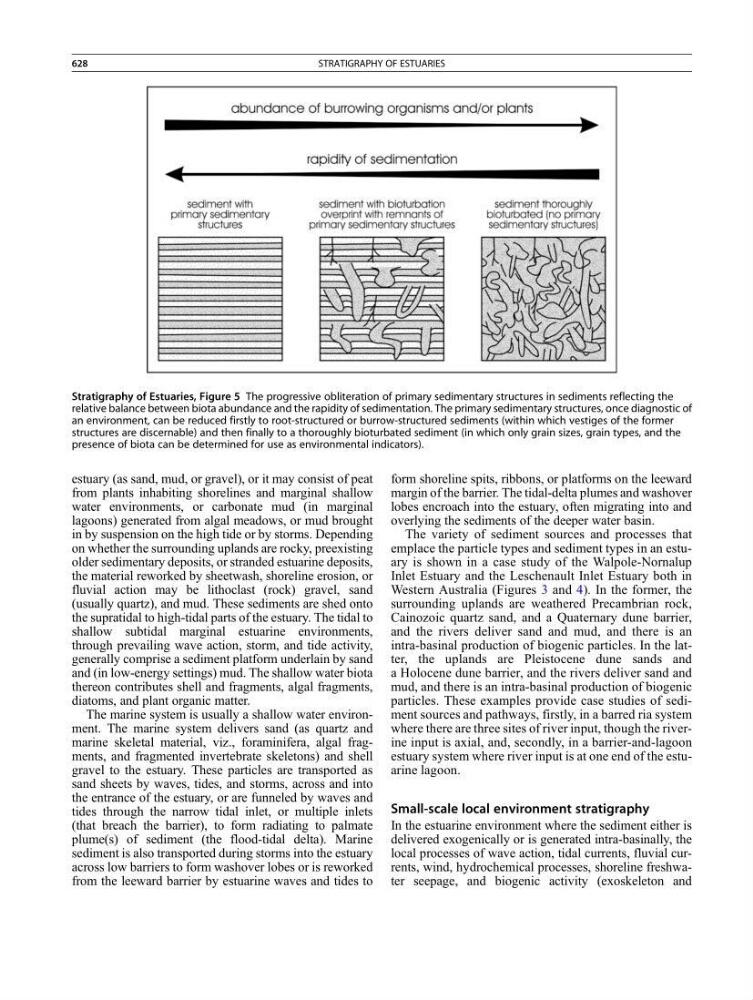
Stratigraphy of Estuaries, Figure 5 The progressive obliteration of primary sedimentary structures in sediments reflecting the
relative balance between biota abundance and the rapidity of sedimentation. The primary sedimentary structures, once diagnostic of
an environment, can be reduced firstly to root-structured or burrow-structured sediments (within which vestiges of the former
structures are discernable) and then finally to a thoroughly bioturbated sediment (in which only grain sizes, grain types, and the
presence of biota can be determined for use as environmental indicators).
628
STRATIGRAPHY OF ESTUARIES