

ripples; the medium-scale bedforms are megaripples or
dunes; the largest metric-scale forms are sandwaves.
There is a demonstrated relationship between the river/
stream regime and the type, dimensions, and orientation
of the dominant bedforms (e.g., Ashley, 1990; Harbor,
1998; Carling et al., 2000). In estuaries, the bedforms
clearly correlate with the tidal current velocity and the
time of action of ebb and flood. As a response to the
reversing tidal current, the sense of asymmetrical forms
can also reverse.
Subaqueous dunes have been described by Duck
et al. (2001), Van Lancker et al. (2004), and Morales
et al. (2006). Similar estuarine bedforms have been described
in North American estuaries by Fenster et al. (1990),
Sherwood and Creager (1990), and Woodruff et al. (2001).
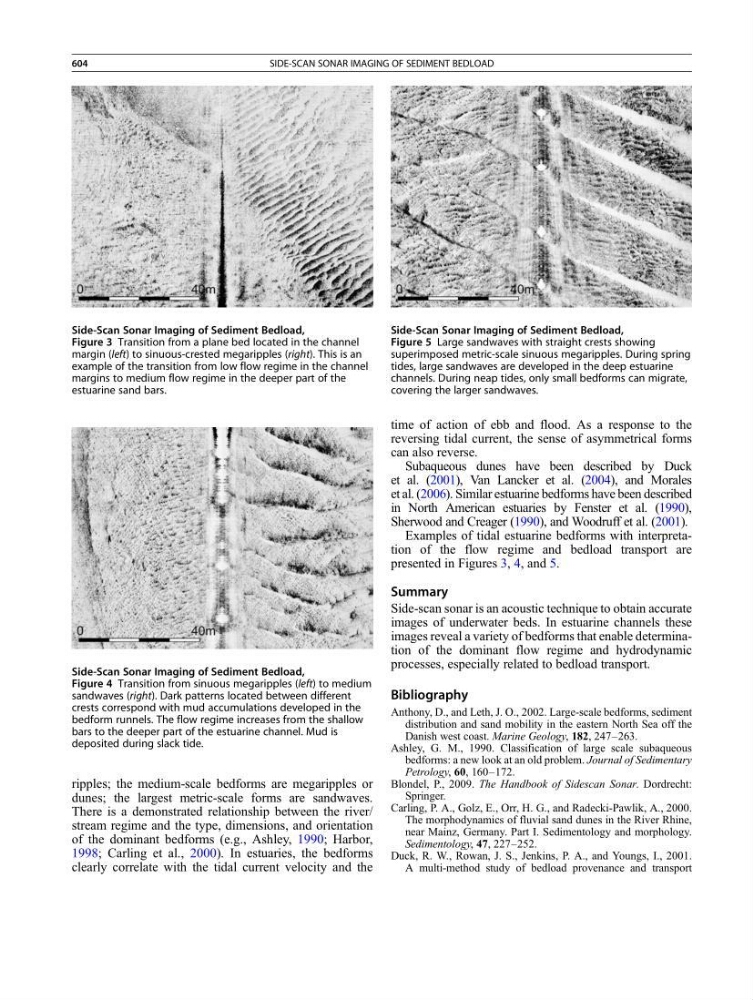
Examples of tidal estuarine bedforms with interpretation of the flow regime and bedload transport are
presented in Figures 3, 4, and 5.
Summary
Side-scan sonar is an acoustic technique to obtain accurate
images of underwater beds. In estuarine channels these
images reveal a variety of bedforms that enable determination of the dominant flow regime and hydrodynamic
processes, especially related to bedload transport.
Bibliography
Anthony, D., and Leth, J. O., 2002. Large-scale bedforms, sediment
distribution and sand mobility in the eastern North Sea off the
Danish west coast. Marine Geology, 182, 247–263.
Ashley, G. M., 1990. Classification of large scale subaqueous
bedforms: a new look at an old problem. Journal of Sedimentary
Petrology, 60, 160–172.
Blondel, P., 2009. The Handbook of Sidescan Sonar. Dordrecht:
Springer.
Carling, P. A., Golz, E., Orr, H. G., and Radecki-Pawlik, A., 2000.
The morphodynamics of fluvial sand dunes in the River Rhine,
near Mainz, Germany. Part I. Sedimentology and morphology.
Sedimentology, 47, 227–252.
Duck, R. W., Rowan, J. S., Jenkins, P. A., and Youngs, I., 2001.
A multi-method study of bedload provenance and transport
Side-Scan Sonar Imaging of Sediment Bedload,
Figure 3 Transition from a plane bed located in the channel
margin (left) to sinuous-crested megaripples (right). This is an
example of the transition from low flow regime in the channel
margins to medium flow regime in the deeper part of the
estuarine sand bars.
Side-Scan Sonar Imaging of Sediment Bedload,
Figure 4 Transition from sinuous megaripples (left) to medium
sandwaves (right). Dark patterns located between different
crests correspond with mud accumulations developed in the
bedform runnels. The flow regime increases from the shallow
bars to the deeper part of the estuarine channel. Mud is
deposited during slack tide.
Side-Scan Sonar Imaging of Sediment Bedload,
Figure 5 Large sandwaves with straight crests showing
superimposed metric-scale sinuous megaripples. During spring
tides, large sandwaves are developed in the deep estuarine
channels. During neap tides, only small bedforms can migrate,
covering the larger sandwaves.
604
SIDE-SCAN SONAR IMAGING OF SEDIMENT BEDLOAD