

contaminants (Borgmann, 2011). Habitat for migrating
shorebirds is particularly threatened because of the movement of people to coastal regions of the world, and managing habitat for both humans and shorebirds will take
collaboration with a range of community stakeholders
(Burger and Niles, 2013). Development in Arctic regions,
particularly for oil and gas, also provides a threat to
shorebird nesting habitat (Kendall et al., 2011).
The vulnerability of migrant and overwintering shorebirds is partly threatened by their migratory patterns and
behavior. Many places serve as massive staging and stopover points during migration for thousands of shorebirds,
including the Copper River Delta in Alaska, Monomoy
Refuge on Cape Cod in Massachusetts, and Delaware
Bay in New Jersey, as well as the Wadden (see WHSR,
2013). At such sites, shorebirds are vulnerable not only
to habitat loss, human disturbance, and predators but also
to food shortages. For example, the massive migration of
shorebirds through Delaware Bay in the spring is threatened by depleted horseshoe crab eggs because of declines
in the crabs caused by overharvesting by bait fishermen
(Niles et al., 2008). Without sufficient crab eggs, shorebirds do not gain enough weight to survive or breed once
they reach their Arctic breeding grounds (Morrison
et al., 2007). Predators can also affect survival and weight
gain during migration (Goss-Custard et al., 2006)
Global warming and sea-level rise provide a long-term
threat to shorebirds because of the potential to render
breeding, migration, and overwintering habitats
unsuitable. Foraging habitat for shorebirds that feed along
coasts is estimated to decrease dramatically, even over the
next few decades (Convertino et al., 2012). Assuming
a conservative global warming scenario of only 2
C over
the next century, Galbraith et al. (2005) predicted that
major intertidal habitat losses for shorebirds in bays in
Washington, California, Texas, and New Jersey/Delaware
would range from 20 % to 70 %. Sea-level rise, however,
may be even higher than the initially expected 1 m (Pfeffer
et al., 2008). Such massive changes in intertidal areas will
affect the amount of suitable foraging habitat for migrating
and wintering shorebirds, as well as those breeding along
coasts. Changes in the insect populations brought about by
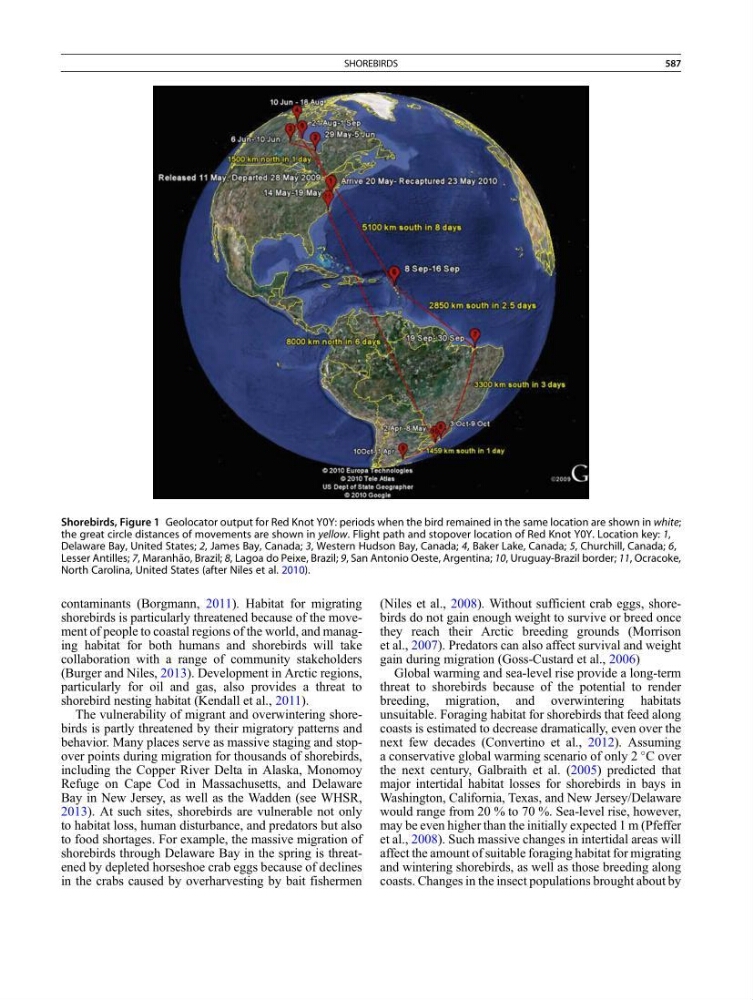
Shorebirds, Figure 1 Geolocator output for Red Knot Y0Y: periods when the bird remained in the same location are shown in white;
the great circle distances of movements are shown in yellow. Flight path and stopover location of Red Knot Y0Y. Location key: 1,
Delaware Bay, United States; 2, James Bay, Canada; 3, Western Hudson Bay, Canada; 4, Baker Lake, Canada; 5, Churchill, Canada; 6,
Lesser Antilles; 7, Maranha ˜o, Brazil; 8, Lagoa do Peixe, Brazil; 9, San Antonio Oeste, Argentina; 10, Uruguay-Brazil border; 11, Ocracoke,
North Carolina, United States (after Niles et al. 2010).
SHOREBIRDS
587