

swim that deep, plunge dive that far below the surface, or
dip down far enough to catch fish.
Predators, competitors, and invasive species
In addition to food availability (both types and quantity),
seabird survival and reproductive success are affected by
predators and competitors. There are no mammalian predators on offshore or oceanic islands where most seabirds
nest, and there are few avian predators so far from land.
Other seabirds nest on cliffs or rocky ledges where mammalian predators have no access, and spaces are too small
for avian predators to land. Seabirds that nest along coasts
either nest on cliffs, islands within bays, or in trees where
predators have little access. Their main competitors are
other seabirds of the same or a different species that nest
within these colonies. In some cases, space itself is limited, restricting the number of pairs that can breed. Stiff
competition among Northern Gannets (Morus bassanus)
for nest sites on rock outcroppings results in adults
remaining several weeks or months after the young fledge,
just to protect their territory (Mowbray, 2002).
Invasive species provide a unique threat because they
did not evolve with seabirds, and they have fewer adaptations for coping with them. Invasive mammalian predators
pose the greatest threat to seabirds worldwide (Nettleship
et al., 1994). Seabirds nesting on oceanic islands evolved
without predators and usually nest on the ground, where
they are vulnerable to invasive mammals such as feral cats
(Felis catus), rats (Rattus sp.), and mice (Mus spp.) that
prey on eggs, young, or even adults. On many islands,
such as the United Kingdom Overseas Territories, cats
and rats have caused near extinction of several seabirds,
resulting in critically endangered species (Hilton and
Cuthbert, 2010). Examining 94 papers that demonstrated
effects of rats on nesting seabirds, Jones et al. (2007)
showed that 74 seabird species in ten families were
affected. Storm Petrels and small, burrow-nesting seabirds
were most affected, and gulls and terns were least affected.
Removing rats and cats from islands with nesting seabirds
should be a high conservation priority (Jones et al., 2007).
Migration and overwintering
Seabirds have some of the longest migration routes of any
birds; but since they mainly migrate over oceans, their patterns were a mystery until very recently. With advances in
radiotelemetry (shore distance), satellite transmitters
(on large birds), and geolocators (for smaller birds), data
on specific migration routes can be combined to form
migration patterns for species. Most seabirds spend the
winter at sea, never or seldom coming to land.
Threats to seabirds
Because seabirds inhabit so many habitats, in all ecosystems, they are exposed to many threats, including habitat
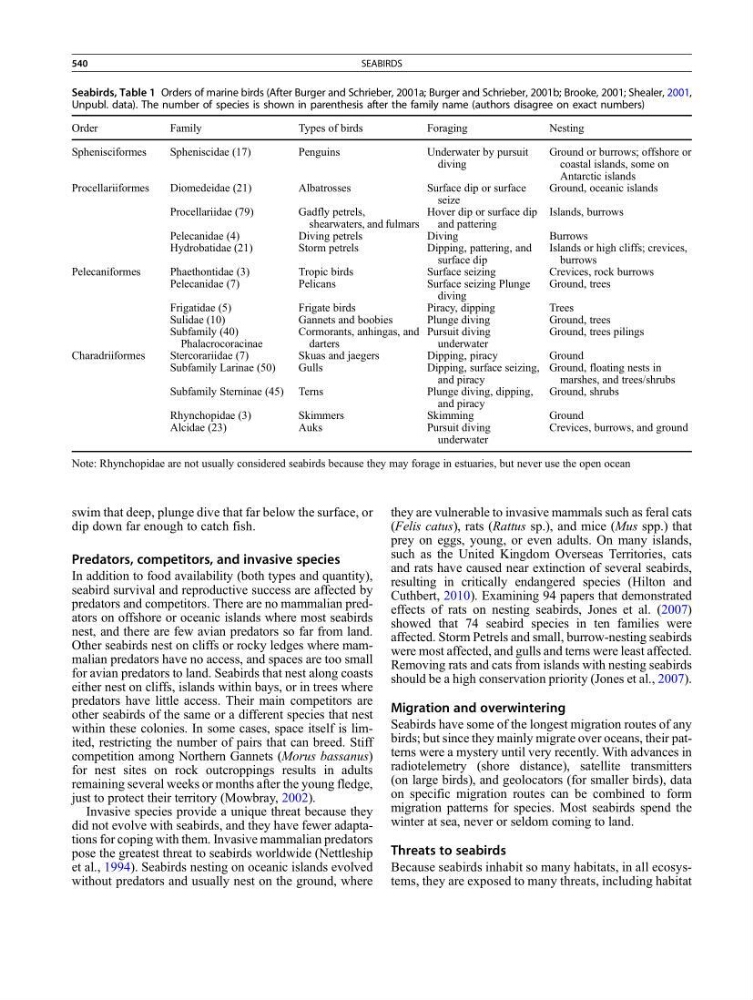
Seabirds, Table 1 Orders of marine birds (After Burger and Schrieber, 2001a; Burger and Schrieber, 2001b; Brooke, 2001; Shealer, 2001,
Unpubl. data). The number of species is shown in parenthesis after the family name (authors disagree on exact numbers)
Order
Family
Types of birds
Foraging
Nesting
Sphenisciformes
Spheniscidae (17)
Penguins
Underwater by pursuit
diving
Ground or burrows; offshore or
coastal islands, some on
Antarctic islands
Procellariiformes
Diomedeidae (21)
Albatrosses
Surface dip or surface
seize
Ground, oceanic islands
Procellariidae (79)
Gadfly petrels,
shearwaters, and fulmars
Hover dip or surface dip
and pattering
Islands, burrows
Pelecanidae (4)
Diving petrels
Diving
Burrows
Hydrobatidae (21)
Storm petrels
Dipping, pattering, and
surface dip
Islands or high cliffs; crevices,
burrows
Pelecaniformes
Phaethontidae (3)
Tropic birds
Surface seizing
Crevices, rock burrows
Pelecanidae (7)
Pelicans
Surface seizing Plunge
diving
Ground, trees
Frigatidae (5)
Frigate birds
Piracy, dipping
Trees
Sulidae (10)
Gannets and boobies
Plunge diving
Ground, trees
Subfamily (40)
Phalacrocoracinae
Cormorants, anhingas, and
darters
Pursuit diving
underwater
Ground, trees pilings
Charadriiformes
Stercorariidae (7)
Skuas and jaegers
Dipping, piracy
Ground
Subfamily Larinae (50)
Gulls
Dipping, surface seizing,
and piracy
Ground, floating nests in
marshes, and trees/shrubs
Subfamily Sterninae (45) Terns
Plunge diving, dipping,
and piracy
Ground, shrubs
Rhynchopidae (3)
Skimmers
Skimming
Ground
Alcidae (23)
Auks
Pursuit diving
underwater
Crevices, burrows, and ground
Note: Rhynchopidae are not usually considered seabirds because they may forage in estuaries, but never use the open ocean
540
SEABIRDS
dip down far enough to catch fish.
Predators, competitors, and invasive species
In addition to food availability (both types and quantity),
seabird survival and reproductive success are affected by
predators and competitors. There are no mammalian predators on offshore or oceanic islands where most seabirds
nest, and there are few avian predators so far from land.
Other seabirds nest on cliffs or rocky ledges where mammalian predators have no access, and spaces are too small
for avian predators to land. Seabirds that nest along coasts
either nest on cliffs, islands within bays, or in trees where
predators have little access. Their main competitors are
other seabirds of the same or a different species that nest
within these colonies. In some cases, space itself is limited, restricting the number of pairs that can breed. Stiff
competition among Northern Gannets (Morus bassanus)
for nest sites on rock outcroppings results in adults
remaining several weeks or months after the young fledge,
just to protect their territory (Mowbray, 2002).
Invasive species provide a unique threat because they
did not evolve with seabirds, and they have fewer adaptations for coping with them. Invasive mammalian predators
pose the greatest threat to seabirds worldwide (Nettleship
et al., 1994). Seabirds nesting on oceanic islands evolved
without predators and usually nest on the ground, where
they are vulnerable to invasive mammals such as feral cats
(Felis catus), rats (Rattus sp.), and mice (Mus spp.) that
prey on eggs, young, or even adults. On many islands,
such as the United Kingdom Overseas Territories, cats
and rats have caused near extinction of several seabirds,
resulting in critically endangered species (Hilton and
Cuthbert, 2010). Examining 94 papers that demonstrated
effects of rats on nesting seabirds, Jones et al. (2007)
showed that 74 seabird species in ten families were
affected. Storm Petrels and small, burrow-nesting seabirds
were most affected, and gulls and terns were least affected.
Removing rats and cats from islands with nesting seabirds
should be a high conservation priority (Jones et al., 2007).
Migration and overwintering
Seabirds have some of the longest migration routes of any
birds; but since they mainly migrate over oceans, their patterns were a mystery until very recently. With advances in
radiotelemetry (shore distance), satellite transmitters
(on large birds), and geolocators (for smaller birds), data
on specific migration routes can be combined to form
migration patterns for species. Most seabirds spend the
winter at sea, never or seldom coming to land.
Threats to seabirds
Because seabirds inhabit so many habitats, in all ecosystems, they are exposed to many threats, including habitat
Seabirds, Table 1 Orders of marine birds (After Burger and Schrieber, 2001a; Burger and Schrieber, 2001b; Brooke, 2001; Shealer, 2001,
Unpubl. data). The number of species is shown in parenthesis after the family name (authors disagree on exact numbers)
Order
Family
Types of birds
Foraging
Nesting
Sphenisciformes
Spheniscidae (17)
Penguins
Underwater by pursuit
diving
Ground or burrows; offshore or
coastal islands, some on
Antarctic islands
Procellariiformes
Diomedeidae (21)
Albatrosses
Surface dip or surface
seize
Ground, oceanic islands
Procellariidae (79)
Gadfly petrels,
shearwaters, and fulmars
Hover dip or surface dip
and pattering
Islands, burrows
Pelecanidae (4)
Diving petrels
Diving
Burrows
Hydrobatidae (21)
Storm petrels
Dipping, pattering, and
surface dip
Islands or high cliffs; crevices,
burrows
Pelecaniformes
Phaethontidae (3)
Tropic birds
Surface seizing
Crevices, rock burrows
Pelecanidae (7)
Pelicans
Surface seizing Plunge
diving
Ground, trees
Frigatidae (5)
Frigate birds
Piracy, dipping
Trees
Sulidae (10)
Gannets and boobies
Plunge diving
Ground, trees
Subfamily (40)
Phalacrocoracinae
Cormorants, anhingas, and
darters
Pursuit diving
underwater
Ground, trees pilings
Charadriiformes
Stercorariidae (7)
Skuas and jaegers
Dipping, piracy
Ground
Subfamily Larinae (50)
Gulls
Dipping, surface seizing,
and piracy
Ground, floating nests in
marshes, and trees/shrubs
Subfamily Sterninae (45) Terns
Plunge diving, dipping,
and piracy
Ground, shrubs
Rhynchopidae (3)
Skimmers
Skimming
Ground
Alcidae (23)
Auks
Pursuit diving
underwater
Crevices, burrows, and ground
Note: Rhynchopidae are not usually considered seabirds because they may forage in estuaries, but never use the open ocean
540
SEABIRDS