

themselves during their lifetimes. Even within seabirds,
life history strategies differ. Gulls and terns breed when
they are 3–5 years old, lay two to three eggs, have incubation periods of a few weeks, produce a young or two
a year, and live only 20 years, whereas albatrosses do
not breed until they are 8–10 years old, lay one egg, do
not raise a young every year, and may live up to 60 years.
David Lack (1968) first proposed that the life history strategy of seabirds evolved because of energy limitations that
derive from the difficulty of feeding over the open ocean
where prey is unpredictable and irregular (Schreiber and
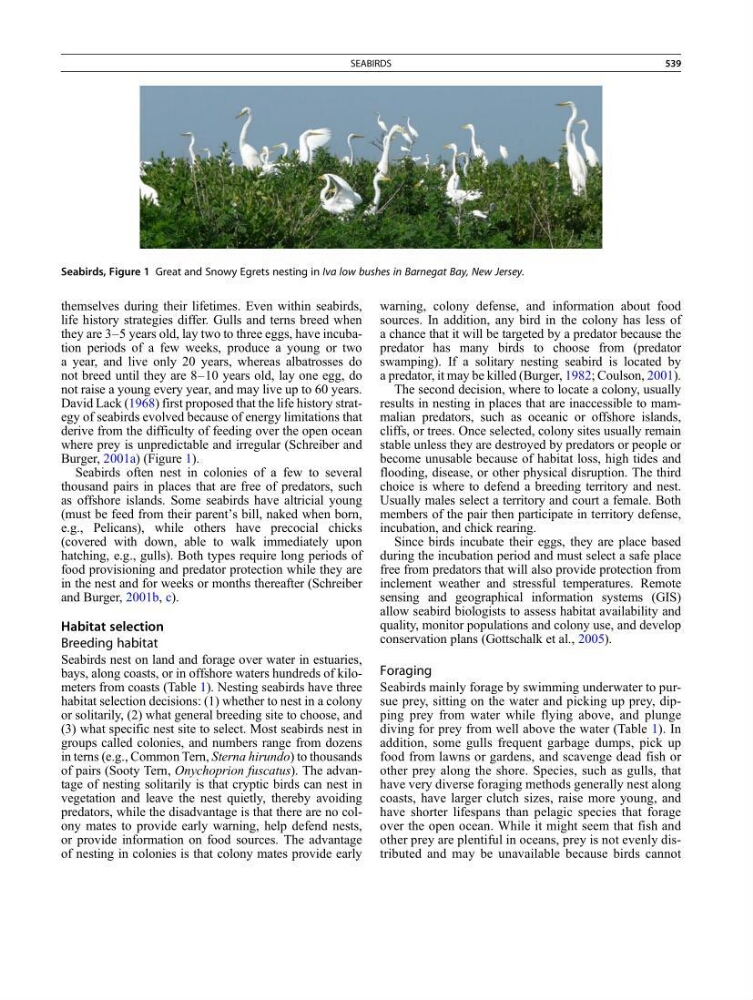
Burger, 2001a) (Figure 1).
Seabirds often nest in colonies of a few to several
thousand pairs in places that are free of predators, such
as offshore islands. Some seabirds have altricial young
(must be feed from their parent’s bill, naked when born,
e.g., Pelicans), while others have precocial chicks
(covered with down, able to walk immediately upon
hatching, e.g., gulls). Both types require long periods of
food provisioning and predator protection while they are
in the nest and for weeks or months thereafter (Schreiber
and Burger, 2001b, c).
Habitat selection
Breeding habitat
Seabirds nest on land and forage over water in estuaries,
bays, along coasts, or in offshore waters hundreds of kilometers from coasts (Table 1). Nesting seabirds have three
habitat selection decisions: (1) whether to nest in a colony
or solitarily, (2) what general breeding site to choose, and
(3) what specific nest site to select. Most seabirds nest in
groups called colonies, and numbers range from dozens
in terns (e.g., Common Tern, Sterna hirundo) to thousands
of pairs (Sooty Tern, Onychoprion fuscatus). The advantage of nesting solitarily is that cryptic birds can nest in
vegetation and leave the nest quietly, thereby avoiding
predators, while the disadvantage is that there are no colony mates to provide early warning, help defend nests,
or provide information on food sources. The advantage
of nesting in colonies is that colony mates provide early
warning, colony defense, and information about food
sources. In addition, any bird in the colony has less of
a chance that it will be targeted by a predator because the
predator has many birds to choose from (predator
swamping). If a solitary nesting seabird is located by
a predator, it may be killed (Burger, 1982; Coulson, 2001).
The second decision, where to locate a colony, usually
results in nesting in places that are inaccessible to mammalian predators, such as oceanic or offshore islands,
cliffs, or trees. Once selected, colony sites usually remain
stable unless they are destroyed by predators or people or
become unusable because of habitat loss, high tides and
flooding, disease, or other physical disruption. The third
choice is where to defend a breeding territory and nest.
Usually males select a territory and court a female. Both
members of the pair then participate in territory defense,
incubation, and chick rearing.
Since birds incubate their eggs, they are place based
during the incubation period and must select a safe place
free from predators that will also provide protection from
inclement weather and stressful temperatures. Remote
sensing and geographical information systems (GIS)
allow seabird biologists to assess habitat availability and
quality, monitor populations and colony use, and develop
conservation plans (Gottschalk et al., 2005).
Foraging
Seabirds mainly forage by swimming underwater to pursue prey, sitting on the water and picking up prey, dipping prey from water while flying above, and plunge
diving for prey from well above the water (Table 1). In
addition, some gulls frequent garbage dumps, pick up
food from lawns or gardens, and scavenge dead fish or
other prey along the shore. Species, such as gulls, that
have very diverse foraging methods generally nest along
coasts, have larger clutch sizes, raise more young, and
have shorter lifespans than pelagic species that forage
over the open ocean. While it might seem that fish and
other prey are plentiful in oceans, prey is not evenly distributed and may be unavailable because birds cannot
Seabirds, Figure 1 Great and Snowy Egrets nesting in Iva low bushes in Barnegat Bay, New Jersey.
SEABIRDS
539
life history strategies differ. Gulls and terns breed when
they are 3–5 years old, lay two to three eggs, have incubation periods of a few weeks, produce a young or two
a year, and live only 20 years, whereas albatrosses do
not breed until they are 8–10 years old, lay one egg, do
not raise a young every year, and may live up to 60 years.
David Lack (1968) first proposed that the life history strategy of seabirds evolved because of energy limitations that
derive from the difficulty of feeding over the open ocean
where prey is unpredictable and irregular (Schreiber and
Burger, 2001a) (Figure 1).
Seabirds often nest in colonies of a few to several
thousand pairs in places that are free of predators, such
as offshore islands. Some seabirds have altricial young
(must be feed from their parent’s bill, naked when born,
e.g., Pelicans), while others have precocial chicks
(covered with down, able to walk immediately upon
hatching, e.g., gulls). Both types require long periods of
food provisioning and predator protection while they are
in the nest and for weeks or months thereafter (Schreiber
and Burger, 2001b, c).
Habitat selection
Breeding habitat
Seabirds nest on land and forage over water in estuaries,
bays, along coasts, or in offshore waters hundreds of kilometers from coasts (Table 1). Nesting seabirds have three
habitat selection decisions: (1) whether to nest in a colony
or solitarily, (2) what general breeding site to choose, and
(3) what specific nest site to select. Most seabirds nest in
groups called colonies, and numbers range from dozens
in terns (e.g., Common Tern, Sterna hirundo) to thousands
of pairs (Sooty Tern, Onychoprion fuscatus). The advantage of nesting solitarily is that cryptic birds can nest in
vegetation and leave the nest quietly, thereby avoiding
predators, while the disadvantage is that there are no colony mates to provide early warning, help defend nests,
or provide information on food sources. The advantage
of nesting in colonies is that colony mates provide early
warning, colony defense, and information about food
sources. In addition, any bird in the colony has less of
a chance that it will be targeted by a predator because the
predator has many birds to choose from (predator
swamping). If a solitary nesting seabird is located by
a predator, it may be killed (Burger, 1982; Coulson, 2001).
The second decision, where to locate a colony, usually
results in nesting in places that are inaccessible to mammalian predators, such as oceanic or offshore islands,
cliffs, or trees. Once selected, colony sites usually remain
stable unless they are destroyed by predators or people or
become unusable because of habitat loss, high tides and
flooding, disease, or other physical disruption. The third
choice is where to defend a breeding territory and nest.
Usually males select a territory and court a female. Both
members of the pair then participate in territory defense,
incubation, and chick rearing.
Since birds incubate their eggs, they are place based
during the incubation period and must select a safe place
free from predators that will also provide protection from
inclement weather and stressful temperatures. Remote
sensing and geographical information systems (GIS)
allow seabird biologists to assess habitat availability and
quality, monitor populations and colony use, and develop
conservation plans (Gottschalk et al., 2005).
Foraging
Seabirds mainly forage by swimming underwater to pursue prey, sitting on the water and picking up prey, dipping prey from water while flying above, and plunge
diving for prey from well above the water (Table 1). In
addition, some gulls frequent garbage dumps, pick up
food from lawns or gardens, and scavenge dead fish or
other prey along the shore. Species, such as gulls, that
have very diverse foraging methods generally nest along
coasts, have larger clutch sizes, raise more young, and
have shorter lifespans than pelagic species that forage
over the open ocean. While it might seem that fish and
other prey are plentiful in oceans, prey is not evenly distributed and may be unavailable because birds cannot
Seabirds, Figure 1 Great and Snowy Egrets nesting in Iva low bushes in Barnegat Bay, New Jersey.
SEABIRDS
539