

Saltmarshes as ecosystems support a wide range of
organisms, but it is the vascular plants which are the most
obvious component. The distribution of plant taxa permits
the recognition of different types of saltmarsh at the global
scale (Chapman, 1953; Chapman, 1960; Chapman, 1977).
Chapman’s classification was adopted by Ibanez
et al. (2013). Adam (1990) proposed a variant of this
model, suggesting broad similarities between temperate
marshes in both hemispheres. With one conspicuous
exception, Spartina dominated marshes on the West
Atlantic coast of the Americas, the distribution of the
major types of saltmarsh can be related to latitude. In terms
of floristic richness, saltmarshes provide an exception to
the general rule that within biomes, species richness is
greatest in the tropics and declines with increasing latitude. Tropical saltmarshes have very low species diversity,
and the highest diversity is shown in high latitude temperate marshes. This pattern is shown both in the northern
hemisphere (Adam, 1990) and in Australia (Saintilan,
2009b; Boon et al., 2011) and South America (Issach
et al., 2006), although in this latter case, at the highest latitudes in Tierra del Fuego, there are floristic links to northern hemisphere temperate marshes. Saltmarshes on coasts
experiencing Mediterranean climates share strong similarities in floristics, vegetation structure, and physiognomy.
Whether biogeographic patterns of saltmarsh fauna at
a global scale are congruent with floristics has not been
fully investigated.
Variation within estuaries
Environmental conditions vary in space and time within
estuaries, and this is associated with changes in the fringing saltmarshes (Ranwell, 1968). Some changes relate to
the stage of geomorphological evolution of estuaries
(Roy, 1984; Roy et al., 2001), others to the gradient in
salinity from the mouth to the head of the estuary. In general, conditions within saltmarshes are more saline
towards the mouth of an estuary, while at the limits of
incursion of saline water, freshwater tidal marshes may
occur (Odum, 1988; Temmerman et al., 2003). The head
of estuaries was often the location of the first established
human settlements, so that there is a very long history of
destruction of freshwater tidal marshes, which in many
parts of the world are now rare. Between the saline and
the freshwater zone, there may be brackish marshes,
which are variable in their species composition (Sainty
et al., 2012). Species characteristic of more saline
sites may occur in the brackish zone, but the zonation
patterns may be inverted (Gillham, 1957), with the saline
zone species being restricted to the higher, less frequently flooded parts of marshes, where evapotranspiration between flooding tides results in more saline
conditions.
Variation within marshes
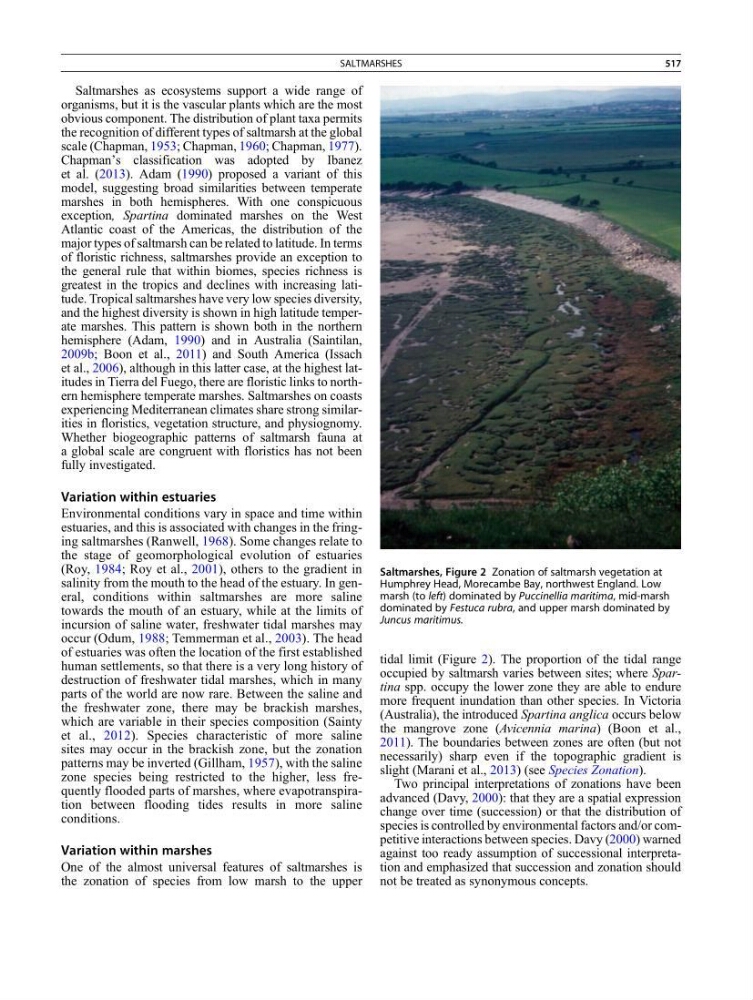
One of the almost universal features of saltmarshes is
the zonation of species from low marsh to the upper
tidal limit (Figure 2). The proportion of the tidal range
occupied by saltmarsh varies between sites; where Spartina spp. occupy the lower zone they are able to endure
more frequent inundation than other species. In Victoria
(Australia), the introduced Spartina anglica occurs below
the mangrove zone (Avicennia marina) (Boon et al.,
2011). The boundaries between zones are often (but not
necessarily) sharp even if the topographic gradient is
slight (Marani et al., 2013) (see Species Zonation).
Two principal interpretations of zonations have been
advanced (Davy, 2000): that they are a spatial expression
change over time (succession) or that the distribution of
species is controlled by environmental factors and/or competitive interactions between species. Davy (2000) warned
against too ready assumption of successional interpretation and emphasized that succession and zonation should
not be treated as synonymous concepts.
Saltmarshes, Figure 2 Zonation of saltmarsh vegetation at
Humphrey Head, Morecambe Bay, northwest England. Low
marsh (to left) dominated by Puccinellia maritima, mid-marsh
dominated by Festuca rubra, and upper marsh dominated by
Juncus maritimus.
SALTMARSHES
517
organisms, but it is the vascular plants which are the most
obvious component. The distribution of plant taxa permits
the recognition of different types of saltmarsh at the global
scale (Chapman, 1953; Chapman, 1960; Chapman, 1977).
Chapman’s classification was adopted by Ibanez
et al. (2013). Adam (1990) proposed a variant of this
model, suggesting broad similarities between temperate
marshes in both hemispheres. With one conspicuous
exception, Spartina dominated marshes on the West
Atlantic coast of the Americas, the distribution of the
major types of saltmarsh can be related to latitude. In terms
of floristic richness, saltmarshes provide an exception to
the general rule that within biomes, species richness is
greatest in the tropics and declines with increasing latitude. Tropical saltmarshes have very low species diversity,
and the highest diversity is shown in high latitude temperate marshes. This pattern is shown both in the northern
hemisphere (Adam, 1990) and in Australia (Saintilan,
2009b; Boon et al., 2011) and South America (Issach
et al., 2006), although in this latter case, at the highest latitudes in Tierra del Fuego, there are floristic links to northern hemisphere temperate marshes. Saltmarshes on coasts
experiencing Mediterranean climates share strong similarities in floristics, vegetation structure, and physiognomy.
Whether biogeographic patterns of saltmarsh fauna at
a global scale are congruent with floristics has not been
fully investigated.
Variation within estuaries
Environmental conditions vary in space and time within
estuaries, and this is associated with changes in the fringing saltmarshes (Ranwell, 1968). Some changes relate to
the stage of geomorphological evolution of estuaries
(Roy, 1984; Roy et al., 2001), others to the gradient in
salinity from the mouth to the head of the estuary. In general, conditions within saltmarshes are more saline
towards the mouth of an estuary, while at the limits of
incursion of saline water, freshwater tidal marshes may
occur (Odum, 1988; Temmerman et al., 2003). The head
of estuaries was often the location of the first established
human settlements, so that there is a very long history of
destruction of freshwater tidal marshes, which in many
parts of the world are now rare. Between the saline and
the freshwater zone, there may be brackish marshes,
which are variable in their species composition (Sainty
et al., 2012). Species characteristic of more saline
sites may occur in the brackish zone, but the zonation
patterns may be inverted (Gillham, 1957), with the saline
zone species being restricted to the higher, less frequently flooded parts of marshes, where evapotranspiration between flooding tides results in more saline
conditions.
Variation within marshes
One of the almost universal features of saltmarshes is
the zonation of species from low marsh to the upper
tidal limit (Figure 2). The proportion of the tidal range
occupied by saltmarsh varies between sites; where Spartina spp. occupy the lower zone they are able to endure
more frequent inundation than other species. In Victoria
(Australia), the introduced Spartina anglica occurs below
the mangrove zone (Avicennia marina) (Boon et al.,
2011). The boundaries between zones are often (but not
necessarily) sharp even if the topographic gradient is
slight (Marani et al., 2013) (see Species Zonation).
Two principal interpretations of zonations have been
advanced (Davy, 2000): that they are a spatial expression
change over time (succession) or that the distribution of
species is controlled by environmental factors and/or competitive interactions between species. Davy (2000) warned
against too ready assumption of successional interpretation and emphasized that succession and zonation should
not be treated as synonymous concepts.
Saltmarshes, Figure 2 Zonation of saltmarsh vegetation at
Humphrey Head, Morecambe Bay, northwest England. Low
marsh (to left) dominated by Puccinellia maritima, mid-marsh
dominated by Festuca rubra, and upper marsh dominated by
Juncus maritimus.
SALTMARSHES
517