

Haines, 2012). ICOLLs are of widespread occurrence, and
some are very large. While lagoon ecosystems have many
distinctive features (Barnes, 1980), the fringing
saltmarshes are, at least floristically, little different from
those found in permanent estuaries in the same region.
Saltmarshes occupy the interface between terrestrial
and marine environments (Valiela et al., 2001) and have
many features and attributes of both, as well as some
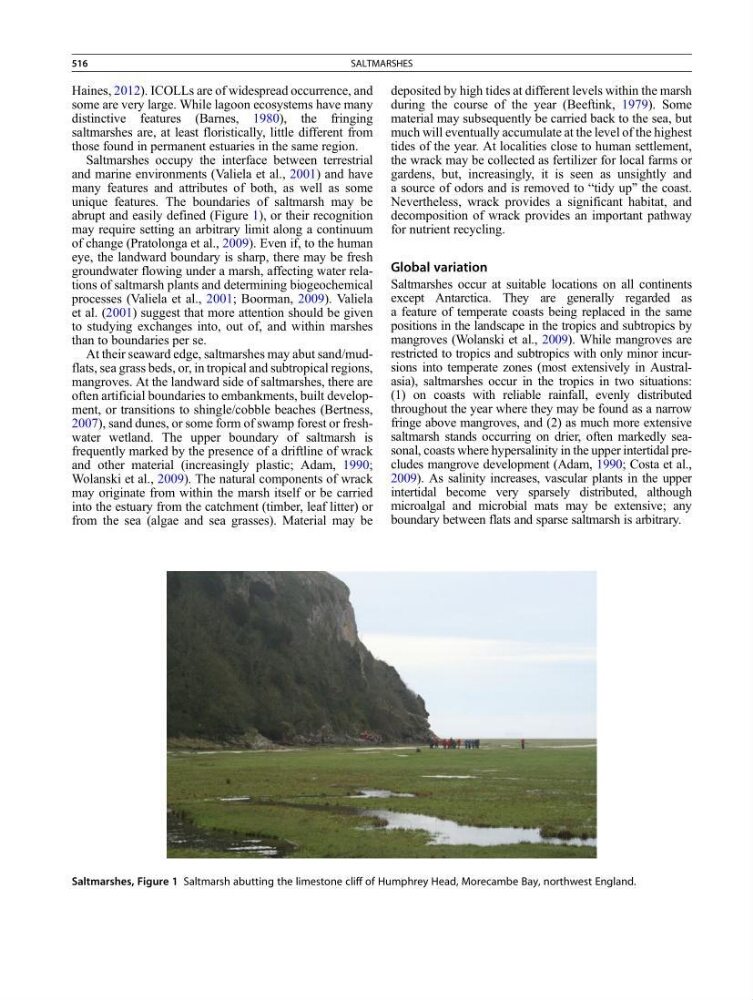
unique features. The boundaries of saltmarsh may be
abrupt and easily defined (Figure 1), or their recognition
may require setting an arbitrary limit along a continuum
of change (Pratolonga et al., 2009). Even if, to the human
eye, the landward boundary is sharp, there may be fresh
groundwater flowing under a marsh, affecting water relations of saltmarsh plants and determining biogeochemical
processes (Valiela et al., 2001; Boorman, 2009). Valiela
et al. (2001) suggest that more attention should be given
to studying exchanges into, out of, and within marshes
than to boundaries per se.
At their seaward edge, saltmarshes may abut sand/mudflats, sea grass beds, or, in tropical and subtropical regions,
mangroves. At the landward side of saltmarshes, there are
often artificial boundaries to embankments, built development, or transitions to shingle/cobble beaches (Bertness,
2007), sand dunes, or some form of swamp forest or freshwater wetland. The upper boundary of saltmarsh is
frequently marked by the presence of a driftline of wrack
and other material (increasingly plastic; Adam, 1990;
Wolanski et al., 2009). The natural components of wrack
may originate from within the marsh itself or be carried
into the estuary from the catchment (timber, leaf litter) or
from the sea (algae and sea grasses). Material may be
deposited by high tides at different levels within the marsh
during the course of the year (Beeftink, 1979). Some
material may subsequently be carried back to the sea, but
much will eventually accumulate at the level of the highest
tides of the year. At localities close to human settlement,
the wrack may be collected as fertilizer for local farms or
gardens, but, increasingly, it is seen as unsightly and
a source of odors and is removed to “tidy up” the coast.
Nevertheless, wrack provides a significant habitat, and
decomposition of wrack provides an important pathway
for nutrient recycling.
Global variation
Saltmarshes occur at suitable locations on all continents
except Antarctica. They are generally regarded as
a feature of temperate coasts being replaced in the same
positions in the landscape in the tropics and subtropics by
mangroves (Wolanski et al., 2009). While mangroves are
restricted to tropics and subtropics with only minor incursions into temperate zones (most extensively in Australasia), saltmarshes occur in the tropics in two situations:
(1) on coasts with reliable rainfall, evenly distributed
throughout the year where they may be found as a narrow
fringe above mangroves, and (2) as much more extensive
saltmarsh stands occurring on drier, often markedly seasonal, coasts where hypersalinity in the upper intertidal precludes mangrove development (Adam, 1990; Costa et al.,
2009). As salinity increases, vascular plants in the upper
intertidal become very sparsely distributed, although
microalgal and microbial mats may be extensive; any
boundary between flats and sparse saltmarsh is arbitrary.
Saltmarshes, Figure 1 Saltmarsh abutting the limestone cliff of Humphrey Head, Morecambe Bay, northwest England.
516
SALTMARSHES
some are very large. While lagoon ecosystems have many
distinctive features (Barnes, 1980), the fringing
saltmarshes are, at least floristically, little different from
those found in permanent estuaries in the same region.
Saltmarshes occupy the interface between terrestrial
and marine environments (Valiela et al., 2001) and have
many features and attributes of both, as well as some
unique features. The boundaries of saltmarsh may be
abrupt and easily defined (Figure 1), or their recognition
may require setting an arbitrary limit along a continuum
of change (Pratolonga et al., 2009). Even if, to the human
eye, the landward boundary is sharp, there may be fresh
groundwater flowing under a marsh, affecting water relations of saltmarsh plants and determining biogeochemical
processes (Valiela et al., 2001; Boorman, 2009). Valiela
et al. (2001) suggest that more attention should be given
to studying exchanges into, out of, and within marshes
than to boundaries per se.
At their seaward edge, saltmarshes may abut sand/mudflats, sea grass beds, or, in tropical and subtropical regions,
mangroves. At the landward side of saltmarshes, there are
often artificial boundaries to embankments, built development, or transitions to shingle/cobble beaches (Bertness,
2007), sand dunes, or some form of swamp forest or freshwater wetland. The upper boundary of saltmarsh is
frequently marked by the presence of a driftline of wrack
and other material (increasingly plastic; Adam, 1990;
Wolanski et al., 2009). The natural components of wrack
may originate from within the marsh itself or be carried
into the estuary from the catchment (timber, leaf litter) or
from the sea (algae and sea grasses). Material may be
deposited by high tides at different levels within the marsh
during the course of the year (Beeftink, 1979). Some
material may subsequently be carried back to the sea, but
much will eventually accumulate at the level of the highest
tides of the year. At localities close to human settlement,
the wrack may be collected as fertilizer for local farms or
gardens, but, increasingly, it is seen as unsightly and
a source of odors and is removed to “tidy up” the coast.
Nevertheless, wrack provides a significant habitat, and
decomposition of wrack provides an important pathway
for nutrient recycling.
Global variation
Saltmarshes occur at suitable locations on all continents
except Antarctica. They are generally regarded as
a feature of temperate coasts being replaced in the same
positions in the landscape in the tropics and subtropics by
mangroves (Wolanski et al., 2009). While mangroves are
restricted to tropics and subtropics with only minor incursions into temperate zones (most extensively in Australasia), saltmarshes occur in the tropics in two situations:
(1) on coasts with reliable rainfall, evenly distributed
throughout the year where they may be found as a narrow
fringe above mangroves, and (2) as much more extensive
saltmarsh stands occurring on drier, often markedly seasonal, coasts where hypersalinity in the upper intertidal precludes mangrove development (Adam, 1990; Costa et al.,
2009). As salinity increases, vascular plants in the upper
intertidal become very sparsely distributed, although
microalgal and microbial mats may be extensive; any
boundary between flats and sparse saltmarsh is arbitrary.
Saltmarshes, Figure 1 Saltmarsh abutting the limestone cliff of Humphrey Head, Morecambe Bay, northwest England.
516
SALTMARSHES