

NEURAL NETWORKS
M. C. Deo
Department of Civil Engineering, Indian Institute of
Technology Bombay, Mumbai, India
Synonyms
Artificial intelligence; Artificial neural networks;
Computational intelligence; Evolutionary algorithms;
Fuzzy logic; Machine learning; Multilayer perceptron
Definition
An artificial neural network, alternatively called neural
network for simplicity, is an interconnected structure of
computational elements called neurons or nodes.
A neural network is designed to mimic the cognition
process followed by biological neurons in human brains.
It is a data-driven technique and can be classified variedly
under categories of soft computing, machine learning, and
artificial intelligence techniques. In neural networks the
intelligence results from communication between different computational elements called neurons.
Use: A neural network is basically suited to map any
random input vector with corresponding output vector,
and its engineering applications include function approximation, optimization, system modeling, and pattern recognition. There are a number of advantages that the networks
carry over the traditional empirical, analytical, numerical,
or statistical approaches. Important among them are as
follows: (1) physics or mechanics of the underlying
process need not be known beforehand, (2) no a priori
assumptions on data behavior are required, and (3) no
exogenous input other than input-output patterns is called
for to calibrate the network (Kosko, 1992).
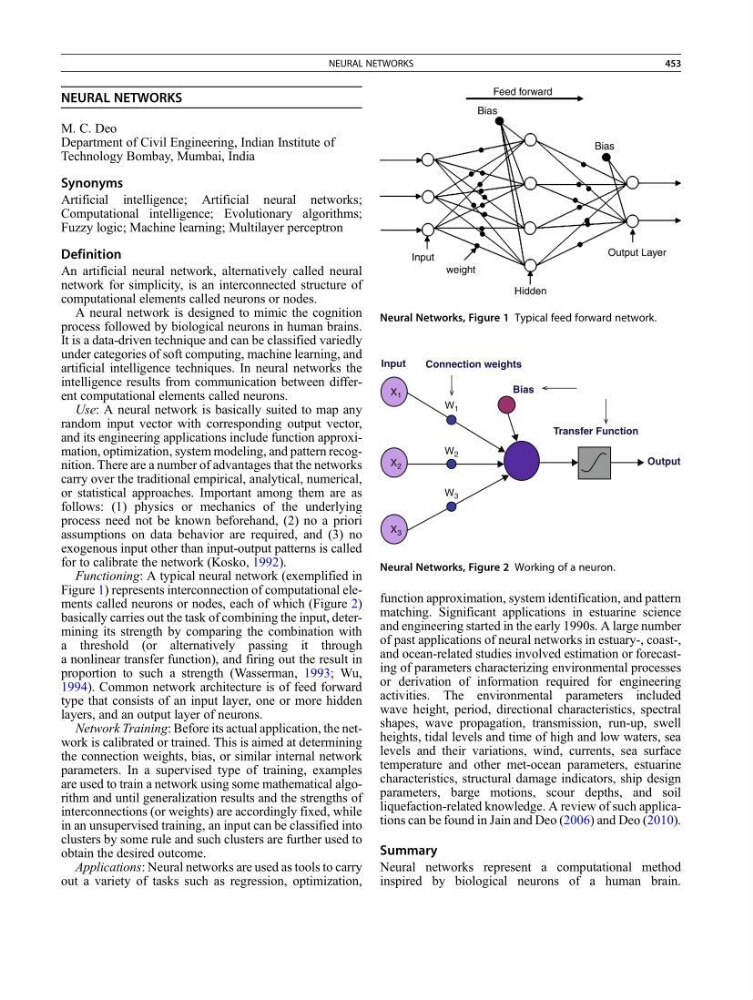
Functioning: A typical neural network (exemplified in
Figure 1) represents interconnection of computational elements called neurons or nodes, each of which (Figure 2)
basically carries out the task of combining the input, determining its strength by comparing the combination with
a threshold (or alternatively passing it through
a nonlinear transfer function), and firing out the result in
proportion to such a strength (Wasserman, 1993; Wu,
1994). Common network architecture is of feed forward
type that consists of an input layer, one or more hidden
layers, and an output layer of neurons.
Network Training: Before its actual application, the network is calibrated or trained. This is aimed at determining
the connection weights, bias, or similar internal network
parameters. In a supervised type of training, examples
are used to train a network using some mathematical algorithm and until generalization results and the strengths of
interconnections (or weights) are accordingly fixed, while
in an unsupervised training, an input can be classified into
clusters by some rule and such clusters are further used to
obtain the desired outcome.
Applications: Neural networks are used as tools to carry
out a variety of tasks such as regression, optimization,
function approximation, system identification, and pattern
matching. Significant applications in estuarine science
and engineering started in the early 1990s. A large number
of past applications of neural networks in estuary-, coast-,
and ocean-related studies involved estimation or forecasting of parameters characterizing environmental processes
or derivation of information required for engineering
activities. The environmental parameters included
wave height, period, directional characteristics, spectral
shapes, wave propagation, transmission, run-up, swell
heights, tidal levels and time of high and low waters, sea
levels and their variations, wind, currents, sea surface
temperature and other met-ocean parameters, estuarine
characteristics, structural damage indicators, ship design
parameters, barge motions, scour depths, and soil
liquefaction-related knowledge. A review of such applications can be found in Jain and Deo (2006) and Deo (2010).
Summary
Neural networks represent a computational method
inspired by biological neurons of a human brain.
Neural Networks, Figure 1 Typical feed forward network.
Input
Connection weights
W 1
X 1
W 2
X 2
W 3
X 3
Bias
Transfer Function
Output
Neural Networks, Figure 2 Working of a neuron.
NEURAL NETWORKS
453
M. C. Deo
Department of Civil Engineering, Indian Institute of
Technology Bombay, Mumbai, India
Synonyms
Artificial intelligence; Artificial neural networks;
Computational intelligence; Evolutionary algorithms;
Fuzzy logic; Machine learning; Multilayer perceptron
Definition
An artificial neural network, alternatively called neural
network for simplicity, is an interconnected structure of
computational elements called neurons or nodes.
A neural network is designed to mimic the cognition
process followed by biological neurons in human brains.
It is a data-driven technique and can be classified variedly
under categories of soft computing, machine learning, and
artificial intelligence techniques. In neural networks the
intelligence results from communication between different computational elements called neurons.
Use: A neural network is basically suited to map any
random input vector with corresponding output vector,
and its engineering applications include function approximation, optimization, system modeling, and pattern recognition. There are a number of advantages that the networks
carry over the traditional empirical, analytical, numerical,
or statistical approaches. Important among them are as
follows: (1) physics or mechanics of the underlying
process need not be known beforehand, (2) no a priori
assumptions on data behavior are required, and (3) no
exogenous input other than input-output patterns is called
for to calibrate the network (Kosko, 1992).
Functioning: A typical neural network (exemplified in
Figure 1) represents interconnection of computational elements called neurons or nodes, each of which (Figure 2)
basically carries out the task of combining the input, determining its strength by comparing the combination with
a threshold (or alternatively passing it through
a nonlinear transfer function), and firing out the result in
proportion to such a strength (Wasserman, 1993; Wu,
1994). Common network architecture is of feed forward
type that consists of an input layer, one or more hidden
layers, and an output layer of neurons.
Network Training: Before its actual application, the network is calibrated or trained. This is aimed at determining
the connection weights, bias, or similar internal network
parameters. In a supervised type of training, examples
are used to train a network using some mathematical algorithm and until generalization results and the strengths of
interconnections (or weights) are accordingly fixed, while
in an unsupervised training, an input can be classified into
clusters by some rule and such clusters are further used to
obtain the desired outcome.
Applications: Neural networks are used as tools to carry
out a variety of tasks such as regression, optimization,
function approximation, system identification, and pattern
matching. Significant applications in estuarine science
and engineering started in the early 1990s. A large number
of past applications of neural networks in estuary-, coast-,
and ocean-related studies involved estimation or forecasting of parameters characterizing environmental processes
or derivation of information required for engineering
activities. The environmental parameters included
wave height, period, directional characteristics, spectral
shapes, wave propagation, transmission, run-up, swell
heights, tidal levels and time of high and low waters, sea
levels and their variations, wind, currents, sea surface
temperature and other met-ocean parameters, estuarine
characteristics, structural damage indicators, ship design
parameters, barge motions, scour depths, and soil
liquefaction-related knowledge. A review of such applications can be found in Jain and Deo (2006) and Deo (2010).
Summary
Neural networks represent a computational method
inspired by biological neurons of a human brain.
Neural Networks, Figure 1 Typical feed forward network.
Input
Connection weights
W 1
X 1
W 2
X 2
W 3
X 3
Bias
Transfer Function
Output
Neural Networks, Figure 2 Working of a neuron.
NEURAL NETWORKS
453