

Bibliography
Flynn, K. J., Stoecker, D. K., Mitra, A., Raven, J. A., Glibert, P. M.,
Hansen, P. J., Graneli, E., and Burkholder, J. M., 2012. Misuse of
the phytoplanktonzooplankton dichotomy: the need to assign
organisms as mixotrophs within plankton functional types.
Journal of Plankton Research, 35, 3–11.
Jones, R. I., 1994. Mixotrophy in planktonic protists as a spectrum
of nutritional strategies. Marine Microbial Food Web Journal,
8, 87–96.
Stickney, H. L., Hood, R. R., and Stoecker, D. K., 2000. The impact
of mixotrophy on planktonic marine ecosystems. Ecological
Modeling, 125, 203–230.
Stoecker, D. K., 1998. Conceptual models of mixotrophy in planktonic protists. European Journal of Protistology, 34, 281–290.
Wilkens, S., Huisman, J., Naus-Wiezer, S., and Van Donk, E., 2012.
Mixotrophic organisms become more heterotrophic with rising
temperature. Ecology Letters, 16, 225–233.
Cross-references
Phytoplankton
Phytoplankton Blooms
Zooplankton
MOSQUITO DITCHING
Keryn Gedan
Department of Biology, University of Maryland,
College Park, MD, USA
Definition
Mosquito ditching is a method of controlling mosquito
breeding in wetlands by draining them.
Description
Mosquito control by ditching drains standing water off of
coastal wetlands to reduce the natal habitat for mosquito
larvae while simultaneously allowing aquatic predators
of mosquito larvae to access their prey (Smith, 1904).
Mosquito ditches were widely installed in tidal wetlands
in the eastern United States in the 1930s, when
Depression-era work relief programs were assigned the
task. In New England, over 90 % of salt marshes have
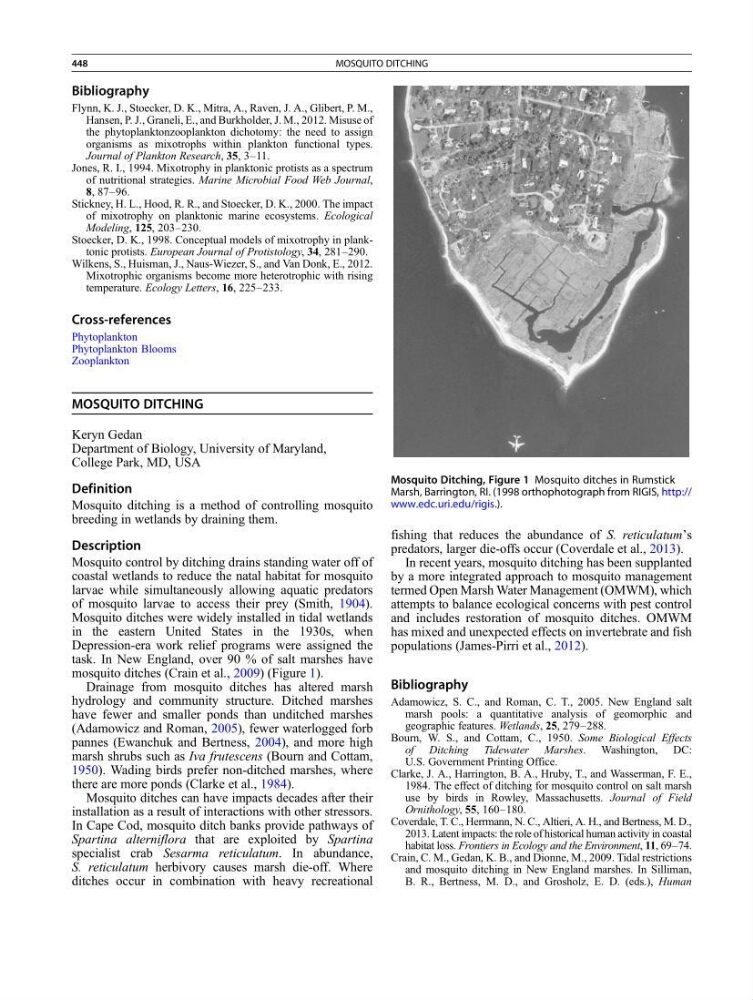
mosquito ditches (Crain et al., 2009) (Figure 1).
Drainage from mosquito ditches has altered marsh
hydrology and community structure. Ditched marshes
have fewer and smaller ponds than unditched marshes
(Adamowicz and Roman, 2005), fewer waterlogged forb
pannes (Ewanchuk and Bertness, 2004), and more high
marsh shrubs such as Iva frutescens (Bourn and Cottam,
1950). Wading birds prefer non-ditched marshes, where
there are more ponds (Clarke et al., 1984).
Mosquito ditches can have impacts decades after their
installation as a result of interactions with other stressors.
In Cape Cod, mosquito ditch banks provide pathways of
Spartina alterniflora that are exploited by Spartina
specialist crab Sesarma reticulatum. In abundance,
S. reticulatum herbivory causes marsh die-off. Where
ditches occur in combination with heavy recreational
fishing that reduces the abundance of S. reticulatum’s
predators, larger die-offs occur (Coverdale et al., 2013).
In recent years, mosquito ditching has been supplanted
by a more integrated approach to mosquito management
termed Open Marsh Water Management (OMWM), which
attempts to balance ecological concerns with pest control
and includes restoration of mosquito ditches. OMWM
has mixed and unexpected effects on invertebrate and fish
populations (James-Pirri et al., 2012).
Bibliography
Adamowicz, S. C., and Roman, C. T., 2005. New England salt
marsh pools: a quantitative analysis of geomorphic and
geographic features. Wetlands, 25, 279–288.
Bourn, W. S., and Cottam, C., 1950. Some Biological Effects
of Ditching Tidewater Marshes. Washington, DC:
U.S. Government Printing Office.
Clarke, J. A., Harrington, B. A., Hruby, T., and Wasserman, F. E.,
1984. The effect of ditching for mosquito control on salt marsh
use by birds in Rowley, Massachusetts. Journal of Field
Ornithology, 55, 160–180.
Coverdale, T. C., Herrmann, N. C., Altieri, A. H., and Bertness, M. D.,
2013. Latent impacts: the role of historical human activity in coastal
habitat loss. Frontiers in Ecology and the Environment, 11, 69–74.
Crain, C. M., Gedan, K. B., and Dionne, M., 2009. Tidal restrictions
and mosquito ditching in New England marshes. In Silliman,
B. R., Bertness, M. D., and Grosholz, E. D. (eds.), Human
Mosquito Ditching, Figure 1 Mosquito ditches in Rumstick
Marsh, Barrington, RI. (1998 orthophotograph from RIGIS, http://
www.edc.uri.edu/rigis.).
448
MOSQUITO DITCHING
Flynn, K. J., Stoecker, D. K., Mitra, A., Raven, J. A., Glibert, P. M.,
Hansen, P. J., Graneli, E., and Burkholder, J. M., 2012. Misuse of
the phytoplanktonzooplankton dichotomy: the need to assign
organisms as mixotrophs within plankton functional types.
Journal of Plankton Research, 35, 3–11.
Jones, R. I., 1994. Mixotrophy in planktonic protists as a spectrum
of nutritional strategies. Marine Microbial Food Web Journal,
8, 87–96.
Stickney, H. L., Hood, R. R., and Stoecker, D. K., 2000. The impact
of mixotrophy on planktonic marine ecosystems. Ecological
Modeling, 125, 203–230.
Stoecker, D. K., 1998. Conceptual models of mixotrophy in planktonic protists. European Journal of Protistology, 34, 281–290.
Wilkens, S., Huisman, J., Naus-Wiezer, S., and Van Donk, E., 2012.
Mixotrophic organisms become more heterotrophic with rising
temperature. Ecology Letters, 16, 225–233.
Cross-references
Phytoplankton
Phytoplankton Blooms
Zooplankton
MOSQUITO DITCHING
Keryn Gedan
Department of Biology, University of Maryland,
College Park, MD, USA
Definition
Mosquito ditching is a method of controlling mosquito
breeding in wetlands by draining them.
Description
Mosquito control by ditching drains standing water off of
coastal wetlands to reduce the natal habitat for mosquito
larvae while simultaneously allowing aquatic predators
of mosquito larvae to access their prey (Smith, 1904).
Mosquito ditches were widely installed in tidal wetlands
in the eastern United States in the 1930s, when
Depression-era work relief programs were assigned the
task. In New England, over 90 % of salt marshes have
mosquito ditches (Crain et al., 2009) (Figure 1).
Drainage from mosquito ditches has altered marsh
hydrology and community structure. Ditched marshes
have fewer and smaller ponds than unditched marshes
(Adamowicz and Roman, 2005), fewer waterlogged forb
pannes (Ewanchuk and Bertness, 2004), and more high
marsh shrubs such as Iva frutescens (Bourn and Cottam,
1950). Wading birds prefer non-ditched marshes, where
there are more ponds (Clarke et al., 1984).
Mosquito ditches can have impacts decades after their
installation as a result of interactions with other stressors.
In Cape Cod, mosquito ditch banks provide pathways of
Spartina alterniflora that are exploited by Spartina
specialist crab Sesarma reticulatum. In abundance,
S. reticulatum herbivory causes marsh die-off. Where
ditches occur in combination with heavy recreational
fishing that reduces the abundance of S. reticulatum’s
predators, larger die-offs occur (Coverdale et al., 2013).
In recent years, mosquito ditching has been supplanted
by a more integrated approach to mosquito management
termed Open Marsh Water Management (OMWM), which
attempts to balance ecological concerns with pest control
and includes restoration of mosquito ditches. OMWM
has mixed and unexpected effects on invertebrate and fish
populations (James-Pirri et al., 2012).
Bibliography
Adamowicz, S. C., and Roman, C. T., 2005. New England salt
marsh pools: a quantitative analysis of geomorphic and
geographic features. Wetlands, 25, 279–288.
Bourn, W. S., and Cottam, C., 1950. Some Biological Effects
of Ditching Tidewater Marshes. Washington, DC:
U.S. Government Printing Office.
Clarke, J. A., Harrington, B. A., Hruby, T., and Wasserman, F. E.,
1984. The effect of ditching for mosquito control on salt marsh
use by birds in Rowley, Massachusetts. Journal of Field
Ornithology, 55, 160–180.
Coverdale, T. C., Herrmann, N. C., Altieri, A. H., and Bertness, M. D.,
2013. Latent impacts: the role of historical human activity in coastal
habitat loss. Frontiers in Ecology and the Environment, 11, 69–74.
Crain, C. M., Gedan, K. B., and Dionne, M., 2009. Tidal restrictions
and mosquito ditching in New England marshes. In Silliman,
B. R., Bertness, M. D., and Grosholz, E. D. (eds.), Human
Mosquito Ditching, Figure 1 Mosquito ditches in Rumstick
Marsh, Barrington, RI. (1998 orthophotograph from RIGIS, http://
www.edc.uri.edu/rigis.).
448
MOSQUITO DITCHING