

weekly, seasonally, and inter-annually. For estuaries with
perennial river flow, the salinity structure may remain
throughout the year, but for estuaries with seasonal river
flow the estuary may change from highly stratified, to
moderately stratified, to vertically homogeneous, or even
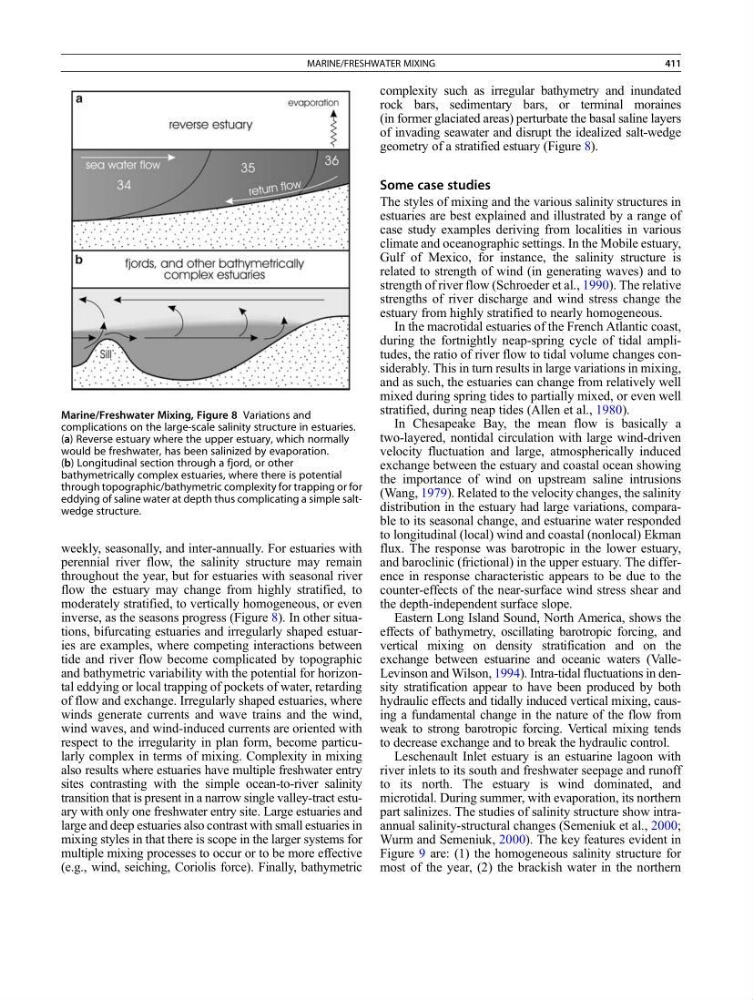
inverse, as the seasons progress (Figure 8). In other situations, bifurcating estuaries and irregularly shaped estuaries are examples, where competing interactions between
tide and river flow become complicated by topographic
and bathymetric variability with the potential for horizontal eddying or local trapping of pockets of water, retarding
of flow and exchange. Irregularly shaped estuaries, where
winds generate currents and wave trains and the wind,
wind waves, and wind-induced currents are oriented with
respect to the irregularity in plan form, become particularly complex in terms of mixing. Complexity in mixing
also results where estuaries have multiple freshwater entry
sites contrasting with the simple ocean-to-river salinity
transition that is present in a narrow single valley-tract estuary with only one freshwater entry site. Large estuaries and
large and deep estuaries also contrast with small estuaries in
mixing styles in that there is scope in the larger systems for
multiple mixing processes to occur or to be more effective
(e.g., wind, seiching, Coriolis force). Finally, bathymetric
complexity such as irregular bathymetry and inundated
rock bars, sedimentary bars, or terminal moraines
(in former glaciated areas) perturbate the basal saline layers
of invading seawater and disrupt the idealized salt-wedge
geometry of a stratified estuary (Figure 8).
Some case studies
The styles of mixing and the various salinity structures in
estuaries are best explained and illustrated by a range of
case study examples deriving from localities in various
climate and oceanographic settings. In the Mobile estuary,
Gulf of Mexico, for instance, the salinity structure is
related to strength of wind (in generating waves) and to
strength of river flow (Schroeder et al., 1990). The relative
strengths of river discharge and wind stress change the
estuary from highly stratified to nearly homogeneous.
In the macrotidal estuaries of the French Atlantic coast,
during the fortnightly neap-spring cycle of tidal amplitudes, the ratio of river flow to tidal volume changes considerably. This in turn results in large variations in mixing,
and as such, the estuaries can change from relatively well
mixed during spring tides to partially mixed, or even well
stratified, during neap tides (Allen et al., 1980).
In Chesapeake Bay, the mean flow is basically a
two-layered, nontidal circulation with large wind-driven
velocity fluctuation and large, atmospherically induced
exchange between the estuary and coastal ocean showing
the importance of wind on upstream saline intrusions
(Wang, 1979). Related to the velocity changes, the salinity
distribution in the estuary had large variations, comparable to its seasonal change, and estuarine water responded
to longitudinal (local) wind and coastal (nonlocal) Ekman
flux. The response was barotropic in the lower estuary,
and baroclinic (frictional) in the upper estuary. The difference in response characteristic appears to be due to the
counter-effects of the near-surface wind stress shear and
the depth-independent surface slope.
Eastern Long Island Sound, North America, shows the
effects of bathymetry, oscillating barotropic forcing, and
vertical mixing on density stratification and on the
exchange between estuarine and oceanic waters (ValleLevinson and Wilson, 1994). Intra-tidal fluctuations in density stratification appear to have been produced by both
hydraulic effects and tidally induced vertical mixing, causing a fundamental change in the nature of the flow from
weak to strong barotropic forcing. Vertical mixing tends
to decrease exchange and to break the hydraulic control.
Leschenault Inlet estuary is an estuarine lagoon with
river inlets to its south and freshwater seepage and runoff
to its north. The estuary is wind dominated, and
microtidal. During summer, with evaporation, its northern
part salinizes. The studies of salinity structure show intraannual salinity-structural changes (Semeniuk et al., 2000;
Wurm and Semeniuk, 2000). The key features evident in
Figure 9 are: (1) the homogeneous salinity structure for
most of the year, (2) the brackish water in the northern
Marine/Freshwater Mixing, Figure 8 Variations and
complications on the large-scale salinity structure in estuaries.
(a) Reverse estuary where the upper estuary, which normally
would be freshwater, has been salinized by evaporation.
(b) Longitudinal section through a fjord, or other
bathymetrically complex estuaries, where there is potential
through topographic/bathymetric complexity for trapping or for
eddying of saline water at depth thus complicating a simple saltwedge structure.
MARINE/FRESHWATER MIXING
411
perennial river flow, the salinity structure may remain
throughout the year, but for estuaries with seasonal river
flow the estuary may change from highly stratified, to
moderately stratified, to vertically homogeneous, or even
inverse, as the seasons progress (Figure 8). In other situations, bifurcating estuaries and irregularly shaped estuaries are examples, where competing interactions between
tide and river flow become complicated by topographic
and bathymetric variability with the potential for horizontal eddying or local trapping of pockets of water, retarding
of flow and exchange. Irregularly shaped estuaries, where
winds generate currents and wave trains and the wind,
wind waves, and wind-induced currents are oriented with
respect to the irregularity in plan form, become particularly complex in terms of mixing. Complexity in mixing
also results where estuaries have multiple freshwater entry
sites contrasting with the simple ocean-to-river salinity
transition that is present in a narrow single valley-tract estuary with only one freshwater entry site. Large estuaries and
large and deep estuaries also contrast with small estuaries in
mixing styles in that there is scope in the larger systems for
multiple mixing processes to occur or to be more effective
(e.g., wind, seiching, Coriolis force). Finally, bathymetric
complexity such as irregular bathymetry and inundated
rock bars, sedimentary bars, or terminal moraines
(in former glaciated areas) perturbate the basal saline layers
of invading seawater and disrupt the idealized salt-wedge
geometry of a stratified estuary (Figure 8).
Some case studies
The styles of mixing and the various salinity structures in
estuaries are best explained and illustrated by a range of
case study examples deriving from localities in various
climate and oceanographic settings. In the Mobile estuary,
Gulf of Mexico, for instance, the salinity structure is
related to strength of wind (in generating waves) and to
strength of river flow (Schroeder et al., 1990). The relative
strengths of river discharge and wind stress change the
estuary from highly stratified to nearly homogeneous.
In the macrotidal estuaries of the French Atlantic coast,
during the fortnightly neap-spring cycle of tidal amplitudes, the ratio of river flow to tidal volume changes considerably. This in turn results in large variations in mixing,
and as such, the estuaries can change from relatively well
mixed during spring tides to partially mixed, or even well
stratified, during neap tides (Allen et al., 1980).
In Chesapeake Bay, the mean flow is basically a
two-layered, nontidal circulation with large wind-driven
velocity fluctuation and large, atmospherically induced
exchange between the estuary and coastal ocean showing
the importance of wind on upstream saline intrusions
(Wang, 1979). Related to the velocity changes, the salinity
distribution in the estuary had large variations, comparable to its seasonal change, and estuarine water responded
to longitudinal (local) wind and coastal (nonlocal) Ekman
flux. The response was barotropic in the lower estuary,
and baroclinic (frictional) in the upper estuary. The difference in response characteristic appears to be due to the
counter-effects of the near-surface wind stress shear and
the depth-independent surface slope.
Eastern Long Island Sound, North America, shows the
effects of bathymetry, oscillating barotropic forcing, and
vertical mixing on density stratification and on the
exchange between estuarine and oceanic waters (ValleLevinson and Wilson, 1994). Intra-tidal fluctuations in density stratification appear to have been produced by both
hydraulic effects and tidally induced vertical mixing, causing a fundamental change in the nature of the flow from
weak to strong barotropic forcing. Vertical mixing tends
to decrease exchange and to break the hydraulic control.
Leschenault Inlet estuary is an estuarine lagoon with
river inlets to its south and freshwater seepage and runoff
to its north. The estuary is wind dominated, and
microtidal. During summer, with evaporation, its northern
part salinizes. The studies of salinity structure show intraannual salinity-structural changes (Semeniuk et al., 2000;
Wurm and Semeniuk, 2000). The key features evident in
Figure 9 are: (1) the homogeneous salinity structure for
most of the year, (2) the brackish water in the northern
Marine/Freshwater Mixing, Figure 8 Variations and
complications on the large-scale salinity structure in estuaries.
(a) Reverse estuary where the upper estuary, which normally
would be freshwater, has been salinized by evaporation.
(b) Longitudinal section through a fjord, or other
bathymetrically complex estuaries, where there is potential
through topographic/bathymetric complexity for trapping or for
eddying of saline water at depth thus complicating a simple saltwedge structure.
MARINE/FRESHWATER MIXING
411