

salinity gradient is an important control on stratification.
While stratification is always reduced by up-estuary wind,
it shows an increase-then-decrease transition when downestuary wind stress increases. Such transition is a result of
the competition between wind straining and direct wind
mixing.
The salinity structure of estuaries
The hydrochemical (salinity) structure of an estuary from
river to sea varies in response to the interaction of freshwater flow, friction, and tidal mixing. The salinity structure
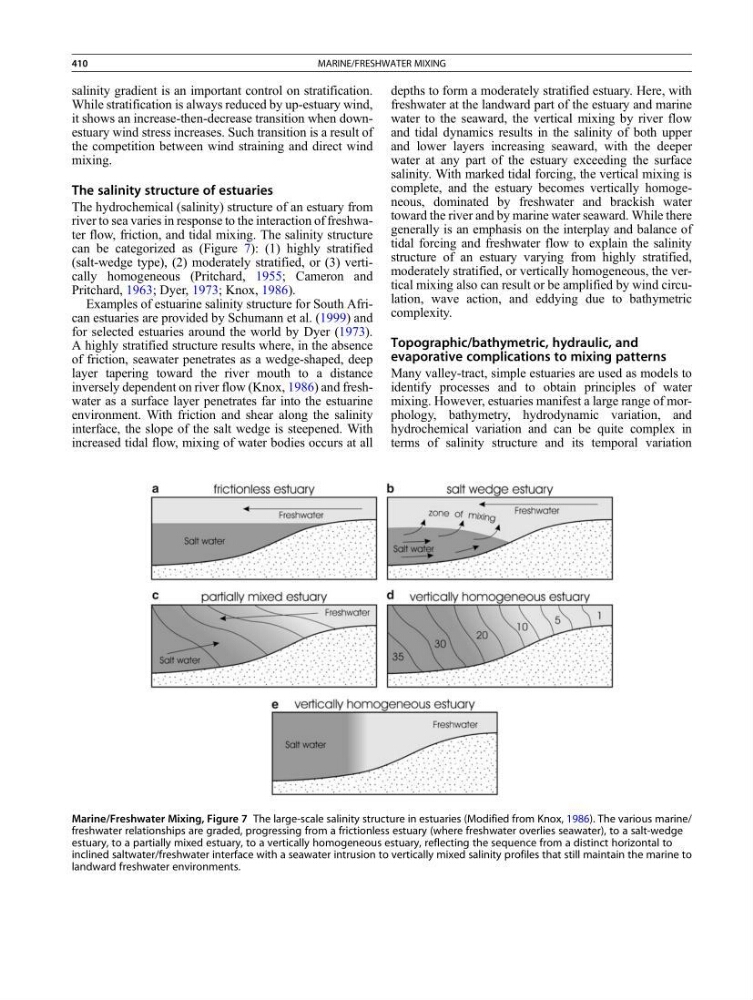
can be categorized as (Figure 7): (1) highly stratified
(salt-wedge type), (2) moderately stratified, or (3) vertically homogeneous (Pritchard, 1955; Cameron and
Pritchard, 1963; Dyer, 1973; Knox, 1986).
Examples of estuarine salinity structure for South African estuaries are provided by Schumann et al. (1999) and
for selected estuaries around the world by Dyer (1973).
A highly stratified structure results where, in the absence
of friction, seawater penetrates as a wedge-shaped, deep
layer tapering toward the river mouth to a distance
inversely dependent on river flow (Knox, 1986) and freshwater as a surface layer penetrates far into the estuarine
environment. With friction and shear along the salinity
interface, the slope of the salt wedge is steepened. With
increased tidal flow, mixing of water bodies occurs at all
depths to form a moderately stratified estuary. Here, with
freshwater at the landward part of the estuary and marine
water to the seaward, the vertical mixing by river flow
and tidal dynamics results in the salinity of both upper
and lower layers increasing seaward, with the deeper
water at any part of the estuary exceeding the surface
salinity. With marked tidal forcing, the vertical mixing is
complete, and the estuary becomes vertically homogeneous, dominated by freshwater and brackish water
toward the river and by marine water seaward. While there
generally is an emphasis on the interplay and balance of
tidal forcing and freshwater flow to explain the salinity
structure of an estuary varying from highly stratified,
moderately stratified, or vertically homogeneous, the vertical mixing also can result or be amplified by wind circulation, wave action, and eddying due to bathymetric
complexity.
Topographic/bathymetric, hydraulic, and
evaporative complications to mixing patterns
Many valley-tract, simple estuaries are used as models to
identify processes and to obtain principles of water
mixing. However, estuaries manifest a large range of morphology, bathymetry, hydrodynamic variation, and
hydrochemical variation and can be quite complex in
terms of salinity structure and its temporal variation
Marine/Freshwater Mixing, Figure 7 The large-scale salinity structure in estuaries (Modified from Knox, 1986). The various marine/
freshwater relationships are graded, progressing from a frictionless estuary (where freshwater overlies seawater), to a salt-wedge
estuary, to a partially mixed estuary, to a vertically homogeneous estuary, reflecting the sequence from a distinct horizontal to
inclined saltwater/freshwater interface with a seawater intrusion to vertically mixed salinity profiles that still maintain the marine to
landward freshwater environments.
410
MARINE/FRESHWATER MIXING
While stratification is always reduced by up-estuary wind,
it shows an increase-then-decrease transition when downestuary wind stress increases. Such transition is a result of
the competition between wind straining and direct wind
mixing.
The salinity structure of estuaries
The hydrochemical (salinity) structure of an estuary from
river to sea varies in response to the interaction of freshwater flow, friction, and tidal mixing. The salinity structure
can be categorized as (Figure 7): (1) highly stratified
(salt-wedge type), (2) moderately stratified, or (3) vertically homogeneous (Pritchard, 1955; Cameron and
Pritchard, 1963; Dyer, 1973; Knox, 1986).
Examples of estuarine salinity structure for South African estuaries are provided by Schumann et al. (1999) and
for selected estuaries around the world by Dyer (1973).
A highly stratified structure results where, in the absence
of friction, seawater penetrates as a wedge-shaped, deep
layer tapering toward the river mouth to a distance
inversely dependent on river flow (Knox, 1986) and freshwater as a surface layer penetrates far into the estuarine
environment. With friction and shear along the salinity
interface, the slope of the salt wedge is steepened. With
increased tidal flow, mixing of water bodies occurs at all
depths to form a moderately stratified estuary. Here, with
freshwater at the landward part of the estuary and marine
water to the seaward, the vertical mixing by river flow
and tidal dynamics results in the salinity of both upper
and lower layers increasing seaward, with the deeper
water at any part of the estuary exceeding the surface
salinity. With marked tidal forcing, the vertical mixing is
complete, and the estuary becomes vertically homogeneous, dominated by freshwater and brackish water
toward the river and by marine water seaward. While there
generally is an emphasis on the interplay and balance of
tidal forcing and freshwater flow to explain the salinity
structure of an estuary varying from highly stratified,
moderately stratified, or vertically homogeneous, the vertical mixing also can result or be amplified by wind circulation, wave action, and eddying due to bathymetric
complexity.
Topographic/bathymetric, hydraulic, and
evaporative complications to mixing patterns
Many valley-tract, simple estuaries are used as models to
identify processes and to obtain principles of water
mixing. However, estuaries manifest a large range of morphology, bathymetry, hydrodynamic variation, and
hydrochemical variation and can be quite complex in
terms of salinity structure and its temporal variation
Marine/Freshwater Mixing, Figure 7 The large-scale salinity structure in estuaries (Modified from Knox, 1986). The various marine/
freshwater relationships are graded, progressing from a frictionless estuary (where freshwater overlies seawater), to a salt-wedge
estuary, to a partially mixed estuary, to a vertically homogeneous estuary, reflecting the sequence from a distinct horizontal to
inclined saltwater/freshwater interface with a seawater intrusion to vertically mixed salinity profiles that still maintain the marine to
landward freshwater environments.
410
MARINE/FRESHWATER MIXING