

Bibliography
Komar, P. D., 2007. The entrainment, transport and sorting of heavy
minerals by waves and currents. In Mange, M. A., and Wright,
D. T. (eds.), Heavy Minerals in Use: Developments in Sedimentology Series. Amsterdam: Elsevier, Vol. 58, pp. 3–48.
Cross-references
Estuarine Sediment Composition
Trace Metals in Estuaries
HERBIVOROUS GRAZERS
Carol Thornber
Department of Biological Sciences, University of Rhode
Island, Kingston, RI, USA
Synonyms
Grazers; Herbivores; Primary consumers
Definition
Herbivorous grazers are heterotrophic organisms that consume algae and/or plants. A wide range of species, both in
terms of body size and taxonomic diversity, are herbivorous grazers.
Summary
Herbivorous grazers occupy the trophic niche immediately above primary producers in food webs. They are
commonly found in estuarine habitats and consume estuarine plants (including seagrasses, salt marsh plants, and
mangroves) and/or algae (including phytoplankton,
benthic microalgae, and benthic or drifting macroalgae).
In estuarine systems, herbivorous grazers can be either
marine or terrestrial in origin, due to the proximity of the
two habitats (Denno et al., 2002; Coverdale et al., 2012).
Estuarine herbivores are frequently grouped into three
general categories based upon their body size: <0.1 cm
micrograzers (e.g., amoeboids, ciliates), 0.1–2 cm
mesograzers (e.g., amphipods, copepods, crabs, small
gastropods, insects), and >2 cm macrograzers (e.g., sea
urchins, fish, birds, mammals). Herbivorous grazers
can also be grouped together on the basis of their
estuarine location or origin (e.g., benthic vs. pelagic
vs. terrestrial). Thus, phytoplankton are consumed by zooplankton and benthic suspension feeders, benthic
microalgae are consumed by benthic deposit feeders and
mobile benthic invertebrate grazers, and macroalgae and
plants are consumed by mobile benthic or terrestrial invertebrates, birds, and fish. Depending on the relative sizes of
herbivorous grazers and their food, they may consume
either entire organisms (i.e., microalgae) or parts of organisms (i.e., macroalgae, plants).
Some herbivorous grazers can also utilize macroalgae
and/or plants as a habitat (Dijkstra et al., 2012), which also
can provide protection from predators and/or be used as
a substrate on which to lay eggs (Balouskus and Targett,
2012).
Bibliography
Balouskus, R. G., and Targett, T. E., 2012. Egg deposition by
Atlantic Silverside, Menidia menidia: substrate utilization and
comparison of natural and altered shoreline type. Estuaries and
Coasts, 35, 1100–1109.
Coverdale, T. C., Altieri, A. H., and Bertness, M. D., 2012.
Belowground herbivory increases vulnerability of New England
salt marshes to die-off. Ecology, 93, 2085–2094.
Denno, R. F., Gratton, C., Peterson, M. A., Langellotto, G. A.,
Finke, D. L., and Huberty, A. F., 2002. Bottom-up forces mediate
natural-enemy impact in a phytophagous insect community.
Ecology, 83, 1443–1458.
Dijkstra, J. A., Boudreau, J., and Dionne, M., 2012. Species-specific
mediation of temperature and community interactions by
multiple foundation species. Oikos, 121, 646–654.
Cross-references
Food Web/Trophic Dynamics
Heterotrophic
Phytoplankton
Zooplankton
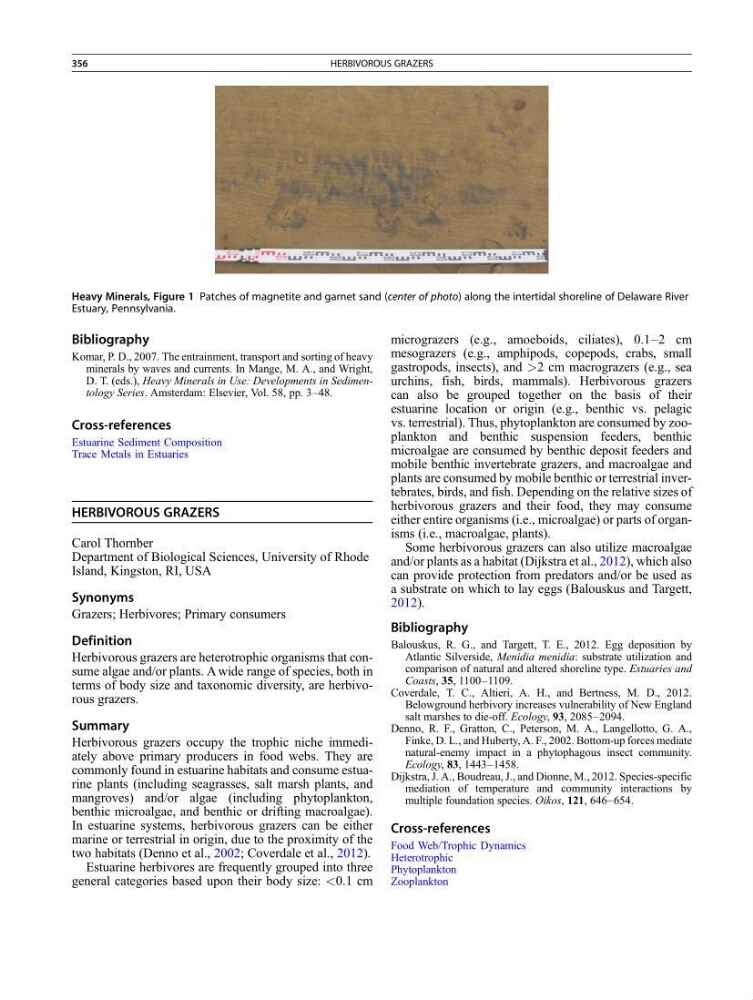
Heavy Minerals, Figure 1 Patches of magnetite and garnet sand (center of photo) along the intertidal shoreline of Delaware River
Estuary, Pennsylvania.
356
HERBIVOROUS GRAZERS
Komar, P. D., 2007. The entrainment, transport and sorting of heavy
minerals by waves and currents. In Mange, M. A., and Wright,
D. T. (eds.), Heavy Minerals in Use: Developments in Sedimentology Series. Amsterdam: Elsevier, Vol. 58, pp. 3–48.
Cross-references
Estuarine Sediment Composition
Trace Metals in Estuaries
HERBIVOROUS GRAZERS
Carol Thornber
Department of Biological Sciences, University of Rhode
Island, Kingston, RI, USA
Synonyms
Grazers; Herbivores; Primary consumers
Definition
Herbivorous grazers are heterotrophic organisms that consume algae and/or plants. A wide range of species, both in
terms of body size and taxonomic diversity, are herbivorous grazers.
Summary
Herbivorous grazers occupy the trophic niche immediately above primary producers in food webs. They are
commonly found in estuarine habitats and consume estuarine plants (including seagrasses, salt marsh plants, and
mangroves) and/or algae (including phytoplankton,
benthic microalgae, and benthic or drifting macroalgae).
In estuarine systems, herbivorous grazers can be either
marine or terrestrial in origin, due to the proximity of the
two habitats (Denno et al., 2002; Coverdale et al., 2012).
Estuarine herbivores are frequently grouped into three
general categories based upon their body size: <0.1 cm
micrograzers (e.g., amoeboids, ciliates), 0.1–2 cm
mesograzers (e.g., amphipods, copepods, crabs, small
gastropods, insects), and >2 cm macrograzers (e.g., sea
urchins, fish, birds, mammals). Herbivorous grazers
can also be grouped together on the basis of their
estuarine location or origin (e.g., benthic vs. pelagic
vs. terrestrial). Thus, phytoplankton are consumed by zooplankton and benthic suspension feeders, benthic
microalgae are consumed by benthic deposit feeders and
mobile benthic invertebrate grazers, and macroalgae and
plants are consumed by mobile benthic or terrestrial invertebrates, birds, and fish. Depending on the relative sizes of
herbivorous grazers and their food, they may consume
either entire organisms (i.e., microalgae) or parts of organisms (i.e., macroalgae, plants).
Some herbivorous grazers can also utilize macroalgae
and/or plants as a habitat (Dijkstra et al., 2012), which also
can provide protection from predators and/or be used as
a substrate on which to lay eggs (Balouskus and Targett,
2012).
Bibliography
Balouskus, R. G., and Targett, T. E., 2012. Egg deposition by
Atlantic Silverside, Menidia menidia: substrate utilization and
comparison of natural and altered shoreline type. Estuaries and
Coasts, 35, 1100–1109.
Coverdale, T. C., Altieri, A. H., and Bertness, M. D., 2012.
Belowground herbivory increases vulnerability of New England
salt marshes to die-off. Ecology, 93, 2085–2094.
Denno, R. F., Gratton, C., Peterson, M. A., Langellotto, G. A.,
Finke, D. L., and Huberty, A. F., 2002. Bottom-up forces mediate
natural-enemy impact in a phytophagous insect community.
Ecology, 83, 1443–1458.
Dijkstra, J. A., Boudreau, J., and Dionne, M., 2012. Species-specific
mediation of temperature and community interactions by
multiple foundation species. Oikos, 121, 646–654.
Cross-references
Food Web/Trophic Dynamics
Heterotrophic
Phytoplankton
Zooplankton
Heavy Minerals, Figure 1 Patches of magnetite and garnet sand (center of photo) along the intertidal shoreline of Delaware River
Estuary, Pennsylvania.
356
HERBIVOROUS GRAZERS