

eutrophic systems from larger, long-lived benthic infauna
(e.g., hard clams, Mercenaria mercenaria) to smaller, rapidly growing, but shorter-lived forms (e.g., coot clams,
Mulinia lateralis). The loss of larger, filter-feeding shellfish species has been well documented in eutrophic systems, such as the Barnegat Bay-Little Egg Harbor
Estuary in New Jersey (USA), which reduces bottom-up
control and regulation of phytoplankton populations
(Kennish, 2001b). In an environment of less top-down
control, toxic phytoplankton blooms may also occur
(e.g., brown tide, Aureococcus anophagefferens). The
potential for permanent alteration of biotic communities
and habitats exists in this type of impacted system, and
its stability and resilience are likely compromised.
Barnegat Bay-Little Egg Harbor Estuary: case study
Barnegat Bay-Little Egg Harbor (BB-LEH) Estuary has
been classified as a highly eutrophic coastal lagoon based
on application of NOAA’s National Estuarine Eutrophication Assessment (NEEA) Model (Bricker et al., 2007)
and Nixon’s Trophic Classification (Kennish et al.,
2007; Kennish et al., 2010; Fertig et al., 2013).
This 280-km
2 estuarine waterbody is highly susceptible
to nutrient loading because it is shallow, poorly flushed,
and bordered by highly developed and altered watershed
areas (1,720 km
2 ) that act as a conduit for nutrient
transport to the estuary. Nutrient enrichment in this
waterbody, as well as other coastal lagoons in the
mid-Atlantic region, is linked to an array of adverse
impacts, most notably eutrophication.
Total nitrogen loading from the BB-LEH watershed
ranges from $455,000 to 857,000 kg N year
À1
; total phosphorus loading in turn ranges from $17,000 to 32,000 kg
P year
À1 (Baker et al., 2013). The nitrogen loading is
a major driver of ecological change in the estuary (Fertig
et al., 2014). Highest loading occurs in the northern segment of the estuary in closest proximity to the most highly
developed areas of the watershed. Elevated total nitrogen
levels have been detected in the north and south segments
of the estuary (Fertig et al., 2013).
Studies of coastal lagoonal systems indicate that environmental impacts escalate as development and the
amount of impervious cover in surrounding coastal watersheds increase. A watershed impact threshold is exceeded
when the amount of impervious surface cover is greater
than 10 % (Arnold and Gibbons, 1996). Development
of the BB-LEH watershed now amounts to $34 %, and
the impervious land cover exceeds 10 %. Ecological
impacts therefore are to be expected with increasing land
alteration in the watershed (Lathrop and Conway, 2001;
Kennish et al., 2007; Fertig et al., 2014). The BB-LEH
Estuary is an ecologically impacted system. This is
manifested by declining ecological conditions such as
significant loss of seagrass, occurrence of nuisance and
toxic algal blooms (including brown tides), heavy epiphytic loading, markedly diminished fisheries (e.g., hard
clams, Mercenaria mercenaria), eruptions of deleterious
organisms (e.g., sea nettles, Chrysaora quinquecirrha),
decreasing biodiversity along hardened shorelines
(which now cover 40–45 % of the estuarine shoreline),
and other degrading changes. These adverse effects have
become increasingly evident during the past 15 years.
Extensive studies, peer-reviewed publications (including
references therein), and numerous technical reports
published on the estuary during the past two decades have
clearly documented these problems (Seitzinger et al.,
1993; Bricker et al., 1999; Bologna et al., 2000; Kennish,
2001a; Lathrop and Bognar, 2001; Seitzinger et al., 2001;
Gastrich et al., 2004; Bricker et al., 2007; Kennish and
Townsend, 2007; Kennish et al., 2007; Kennish et al.,
2008; Kennish, 2009; Moore, 2009; Kennish et al.,
2010; Kennish et al., 2011; Lathrop and Haag 2011;
Kennish and Fertig, 2012; Fertig et al., 2013).
Nutrient enrichment elicits negative biotic responses in
BB-LEH. For example, nitrogen loading stimulates algal
growth and epiphytic infestation that cause light attenuation and shading of seagrasses (Kennish, 2001b; Kennish
et al., 2011; Fertig et al., 2013, 2014). Blooms of drifting,
ephemeral macroalgae (e.g., Ulva lactuca, Enteromorpha
intestinalis, Gracilaria tikvahiae, and other species) have
produced thick canopies of organic matter that pose
a potential danger to the seagrass beds by smothering the
plants and blocking light penetration (Kennish et al.,
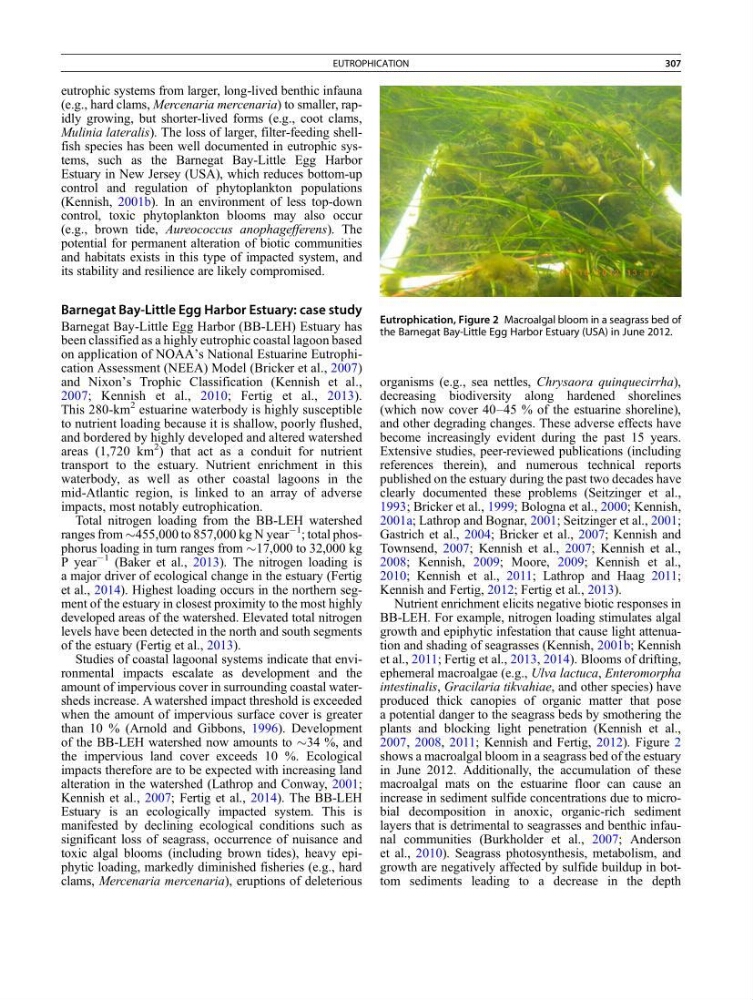
2007, 2008, 2011; Kennish and Fertig, 2012). Figure 2
shows a macroalgal bloom in a seagrass bed of the estuary
in June 2012. Additionally, the accumulation of these
macroalgal mats on the estuarine floor can cause an
increase in sediment sulfide concentrations due to microbial decomposition in anoxic, organic-rich sediment
layers that is detrimental to seagrasses and benthic infaunal communities (Burkholder et al., 2007; Anderson
et al., 2010). Seagrass photosynthesis, metabolism, and
growth are negatively affected by sulfide buildup in bottom sediments leading to a decrease in the depth
Eutrophication, Figure 2 Macroalgal bloom in a seagrass bed of
the Barnegat Bay-Little Egg Harbor Estuary (USA) in June 2012.
EUTROPHICATION
307
(e.g., hard clams, Mercenaria mercenaria) to smaller, rapidly growing, but shorter-lived forms (e.g., coot clams,
Mulinia lateralis). The loss of larger, filter-feeding shellfish species has been well documented in eutrophic systems, such as the Barnegat Bay-Little Egg Harbor
Estuary in New Jersey (USA), which reduces bottom-up
control and regulation of phytoplankton populations
(Kennish, 2001b). In an environment of less top-down
control, toxic phytoplankton blooms may also occur
(e.g., brown tide, Aureococcus anophagefferens). The
potential for permanent alteration of biotic communities
and habitats exists in this type of impacted system, and
its stability and resilience are likely compromised.
Barnegat Bay-Little Egg Harbor Estuary: case study
Barnegat Bay-Little Egg Harbor (BB-LEH) Estuary has
been classified as a highly eutrophic coastal lagoon based
on application of NOAA’s National Estuarine Eutrophication Assessment (NEEA) Model (Bricker et al., 2007)
and Nixon’s Trophic Classification (Kennish et al.,
2007; Kennish et al., 2010; Fertig et al., 2013).
This 280-km
2 estuarine waterbody is highly susceptible
to nutrient loading because it is shallow, poorly flushed,
and bordered by highly developed and altered watershed
areas (1,720 km
2 ) that act as a conduit for nutrient
transport to the estuary. Nutrient enrichment in this
waterbody, as well as other coastal lagoons in the
mid-Atlantic region, is linked to an array of adverse
impacts, most notably eutrophication.
Total nitrogen loading from the BB-LEH watershed
ranges from $455,000 to 857,000 kg N year
À1
; total phosphorus loading in turn ranges from $17,000 to 32,000 kg
P year
À1 (Baker et al., 2013). The nitrogen loading is
a major driver of ecological change in the estuary (Fertig
et al., 2014). Highest loading occurs in the northern segment of the estuary in closest proximity to the most highly
developed areas of the watershed. Elevated total nitrogen
levels have been detected in the north and south segments
of the estuary (Fertig et al., 2013).
Studies of coastal lagoonal systems indicate that environmental impacts escalate as development and the
amount of impervious cover in surrounding coastal watersheds increase. A watershed impact threshold is exceeded
when the amount of impervious surface cover is greater
than 10 % (Arnold and Gibbons, 1996). Development
of the BB-LEH watershed now amounts to $34 %, and
the impervious land cover exceeds 10 %. Ecological
impacts therefore are to be expected with increasing land
alteration in the watershed (Lathrop and Conway, 2001;
Kennish et al., 2007; Fertig et al., 2014). The BB-LEH
Estuary is an ecologically impacted system. This is
manifested by declining ecological conditions such as
significant loss of seagrass, occurrence of nuisance and
toxic algal blooms (including brown tides), heavy epiphytic loading, markedly diminished fisheries (e.g., hard
clams, Mercenaria mercenaria), eruptions of deleterious
organisms (e.g., sea nettles, Chrysaora quinquecirrha),
decreasing biodiversity along hardened shorelines
(which now cover 40–45 % of the estuarine shoreline),
and other degrading changes. These adverse effects have
become increasingly evident during the past 15 years.
Extensive studies, peer-reviewed publications (including
references therein), and numerous technical reports
published on the estuary during the past two decades have
clearly documented these problems (Seitzinger et al.,
1993; Bricker et al., 1999; Bologna et al., 2000; Kennish,
2001a; Lathrop and Bognar, 2001; Seitzinger et al., 2001;
Gastrich et al., 2004; Bricker et al., 2007; Kennish and
Townsend, 2007; Kennish et al., 2007; Kennish et al.,
2008; Kennish, 2009; Moore, 2009; Kennish et al.,
2010; Kennish et al., 2011; Lathrop and Haag 2011;
Kennish and Fertig, 2012; Fertig et al., 2013).
Nutrient enrichment elicits negative biotic responses in
BB-LEH. For example, nitrogen loading stimulates algal
growth and epiphytic infestation that cause light attenuation and shading of seagrasses (Kennish, 2001b; Kennish
et al., 2011; Fertig et al., 2013, 2014). Blooms of drifting,
ephemeral macroalgae (e.g., Ulva lactuca, Enteromorpha
intestinalis, Gracilaria tikvahiae, and other species) have
produced thick canopies of organic matter that pose
a potential danger to the seagrass beds by smothering the
plants and blocking light penetration (Kennish et al.,
2007, 2008, 2011; Kennish and Fertig, 2012). Figure 2
shows a macroalgal bloom in a seagrass bed of the estuary
in June 2012. Additionally, the accumulation of these
macroalgal mats on the estuarine floor can cause an
increase in sediment sulfide concentrations due to microbial decomposition in anoxic, organic-rich sediment
layers that is detrimental to seagrasses and benthic infaunal communities (Burkholder et al., 2007; Anderson
et al., 2010). Seagrass photosynthesis, metabolism, and
growth are negatively affected by sulfide buildup in bottom sediments leading to a decrease in the depth
Eutrophication, Figure 2 Macroalgal bloom in a seagrass bed of
the Barnegat Bay-Little Egg Harbor Estuary (USA) in June 2012.
EUTROPHICATION
307