

the estuary, they undergo microbial decomposition which
uses up oxygen, causing stress and loss of living
resources.
Dramatic increases in nutrient enrichment of coastal
waters have occurred over the past several decades driven
by anthropogenic activities (Kennish, 1992; Kennish,
1997; Kennish, 2001a; Kennish, 2002; Kennish and de
Jonge, 2011). Howarth et al. (2002), for example, showed
that the amount of dissolved inorganic nitrogen
transported from rivers to coastal ocean waters nearly doubled between 1961 (3.0 Tg-N year
À1
) and 1997 (5.0
Tg-N year
À1
), reflecting increased fertilizer use, fossil fuel
combustion, and nitrogen fixation in agricultural systems
(see Galloway et al., 2002). Howarth et al. (1995) also
revealed that phosphorus loads through the river-estuaryocean continuum have increased markedly from historic
levels of $8 Â 10
6 mt (metric tons) year
À1 to $22 Â
10
6 mt year
À1
.
While nitrogen is generally regarded as the primary
nutrient of concern in eutrophic estuaries, phosphorus
must also be considered because it can contribute significantly to eutrophication and may be the principal control
of primary production in some estuaries. Hence, nutrient
pollution abatement should focus on reduction of both
nitrogen and phosphorus loading to estuarine waters
(Conley et al., 2009).
Hypoxia (low dissolved oxygen in the water, <2 mg l
À1 )
and anoxia (dissolved oxygen concentrations ¼ 0 mg l
À1
)
of estuarine and coastal marine environments are
increasing with escalating nutrient enrichment (Diaz and
Rosenberg, 1995; Kennish, 2002; Diaz and Rosenberg,
2008; Kennish and Paerl, 2010). Increasing nutrient inputs
to these environments leads to greater organic matter production, biomass accumulation in bottom sediments,
higher biochemical oxygen demands, and accelerated
microbial decomposition of the accumulated detrital biomass which depletes oxygen concentrations, with adverse
effects resonating through higher trophic levels. This process is evident in some highly stratified water columns
such as Chesapeake Bay, which has a long history of seasonal declines in deepwater dissolved oxygen concentrations (Boynton and Kemp, 2000). Other examples are
the northwestern shelf of the Black Sea, the large coastal
areas of the Baltic Sea with expansive hypoxic zones,
and the Louisiana inner shelf in the northern Gulf of
Mexico (USA) (Rabalais et al., 2007; Kennish
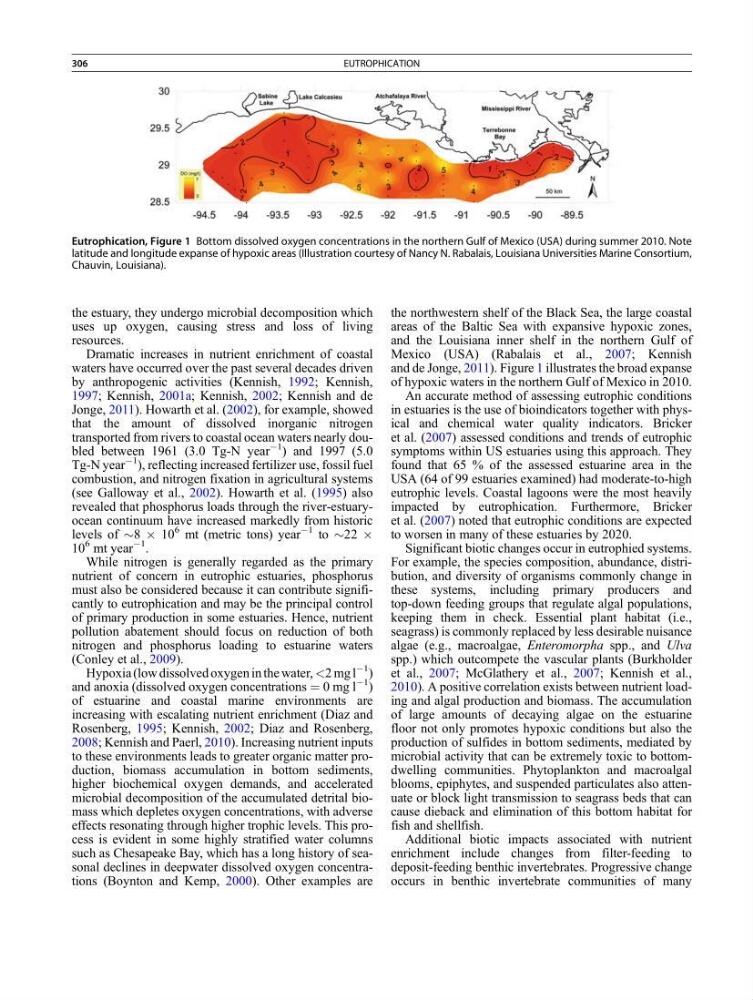
and de Jonge, 2011). Figure 1 illustrates the broad expanse
of hypoxic waters in the northern Gulf of Mexico in 2010.
An accurate method of assessing eutrophic conditions
in estuaries is the use of bioindicators together with physical and chemical water quality indicators. Bricker
et al. (2007) assessed conditions and trends of eutrophic
symptoms within US estuaries using this approach. They
found that 65 % of the assessed estuarine area in the
USA (64 of 99 estuaries examined) had moderate-to-high
eutrophic levels. Coastal lagoons were the most heavily
impacted by eutrophication. Furthermore, Bricker
et al. (2007) noted that eutrophic conditions are expected
to worsen in many of these estuaries by 2020.
Significant biotic changes occur in eutrophied systems.
For example, the species composition, abundance, distribution, and diversity of organisms commonly change in
these systems, including primary producers and
top-down feeding groups that regulate algal populations,
keeping them in check. Essential plant habitat (i.e.,
seagrass) is commonly replaced by less desirable nuisance
algae (e.g., macroalgae, Enteromorpha spp., and Ulva
spp.) which outcompete the vascular plants (Burkholder
et al., 2007; McGlathery et al., 2007; Kennish et al.,
2010). A positive correlation exists between nutrient loading and algal production and biomass. The accumulation
of large amounts of decaying algae on the estuarine
floor not only promotes hypoxic conditions but also the
production of sulfides in bottom sediments, mediated by
microbial activity that can be extremely toxic to bottomdwelling communities. Phytoplankton and macroalgal
blooms, epiphytes, and suspended particulates also attenuate or block light transmission to seagrass beds that can
cause dieback and elimination of this bottom habitat for
fish and shellfish.
Additional biotic impacts associated with nutrient
enrichment include changes from filter-feeding to
deposit-feeding benthic invertebrates. Progressive change
occurs in benthic invertebrate communities of many
Eutrophication, Figure 1 Bottom dissolved oxygen concentrations in the northern Gulf of Mexico (USA) during summer 2010. Note
latitude and longitude expanse of hypoxic areas (Illustration courtesy of Nancy N. Rabalais, Louisiana Universities Marine Consortium,
Chauvin, Louisiana).
306
EUTROPHICATION
uses up oxygen, causing stress and loss of living
resources.
Dramatic increases in nutrient enrichment of coastal
waters have occurred over the past several decades driven
by anthropogenic activities (Kennish, 1992; Kennish,
1997; Kennish, 2001a; Kennish, 2002; Kennish and de
Jonge, 2011). Howarth et al. (2002), for example, showed
that the amount of dissolved inorganic nitrogen
transported from rivers to coastal ocean waters nearly doubled between 1961 (3.0 Tg-N year
À1
) and 1997 (5.0
Tg-N year
À1
), reflecting increased fertilizer use, fossil fuel
combustion, and nitrogen fixation in agricultural systems
(see Galloway et al., 2002). Howarth et al. (1995) also
revealed that phosphorus loads through the river-estuaryocean continuum have increased markedly from historic
levels of $8 Â 10
6 mt (metric tons) year
À1 to $22 Â
10
6 mt year
À1
.
While nitrogen is generally regarded as the primary
nutrient of concern in eutrophic estuaries, phosphorus
must also be considered because it can contribute significantly to eutrophication and may be the principal control
of primary production in some estuaries. Hence, nutrient
pollution abatement should focus on reduction of both
nitrogen and phosphorus loading to estuarine waters
(Conley et al., 2009).
Hypoxia (low dissolved oxygen in the water, <2 mg l
À1 )
and anoxia (dissolved oxygen concentrations ¼ 0 mg l
À1
)
of estuarine and coastal marine environments are
increasing with escalating nutrient enrichment (Diaz and
Rosenberg, 1995; Kennish, 2002; Diaz and Rosenberg,
2008; Kennish and Paerl, 2010). Increasing nutrient inputs
to these environments leads to greater organic matter production, biomass accumulation in bottom sediments,
higher biochemical oxygen demands, and accelerated
microbial decomposition of the accumulated detrital biomass which depletes oxygen concentrations, with adverse
effects resonating through higher trophic levels. This process is evident in some highly stratified water columns
such as Chesapeake Bay, which has a long history of seasonal declines in deepwater dissolved oxygen concentrations (Boynton and Kemp, 2000). Other examples are
the northwestern shelf of the Black Sea, the large coastal
areas of the Baltic Sea with expansive hypoxic zones,
and the Louisiana inner shelf in the northern Gulf of
Mexico (USA) (Rabalais et al., 2007; Kennish
and de Jonge, 2011). Figure 1 illustrates the broad expanse
of hypoxic waters in the northern Gulf of Mexico in 2010.
An accurate method of assessing eutrophic conditions
in estuaries is the use of bioindicators together with physical and chemical water quality indicators. Bricker
et al. (2007) assessed conditions and trends of eutrophic
symptoms within US estuaries using this approach. They
found that 65 % of the assessed estuarine area in the
USA (64 of 99 estuaries examined) had moderate-to-high
eutrophic levels. Coastal lagoons were the most heavily
impacted by eutrophication. Furthermore, Bricker
et al. (2007) noted that eutrophic conditions are expected
to worsen in many of these estuaries by 2020.
Significant biotic changes occur in eutrophied systems.
For example, the species composition, abundance, distribution, and diversity of organisms commonly change in
these systems, including primary producers and
top-down feeding groups that regulate algal populations,
keeping them in check. Essential plant habitat (i.e.,
seagrass) is commonly replaced by less desirable nuisance
algae (e.g., macroalgae, Enteromorpha spp., and Ulva
spp.) which outcompete the vascular plants (Burkholder
et al., 2007; McGlathery et al., 2007; Kennish et al.,
2010). A positive correlation exists between nutrient loading and algal production and biomass. The accumulation
of large amounts of decaying algae on the estuarine
floor not only promotes hypoxic conditions but also the
production of sulfides in bottom sediments, mediated by
microbial activity that can be extremely toxic to bottomdwelling communities. Phytoplankton and macroalgal
blooms, epiphytes, and suspended particulates also attenuate or block light transmission to seagrass beds that can
cause dieback and elimination of this bottom habitat for
fish and shellfish.
Additional biotic impacts associated with nutrient
enrichment include changes from filter-feeding to
deposit-feeding benthic invertebrates. Progressive change
occurs in benthic invertebrate communities of many
Eutrophication, Figure 1 Bottom dissolved oxygen concentrations in the northern Gulf of Mexico (USA) during summer 2010. Note
latitude and longitude expanse of hypoxic areas (Illustration courtesy of Nancy N. Rabalais, Louisiana Universities Marine Consortium,
Chauvin, Louisiana).
306
EUTROPHICATION