

sea-level fall at the end of the development, generating a
forced-regression deposit. The other significant feature of
many fjord infills is the frequent occurrence of gravitycontrolled deposits, due to the influence of rapid isostatic
rebound during and after the deglaciation (Hjelstuen et al.,
2013). In general terms, three main depositional units are
distinguished in fjord infills (Corner, 2006):
1. Deglacial transgressive systems tract, formed by
retrogradational transgressive infilling during deglaciation. The infilling is primarily derived of glacial meltwater from the retreating glacier.
2. Deglacial highstand systems tract, formed by
progradational infill at the head of the fjord during
short-lived highstand conditions at the end of the
glaciar retreat.
3. Postglacial forced regressive systems tract, formed by
aggradational and progradational fluvio-deltaic
infilling led by relative sea-level fall and accompanied
by emergence.
Controlling factors
The simple facies and stratigraphic models described
above cannot cover all the causal factors observed in
nature. The factors that control the development of estuarine stratigraphic features, including different methods of
formation and preservation of sediment bodies and stratigraphic surfaces, are the following:
1. Bedrock valley morphology. The shape of the valley
may influence its subsequent transformation into an
estuarine system and the different development of
depositional systems (Dalrymple et al., 1992; Boyd
et al., 2006). The existence of irregularities caused by
sedimentary or tectonic processes may favor the development of wave-dominated estuaries (Dalrymple,
2006). In contrast, funnel-shaped valleys with a high
length-width ratio tend to develop tide-dominated estuaries, as they favor the generation of hypersynchronous
estuaries (Tessier, 2012). Additionally, the depth of the
incision controls the preservation potential of infilling
deposits, particularly of the lowermost such as LSTs
and/or TSTs (Chaumillon et al., 2010).
2. Interrelation between hydrodynamic processes. Estuarine facies distribution and deposit architecture of the
two end-member states (wave versus tide dominance)
are variable according to the relative importance of
waves and tidal and fluvial currents (Dalrymple et al.,
1992). For example, tidal accommodation controlled
by tidal range and depth of tidal ravinement surface is
a major control on the preservation of estuarine
deposits in tide and mixed settings (Chaumillon et al.,
2010; Tessier, 2012). In wave-dominated estuaries,
wave activity is a major factor that controls barrier
growth (Chaumillon et al., 2010).
3. Sea-level fluctuations. The relative sea-level patterns
govern the overall stratigraphic change observed in
most estuaries from transgressive to regressive conditions, related to a significant decrease of relative
sea-level rise. The inundation of the fluvial valley
during sea-level rise may lead to a tidal resonance
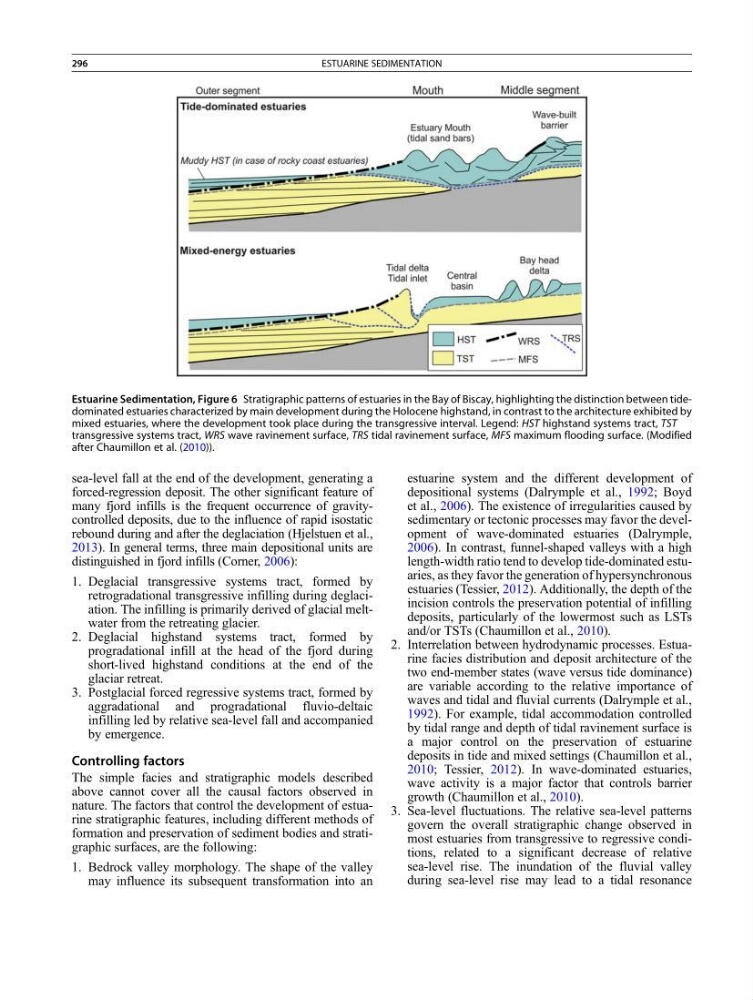
Estuarine Sedimentation, Figure 6 Stratigraphic patterns of estuaries in the Bay of Biscay, highlighting the distinction between tidedominated estuaries characterized by main development during the Holocene highstand, in contrast to the architecture exhibited by
mixed estuaries, where the development took place during the transgressive interval. Legend: HST highstand systems tract, TST
transgressive systems tract, WRS wave ravinement surface, TRS tidal ravinement surface, MFS maximum flooding surface. (Modified
after Chaumillon et al. (2010)).
296
ESTUARINE SEDIMENTATION
forced-regression deposit. The other significant feature of
many fjord infills is the frequent occurrence of gravitycontrolled deposits, due to the influence of rapid isostatic
rebound during and after the deglaciation (Hjelstuen et al.,
2013). In general terms, three main depositional units are
distinguished in fjord infills (Corner, 2006):
1. Deglacial transgressive systems tract, formed by
retrogradational transgressive infilling during deglaciation. The infilling is primarily derived of glacial meltwater from the retreating glacier.
2. Deglacial highstand systems tract, formed by
progradational infill at the head of the fjord during
short-lived highstand conditions at the end of the
glaciar retreat.
3. Postglacial forced regressive systems tract, formed by
aggradational and progradational fluvio-deltaic
infilling led by relative sea-level fall and accompanied
by emergence.
Controlling factors
The simple facies and stratigraphic models described
above cannot cover all the causal factors observed in
nature. The factors that control the development of estuarine stratigraphic features, including different methods of
formation and preservation of sediment bodies and stratigraphic surfaces, are the following:
1. Bedrock valley morphology. The shape of the valley
may influence its subsequent transformation into an
estuarine system and the different development of
depositional systems (Dalrymple et al., 1992; Boyd
et al., 2006). The existence of irregularities caused by
sedimentary or tectonic processes may favor the development of wave-dominated estuaries (Dalrymple,
2006). In contrast, funnel-shaped valleys with a high
length-width ratio tend to develop tide-dominated estuaries, as they favor the generation of hypersynchronous
estuaries (Tessier, 2012). Additionally, the depth of the
incision controls the preservation potential of infilling
deposits, particularly of the lowermost such as LSTs
and/or TSTs (Chaumillon et al., 2010).
2. Interrelation between hydrodynamic processes. Estuarine facies distribution and deposit architecture of the
two end-member states (wave versus tide dominance)
are variable according to the relative importance of
waves and tidal and fluvial currents (Dalrymple et al.,
1992). For example, tidal accommodation controlled
by tidal range and depth of tidal ravinement surface is
a major control on the preservation of estuarine
deposits in tide and mixed settings (Chaumillon et al.,
2010; Tessier, 2012). In wave-dominated estuaries,
wave activity is a major factor that controls barrier
growth (Chaumillon et al., 2010).
3. Sea-level fluctuations. The relative sea-level patterns
govern the overall stratigraphic change observed in
most estuaries from transgressive to regressive conditions, related to a significant decrease of relative
sea-level rise. The inundation of the fluvial valley
during sea-level rise may lead to a tidal resonance
Estuarine Sedimentation, Figure 6 Stratigraphic patterns of estuaries in the Bay of Biscay, highlighting the distinction between tidedominated estuaries characterized by main development during the Holocene highstand, in contrast to the architecture exhibited by
mixed estuaries, where the development took place during the transgressive interval. Legend: HST highstand systems tract, TST
transgressive systems tract, WRS wave ravinement surface, TRS tidal ravinement surface, MFS maximum flooding surface. (Modified
after Chaumillon et al. (2010)).
296
ESTUARINE SEDIMENTATION