

estuarine flooding. In other cases, tide-dominated facies
generated during the highstand interval laterally evolve
to wave-built coastal barriers (Tessier, 2012); this lateral
change is related to the lower incision which leads to less
active tidal dynamics, favoring wave activity (Tessier
et al., 2012). In addition, tide-dominated estuaries generally show a dominance of sandy over muddy facies, due
to tidal activity in the estuary (Chaumillon et al., 2010).
Rias and rocky coast estuaries
These types of estuaries display a dominant control of
bedrock morphology during the entire infilling of the
estuarine system (Chaumillon et al., 2010). Due to their
deep valleys, rias are prone to record compound infills,
containing sequences prior to the LGM and multiple
postglacial transgressive deposits, as in the case of the
Ría de Vigo in the Galizian Margin (García-García et al.,
2005).
Fjords
Fjord sediment infills also have an overall transgressiveregressive architecture. However, as a major difference
to lower-latitude estuaries, the infill of fjords is primarily
affected by isostatic uplift processes, causing a relative
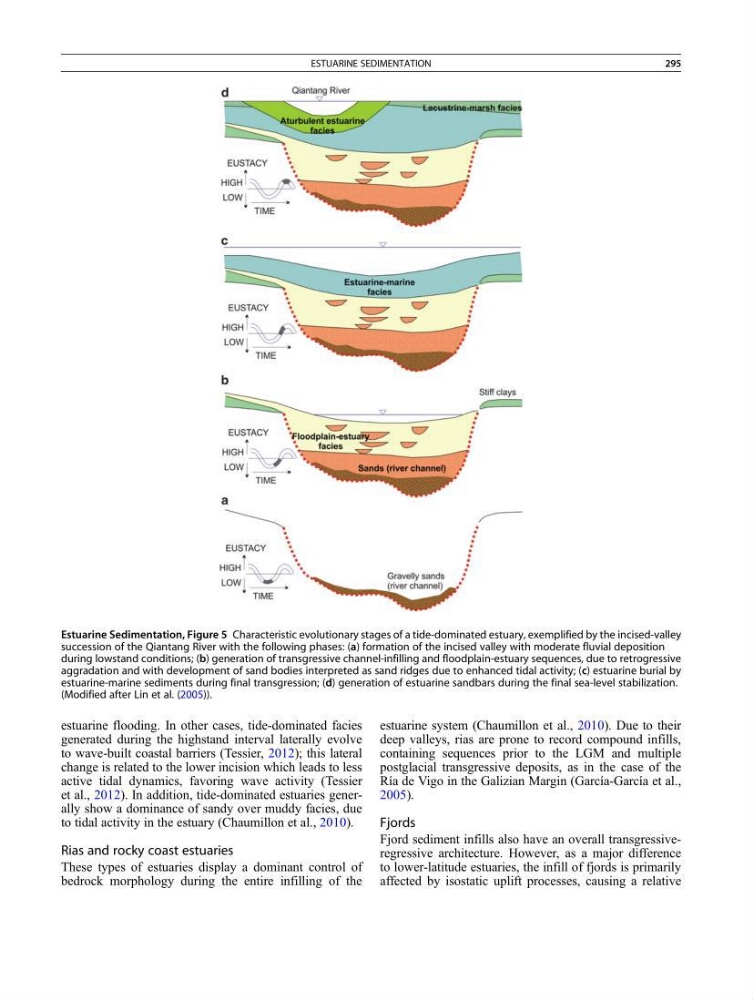
Estuarine Sedimentation, Figure 5 Characteristic evolutionary stages of a tide-dominated estuary, exemplified by the incised-valley
succession of the Qiantang River with the following phases: (a) formation of the incised valley with moderate fluvial deposition
during lowstand conditions; (b) generation of transgressive channel-infilling and floodplain-estuary sequences, due to retrogressive
aggradation and with development of sand bodies interpreted as sand ridges due to enhanced tidal activity; (c) estuarine burial by
estuarine-marine sediments during final transgression; (d) generation of estuarine sandbars during the final sea-level stabilization.
(Modified after Lin et al. (2005)).
ESTUARINE SEDIMENTATION
295
generated during the highstand interval laterally evolve
to wave-built coastal barriers (Tessier, 2012); this lateral
change is related to the lower incision which leads to less
active tidal dynamics, favoring wave activity (Tessier
et al., 2012). In addition, tide-dominated estuaries generally show a dominance of sandy over muddy facies, due
to tidal activity in the estuary (Chaumillon et al., 2010).
Rias and rocky coast estuaries
These types of estuaries display a dominant control of
bedrock morphology during the entire infilling of the
estuarine system (Chaumillon et al., 2010). Due to their
deep valleys, rias are prone to record compound infills,
containing sequences prior to the LGM and multiple
postglacial transgressive deposits, as in the case of the
Ría de Vigo in the Galizian Margin (García-García et al.,
2005).
Fjords
Fjord sediment infills also have an overall transgressiveregressive architecture. However, as a major difference
to lower-latitude estuaries, the infill of fjords is primarily
affected by isostatic uplift processes, causing a relative
Estuarine Sedimentation, Figure 5 Characteristic evolutionary stages of a tide-dominated estuary, exemplified by the incised-valley
succession of the Qiantang River with the following phases: (a) formation of the incised valley with moderate fluvial deposition
during lowstand conditions; (b) generation of transgressive channel-infilling and floodplain-estuary sequences, due to retrogressive
aggradation and with development of sand bodies interpreted as sand ridges due to enhanced tidal activity; (c) estuarine burial by
estuarine-marine sediments during final transgression; (d) generation of estuarine sandbars during the final sea-level stabilization.
(Modified after Lin et al. (2005)).
ESTUARINE SEDIMENTATION
295