

characterized by the occurrence of the marine sand body
(Figure 3), whose degree of preservation depends on the
transgressive-progradational nature of the estuary
(Dalrymple et al., 1992). A high sediment input and limited activity of the tidal inlet diastem would favor
a significant generation and/or preservation of the marine
sand body (Nichol et al., 1994), whose development takes
place preferentially during the transgressive interval; thus,
most of the estuarine mouth barrier is usually a component
of the TST. The generation of a wave-dominated sediment
body at the estuary mouth favors the accumulation of
back-barrier muds (or central basin facies) or tidalestuarine sands and muds in the case of mixed estuaries
(Allen and Posamentier, 1993). These back-barrier
deposits rest directly over the TS, which marks the transition to previous coarse-grained facies (bayhead deltas
and/or fluvial facies), and evolve laterally to tidal flats
and marshes.
The transgressive stratigraphic pattern records the
change from central basin/estuarine sand and muds and
lateral tidal flat/marsh deposits to fully marine conditions
that are marked by the TRS (Allen and Posamentier,
1993) (Figure 3). This usually diachronous surface
implies tidal channel formation and associated sediment
removal that tends to be concentrated in the seaward portion of the estuary in the case of wave-dominated estuaries
(Vis and Kasse, 2009), but may be more extensive in the
case of mixed estuaries (Allen and Posamentier, 1993).
In some cases, the marine sand and the TRS may extend
significantly upstream in the estuarine environment, indicating hypersynchronous tidal characteristics (Lessa
et al., 1998). The WRS has also been documented
in wave-dominated or mixed systems, displaying a
sharp contact of nearshore marine sands (Allen and
Posamentier, 1993).
The development of a bayhead delta by the head of
the progradational estuary (Dalrymple et al., 1992) tends
to be fostered during highstand conditions (Allen and
Posamentier, 1993), particularly under circumstances of
enhanced fluvial supply and/or reduced wave activity
(by sheltering). Bayhead deltas may coexist with distributary mouth bars, a seaward-migrating channel diastem and
distal prodelta deposits that further contribute to the growth
of the central basin facies (Nichol et al., 1994; Vis and
Kasse, 2009). The development of central basin during
highstand conditions implies that the MFS would presumably lie within these facies (Lessa et al., 1998). In mixed
estuarine environments, tidal bars may also be developed
in the middle estuarine sector during highstand conditions,
prograding over previously deposited estuary-mouth sands
(Allen and Posamentier, 1993; Tang et al., 2010).
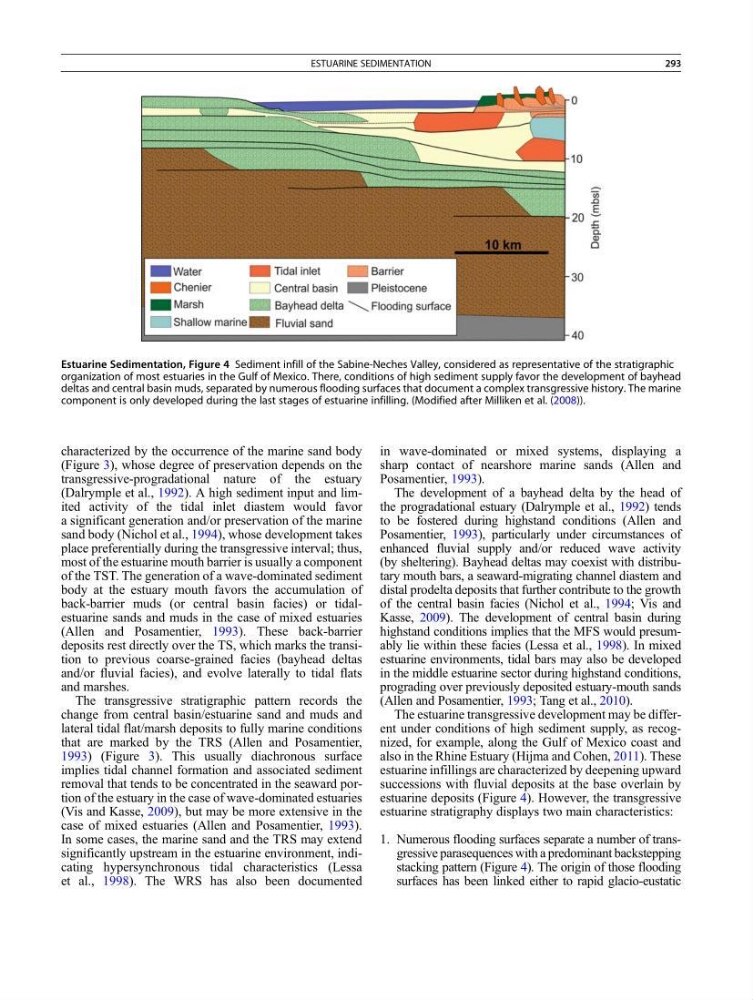
The estuarine transgressive development may be different under conditions of high sediment supply, as recognized, for example, along the Gulf of Mexico coast and
also in the Rhine Estuary (Hijma and Cohen, 2011). These
estuarine infillings are characterized by deepening upward
successions with fluvial deposits at the base overlain by
estuarine deposits (Figure 4). However, the transgressive
estuarine stratigraphy displays two main characteristics:
1. Numerous flooding surfaces separate a number of transgressive parasequences with a predominant backstepping
stacking pattern (Figure 4). The origin of those flooding
surfaces has been linked either to rapid glacio-eustatic
Estuarine Sedimentation, Figure 4 Sediment infill of the Sabine-Neches Valley, considered as representative of the stratigraphic
organization of most estuaries in the Gulf of Mexico. There, conditions of high sediment supply favor the development of bayhead
deltas and central basin muds, separated by numerous flooding surfaces that document a complex transgressive history. The marine
component is only developed during the last stages of estuarine infilling. (Modified after Milliken et al. (2008)).
ESTUARINE SEDIMENTATION
293
(Figure 3), whose degree of preservation depends on the
transgressive-progradational nature of the estuary
(Dalrymple et al., 1992). A high sediment input and limited activity of the tidal inlet diastem would favor
a significant generation and/or preservation of the marine
sand body (Nichol et al., 1994), whose development takes
place preferentially during the transgressive interval; thus,
most of the estuarine mouth barrier is usually a component
of the TST. The generation of a wave-dominated sediment
body at the estuary mouth favors the accumulation of
back-barrier muds (or central basin facies) or tidalestuarine sands and muds in the case of mixed estuaries
(Allen and Posamentier, 1993). These back-barrier
deposits rest directly over the TS, which marks the transition to previous coarse-grained facies (bayhead deltas
and/or fluvial facies), and evolve laterally to tidal flats
and marshes.
The transgressive stratigraphic pattern records the
change from central basin/estuarine sand and muds and
lateral tidal flat/marsh deposits to fully marine conditions
that are marked by the TRS (Allen and Posamentier,
1993) (Figure 3). This usually diachronous surface
implies tidal channel formation and associated sediment
removal that tends to be concentrated in the seaward portion of the estuary in the case of wave-dominated estuaries
(Vis and Kasse, 2009), but may be more extensive in the
case of mixed estuaries (Allen and Posamentier, 1993).
In some cases, the marine sand and the TRS may extend
significantly upstream in the estuarine environment, indicating hypersynchronous tidal characteristics (Lessa
et al., 1998). The WRS has also been documented
in wave-dominated or mixed systems, displaying a
sharp contact of nearshore marine sands (Allen and
Posamentier, 1993).
The development of a bayhead delta by the head of
the progradational estuary (Dalrymple et al., 1992) tends
to be fostered during highstand conditions (Allen and
Posamentier, 1993), particularly under circumstances of
enhanced fluvial supply and/or reduced wave activity
(by sheltering). Bayhead deltas may coexist with distributary mouth bars, a seaward-migrating channel diastem and
distal prodelta deposits that further contribute to the growth
of the central basin facies (Nichol et al., 1994; Vis and
Kasse, 2009). The development of central basin during
highstand conditions implies that the MFS would presumably lie within these facies (Lessa et al., 1998). In mixed
estuarine environments, tidal bars may also be developed
in the middle estuarine sector during highstand conditions,
prograding over previously deposited estuary-mouth sands
(Allen and Posamentier, 1993; Tang et al., 2010).
The estuarine transgressive development may be different under conditions of high sediment supply, as recognized, for example, along the Gulf of Mexico coast and
also in the Rhine Estuary (Hijma and Cohen, 2011). These
estuarine infillings are characterized by deepening upward
successions with fluvial deposits at the base overlain by
estuarine deposits (Figure 4). However, the transgressive
estuarine stratigraphy displays two main characteristics:
1. Numerous flooding surfaces separate a number of transgressive parasequences with a predominant backstepping
stacking pattern (Figure 4). The origin of those flooding
surfaces has been linked either to rapid glacio-eustatic
Estuarine Sedimentation, Figure 4 Sediment infill of the Sabine-Neches Valley, considered as representative of the stratigraphic
organization of most estuaries in the Gulf of Mexico. There, conditions of high sediment supply favor the development of bayhead
deltas and central basin muds, separated by numerous flooding surfaces that document a complex transgressive history. The marine
component is only developed during the last stages of estuarine infilling. (Modified after Milliken et al. (2008)).
ESTUARINE SEDIMENTATION
293