

surface (TRS) at the mouth of the estuary that migrates
landward or the bayhead diastem at the head of the estuary
that migrates seaward (Dalrymple et al., 1994; Nichol
et al., 1994). Additionally, a wave ravinement surface
(WRS) may modify the top of estuarine deposits in distal
settings, but this surface is generally out of the estuarine
complex (Zaitlin et al., 1994).
Transgressive deposits may be finally buried by
progradational estuarine deposits generated during the
highstand (Figure 1), with an intervening maximum
flooding surface (MFS) between transgressive and
highstand deposits (Dalrymple et al., 1992). This change
may be induced by a decrease in the rate of sea-level rise
and/or by an increase of sediment supply (Emery and
Myers, 1996), causing the MFS to be diachronous in most
estuarine settings (Chaumillon et al., 2010). The expression of the MFS is variable according to the location along
the estuary in both wave- and tide-dominated examples
(Allen and Posamentier, 1993); most usually, its distinction is based on the recognition of a seaward shift of successive estuarine environments or more generically on
the existence of a downlap pattern generated by
progradation of overlying highstand sediments.
Simple versus compound estuarine infills
The above description of a typical infill of present-day
estuaries refers to a simple situation, when the fill consists
of a single depositional sequence. Alternatively, the fill
can be compound, when it contains multiple sequences
influenced by superimposed sea-level cycles (Dalrymple
et al., 1994). There are several factors that influence the
generation of simple versus compound infills such as rates
of sediment supply, subsidence, and amount of
transgressive/regressive erosion and depth of incision
(Chaumillon et al., 2010). Thus, low values of those variables would tend to favor the generation of simple infills.
Compound estuarine infills preserve lower estuarine
sequences below the most recent sequence boundary typically related to the LGM. These lower sequences tend to
be composed of previous relative highstand deposits
(e.g., genesis during Marine Isotope Stages (MISs)
3 and/or 5), such as barrier systems (Sloss et al., 2006).
Alternatively, the development of lower sequences in estuarine settings may also be led by relative sea-level changes
driven by isostatic rebound processes (Dalrymple and
Zaitlin, 1994).
Wave-dominated estuaries
The development of the tripartite estuarine facies may
occur both during transgressive and highstand stages,
although the outer marine parts seem to be favored during
transgressive conditions, whereas the inner fluvial parts
seem to be favored during highstand conditions
(Chaumillon et al., 2010). Mixed systems show both tidal
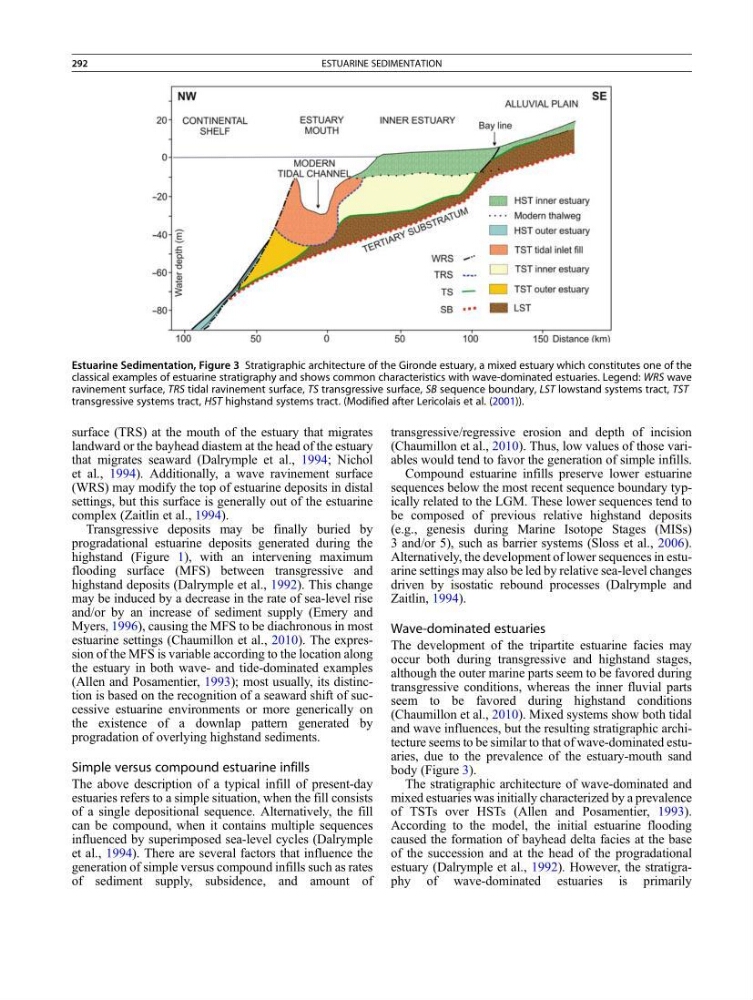
and wave influences, but the resulting stratigraphic architecture seems to be similar to that of wave-dominated estuaries, due to the prevalence of the estuary-mouth sand
body (Figure 3).
The stratigraphic architecture of wave-dominated and
mixed estuaries was initially characterized by a prevalence
of TSTs over HSTs (Allen and Posamentier, 1993).
According to the model, the initial estuarine flooding
caused the formation of bayhead delta facies at the base
of the succession and at the head of the progradational
estuary (Dalrymple et al., 1992). However, the stratigraphy of wave-dominated estuaries is primarily
Estuarine Sedimentation, Figure 3 Stratigraphic architecture of the Gironde estuary, a mixed estuary which constitutes one of the
classical examples of estuarine stratigraphy and shows common characteristics with wave-dominated estuaries. Legend: WRS wave
ravinement surface, TRS tidal ravinement surface, TS transgressive surface, SB sequence boundary, LST lowstand systems tract, TST
transgressive systems tract, HST highstand systems tract. (Modified after Lericolais et al. (2001)).
292
ESTUARINE SEDIMENTATION
landward or the bayhead diastem at the head of the estuary
that migrates seaward (Dalrymple et al., 1994; Nichol
et al., 1994). Additionally, a wave ravinement surface
(WRS) may modify the top of estuarine deposits in distal
settings, but this surface is generally out of the estuarine
complex (Zaitlin et al., 1994).
Transgressive deposits may be finally buried by
progradational estuarine deposits generated during the
highstand (Figure 1), with an intervening maximum
flooding surface (MFS) between transgressive and
highstand deposits (Dalrymple et al., 1992). This change
may be induced by a decrease in the rate of sea-level rise
and/or by an increase of sediment supply (Emery and
Myers, 1996), causing the MFS to be diachronous in most
estuarine settings (Chaumillon et al., 2010). The expression of the MFS is variable according to the location along
the estuary in both wave- and tide-dominated examples
(Allen and Posamentier, 1993); most usually, its distinction is based on the recognition of a seaward shift of successive estuarine environments or more generically on
the existence of a downlap pattern generated by
progradation of overlying highstand sediments.
Simple versus compound estuarine infills
The above description of a typical infill of present-day
estuaries refers to a simple situation, when the fill consists
of a single depositional sequence. Alternatively, the fill
can be compound, when it contains multiple sequences
influenced by superimposed sea-level cycles (Dalrymple
et al., 1994). There are several factors that influence the
generation of simple versus compound infills such as rates
of sediment supply, subsidence, and amount of
transgressive/regressive erosion and depth of incision
(Chaumillon et al., 2010). Thus, low values of those variables would tend to favor the generation of simple infills.
Compound estuarine infills preserve lower estuarine
sequences below the most recent sequence boundary typically related to the LGM. These lower sequences tend to
be composed of previous relative highstand deposits
(e.g., genesis during Marine Isotope Stages (MISs)
3 and/or 5), such as barrier systems (Sloss et al., 2006).
Alternatively, the development of lower sequences in estuarine settings may also be led by relative sea-level changes
driven by isostatic rebound processes (Dalrymple and
Zaitlin, 1994).
Wave-dominated estuaries
The development of the tripartite estuarine facies may
occur both during transgressive and highstand stages,
although the outer marine parts seem to be favored during
transgressive conditions, whereas the inner fluvial parts
seem to be favored during highstand conditions
(Chaumillon et al., 2010). Mixed systems show both tidal
and wave influences, but the resulting stratigraphic architecture seems to be similar to that of wave-dominated estuaries, due to the prevalence of the estuary-mouth sand
body (Figure 3).
The stratigraphic architecture of wave-dominated and
mixed estuaries was initially characterized by a prevalence
of TSTs over HSTs (Allen and Posamentier, 1993).
According to the model, the initial estuarine flooding
caused the formation of bayhead delta facies at the base
of the succession and at the head of the progradational
estuary (Dalrymple et al., 1992). However, the stratigraphy of wave-dominated estuaries is primarily
Estuarine Sedimentation, Figure 3 Stratigraphic architecture of the Gironde estuary, a mixed estuary which constitutes one of the
classical examples of estuarine stratigraphy and shows common characteristics with wave-dominated estuaries. Legend: WRS wave
ravinement surface, TRS tidal ravinement surface, TS transgressive surface, SB sequence boundary, LST lowstand systems tract, TST
transgressive systems tract, HST highstand systems tract. (Modified after Lericolais et al. (2001)).
292
ESTUARINE SEDIMENTATION