

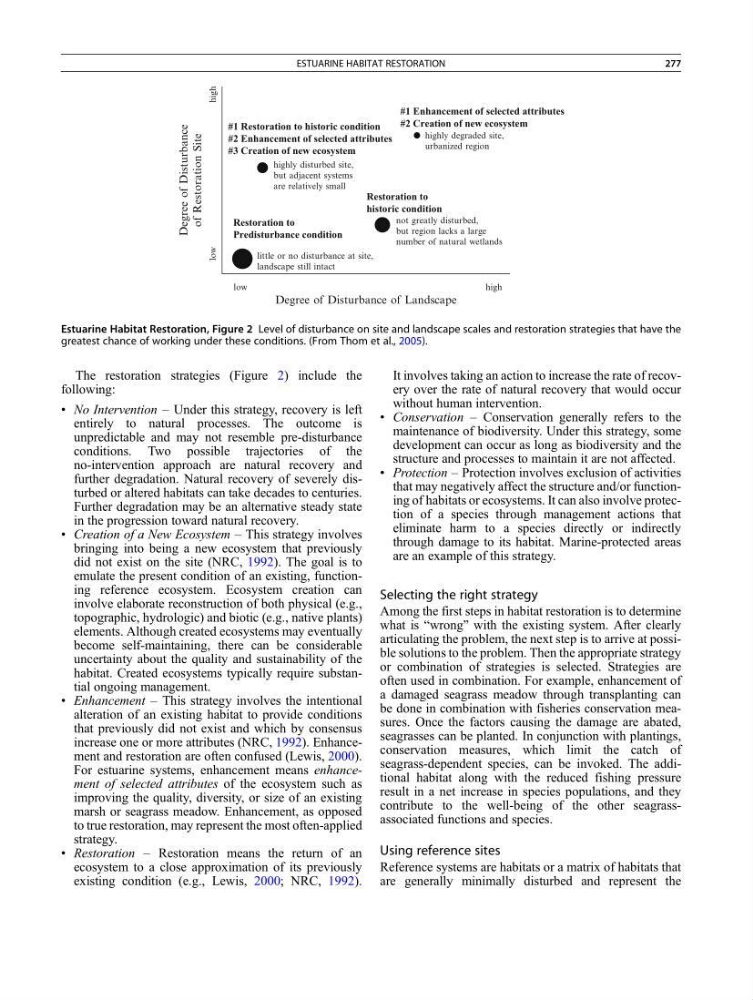
The restoration strategies (Figure 2) include the
following:
• No Intervention – Under this strategy, recovery is left
entirely to natural processes. The outcome is
unpredictable and may not resemble pre-disturbance
conditions. Two possible trajectories of the
no-intervention approach are natural recovery and
further degradation. Natural recovery of severely disturbed or altered habitats can take decades to centuries.
Further degradation may be an alternative steady state
in the progression toward natural recovery.
• Creation of a New Ecosystem – This strategy involves
bringing into being a new ecosystem that previously
did not exist on the site (NRC, 1992). The goal is to
emulate the present condition of an existing, functioning reference ecosystem. Ecosystem creation can
involve elaborate reconstruction of both physical (e.g.,
topographic, hydrologic) and biotic (e.g., native plants)
elements. Although created ecosystems may eventually
become self-maintaining, there can be considerable
uncertainty about the quality and sustainability of the
habitat. Created ecosystems typically require substantial ongoing management.
• Enhancement – This strategy involves the intentional
alteration of an existing habitat to provide conditions
that previously did not exist and which by consensus
increase one or more attributes (NRC, 1992). Enhancement and restoration are often confused (Lewis, 2000).
For estuarine systems, enhancement means enhancement of selected attributes of the ecosystem such as
improving the quality, diversity, or size of an existing
marsh or seagrass meadow. Enhancement, as opposed
to true restoration, may represent the most often-applied
strategy.
• Restoration – Restoration means the return of an
ecosystem to a close approximation of its previously
existing condition (e.g., Lewis, 2000; NRC, 1992).
It involves taking an action to increase the rate of recovery over the rate of natural recovery that would occur
without human intervention.
• Conservation – Conservation generally refers to the
maintenance of biodiversity. Under this strategy, some
development can occur as long as biodiversity and the
structure and processes to maintain it are not affected.
• Protection – Protection involves exclusion of activities
that may negatively affect the structure and/or functioning of habitats or ecosystems. It can also involve protection of a species through management actions that
eliminate harm to a species directly or indirectly
through damage to its habitat. Marine-protected areas
are an example of this strategy.
Selecting the right strategy
Among the first steps in habitat restoration is to determine
what is “wrong” with the existing system. After clearly
articulating the problem, the next step is to arrive at possible solutions to the problem. Then the appropriate strategy
or combination of strategies is selected. Strategies are
often used in combination. For example, enhancement of
a damaged seagrass meadow through transplanting can
be done in combination with fisheries conservation measures. Once the factors causing the damage are abated,
seagrasses can be planted. In conjunction with plantings,
conservation measures, which limit the catch of
seagrass-dependent species, can be invoked. The additional habitat along with the reduced fishing pressure
result in a net increase in species populations, and they
contribute to the well-being of the other seagrassassociated functions and species.
Using reference sites
Reference systems are habitats or a matrix of habitats that
are generally minimally disturbed and represent the
#1 Restoration to historic condition
#2 Enhancement of selected attributes
#3 Creation of new ecosystem
highly disturbed site,
but adjacent systems
are relatively small
#1 Enhancement of selected attributes
#2 Creation of new ecosystem
highly degraded site,
urbanized region
Restoration to
historic condition
not greatly disturbed,
but region lacks a large
number of natural wetlands
Restoration to
Predisturbance condition
Degree of Disturbance of Landscape
Degree of Disturbance
of Restoration Site
little or no disturbance at site,
landscape still intact
low
low
high
high
Estuarine Habitat Restoration, Figure 2 Level of disturbance on site and landscape scales and restoration strategies that have the
greatest chance of working under these conditions. (From Thom et al., 2005).
ESTUARINE HABITAT RESTORATION
277
following:
• No Intervention – Under this strategy, recovery is left
entirely to natural processes. The outcome is
unpredictable and may not resemble pre-disturbance
conditions. Two possible trajectories of the
no-intervention approach are natural recovery and
further degradation. Natural recovery of severely disturbed or altered habitats can take decades to centuries.
Further degradation may be an alternative steady state
in the progression toward natural recovery.
• Creation of a New Ecosystem – This strategy involves
bringing into being a new ecosystem that previously
did not exist on the site (NRC, 1992). The goal is to
emulate the present condition of an existing, functioning reference ecosystem. Ecosystem creation can
involve elaborate reconstruction of both physical (e.g.,
topographic, hydrologic) and biotic (e.g., native plants)
elements. Although created ecosystems may eventually
become self-maintaining, there can be considerable
uncertainty about the quality and sustainability of the
habitat. Created ecosystems typically require substantial ongoing management.
• Enhancement – This strategy involves the intentional
alteration of an existing habitat to provide conditions
that previously did not exist and which by consensus
increase one or more attributes (NRC, 1992). Enhancement and restoration are often confused (Lewis, 2000).
For estuarine systems, enhancement means enhancement of selected attributes of the ecosystem such as
improving the quality, diversity, or size of an existing
marsh or seagrass meadow. Enhancement, as opposed
to true restoration, may represent the most often-applied
strategy.
• Restoration – Restoration means the return of an
ecosystem to a close approximation of its previously
existing condition (e.g., Lewis, 2000; NRC, 1992).
It involves taking an action to increase the rate of recovery over the rate of natural recovery that would occur
without human intervention.
• Conservation – Conservation generally refers to the
maintenance of biodiversity. Under this strategy, some
development can occur as long as biodiversity and the
structure and processes to maintain it are not affected.
• Protection – Protection involves exclusion of activities
that may negatively affect the structure and/or functioning of habitats or ecosystems. It can also involve protection of a species through management actions that
eliminate harm to a species directly or indirectly
through damage to its habitat. Marine-protected areas
are an example of this strategy.
Selecting the right strategy
Among the first steps in habitat restoration is to determine
what is “wrong” with the existing system. After clearly
articulating the problem, the next step is to arrive at possible solutions to the problem. Then the appropriate strategy
or combination of strategies is selected. Strategies are
often used in combination. For example, enhancement of
a damaged seagrass meadow through transplanting can
be done in combination with fisheries conservation measures. Once the factors causing the damage are abated,
seagrasses can be planted. In conjunction with plantings,
conservation measures, which limit the catch of
seagrass-dependent species, can be invoked. The additional habitat along with the reduced fishing pressure
result in a net increase in species populations, and they
contribute to the well-being of the other seagrassassociated functions and species.
Using reference sites
Reference systems are habitats or a matrix of habitats that
are generally minimally disturbed and represent the
#1 Restoration to historic condition
#2 Enhancement of selected attributes
#3 Creation of new ecosystem
highly disturbed site,
but adjacent systems
are relatively small
#1 Enhancement of selected attributes
#2 Creation of new ecosystem
highly degraded site,
urbanized region
Restoration to
historic condition
not greatly disturbed,
but region lacks a large
number of natural wetlands
Restoration to
Predisturbance condition
Degree of Disturbance of Landscape
Degree of Disturbance
of Restoration Site
little or no disturbance at site,
landscape still intact
low
low
high
high
Estuarine Habitat Restoration, Figure 2 Level of disturbance on site and landscape scales and restoration strategies that have the
greatest chance of working under these conditions. (From Thom et al., 2005).
ESTUARINE HABITAT RESTORATION
277