

of the system is altered from prehistoric conditions and is
not in a desirable state. The structure and functioning of
the system is different than it was prior to hydrologic modification and other changes, and it probably has reached
equilibrium in this altered state. The growing body of
information indicates that the survival of salmon may be
dependent on the return of the estuary to a less altered
state. With regard to salmon that as juveniles use the floodplain habitats, the system now exists in what can be termed
an unacceptable ecosystem condition. Under a restoration
scenario, if the system occupies any set of values that are
within the state identified as desirable ecosystem condition, then it has met the goal. Because of uncertainties
related to natural variability, influences from the surrounding landscape, and low predictive capabilities, we can reliably only get close to the goal (Shreffler and Thom, 1993;
Hobbs and Norton, 1996). Also, in a case where the habitat is not in the desirable state, there should be plausible
explanations. From these explanations, options for actions
to improve conditions can be recommended (Thom, 1997,
2000).
Research on estuarine habitat restoration has focused
chiefly on techniques of species establishment and on
development of community structure (NRC, 1992; Warren
et al., 2002; Moreno-Mateos et al., 2012). The functions of
estuarine habitats, although widely recognized, are seldom evaluated during post-restoration monitoring. The
science of estuarine habitat restoration and creation has
not yet evolved to the point that lost habitat functions
can be predictably replaced (Kusler and Kentula, 1990).
Further, the feasibility of restoring or creating habitats
has been demonstrated, but their functions, stability, and
resiliency are largely unknown (Thayer, 1992). Zedler
and Weller (1990) concluded that “It has not been shown
that restored or constructed wetlands maintain regional
biodiversity and recreate functional ecosystems – there
is some evidence that constructed wetlands can look like
natural ones; there are few data to show they behave like
natural ones.”
Restoration strategies
Restoration of natural systems in general can involve
several strategies (Thom et al., 2005). The application of
these strategies is dictated by which one is the best solution to the problem, the probability that the strategy will
work to produce the desired outcomes, the period of time
to reach desired outcomes, feasibility, and cost, etc.
Returning a habitat to pre-disturbance conditions is difficult in many cases and almost impossible where the habitat and the landscape in which it occurs are both highly
disturbed and altered. Hence, restoring habitat to some
alternative state, referred to as a novel habitat or ecosystem, may be the only feasible outcome (Thom, 1997).
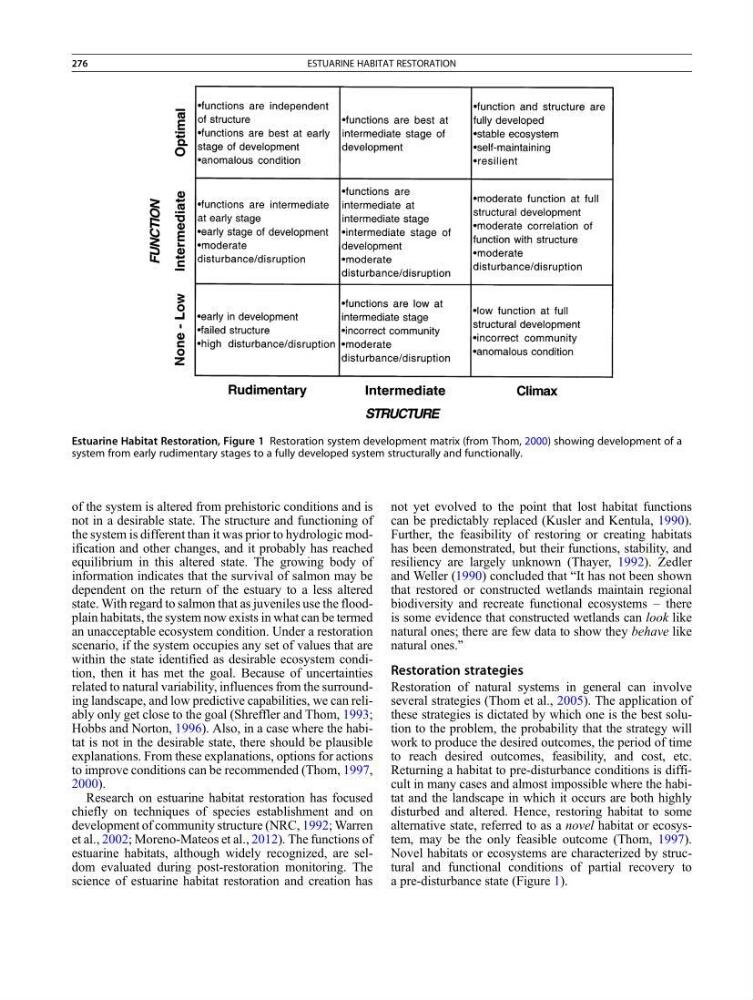
Novel habitats or ecosystems are characterized by structural and functional conditions of partial recovery to
a pre-disturbance state (Figure 1).
Estuarine Habitat Restoration, Figure 1 Restoration system development matrix (from Thom, 2000) showing development of a
system from early rudimentary stages to a fully developed system structurally and functionally.
276
ESTUARINE HABITAT RESTORATION
not in a desirable state. The structure and functioning of
the system is different than it was prior to hydrologic modification and other changes, and it probably has reached
equilibrium in this altered state. The growing body of
information indicates that the survival of salmon may be
dependent on the return of the estuary to a less altered
state. With regard to salmon that as juveniles use the floodplain habitats, the system now exists in what can be termed
an unacceptable ecosystem condition. Under a restoration
scenario, if the system occupies any set of values that are
within the state identified as desirable ecosystem condition, then it has met the goal. Because of uncertainties
related to natural variability, influences from the surrounding landscape, and low predictive capabilities, we can reliably only get close to the goal (Shreffler and Thom, 1993;
Hobbs and Norton, 1996). Also, in a case where the habitat is not in the desirable state, there should be plausible
explanations. From these explanations, options for actions
to improve conditions can be recommended (Thom, 1997,
2000).
Research on estuarine habitat restoration has focused
chiefly on techniques of species establishment and on
development of community structure (NRC, 1992; Warren
et al., 2002; Moreno-Mateos et al., 2012). The functions of
estuarine habitats, although widely recognized, are seldom evaluated during post-restoration monitoring. The
science of estuarine habitat restoration and creation has
not yet evolved to the point that lost habitat functions
can be predictably replaced (Kusler and Kentula, 1990).
Further, the feasibility of restoring or creating habitats
has been demonstrated, but their functions, stability, and
resiliency are largely unknown (Thayer, 1992). Zedler
and Weller (1990) concluded that “It has not been shown
that restored or constructed wetlands maintain regional
biodiversity and recreate functional ecosystems – there
is some evidence that constructed wetlands can look like
natural ones; there are few data to show they behave like
natural ones.”
Restoration strategies
Restoration of natural systems in general can involve
several strategies (Thom et al., 2005). The application of
these strategies is dictated by which one is the best solution to the problem, the probability that the strategy will
work to produce the desired outcomes, the period of time
to reach desired outcomes, feasibility, and cost, etc.
Returning a habitat to pre-disturbance conditions is difficult in many cases and almost impossible where the habitat and the landscape in which it occurs are both highly
disturbed and altered. Hence, restoring habitat to some
alternative state, referred to as a novel habitat or ecosystem, may be the only feasible outcome (Thom, 1997).
Novel habitats or ecosystems are characterized by structural and functional conditions of partial recovery to
a pre-disturbance state (Figure 1).
Estuarine Habitat Restoration, Figure 1 Restoration system development matrix (from Thom, 2000) showing development of a
system from early rudimentary stages to a fully developed system structurally and functionally.
276
ESTUARINE HABITAT RESTORATION