

mean along-channel currents and the associated secondary
circulation for different estuarine types: salt-wedge (types
A or 4), partially mixed (types B or 2), and well mixed
(types C or 1). The dynamic balance of the secondary
flows was established by taking into account the interaction of the following factors: bottom topography and
channel geometry, lateral stratification of density due to
vertical mixing, and gradient pressure forces, Coriolis
acceleration and centrifugal acceleration (Nunes and
Simpson, 1985).
In the bi-dimensional analytical simulation of the
secondary circulation, according to Nunes and Sympson
(op. cit.), the simplifying hypothesis are applied: (1) stationary conditions; (2) lateral density (salinity) stratification
@r
@y ¼ g y
ð Þ, and; (3) straight channel. The solution of
the secondary circulation v ¼ v(y, Z) and its associated
vertical component w ¼ (y, Z) obtained with this model
is exemplified by Miranda et al. (2012).
The importance of the secondary flows and mixing
across a channel as interrelated processes, were recently
discussed in detail by Chant (2010).
Summary
Estuaries were formed in a narrow coastal boundary zone
between the sea and land, during the last interglacial
period. This contribution is intended to present some
aspects of estuarine circulation related to: (1) transitional
environments along the coastline that are ultimately
dependent on estuarine dynamics; and (2) investigations
of the processes that have focused on estuarine preservation, water quality, morphology, biodiversity, and fisheries
which are strongly dependent on the dynamic behavior of
estuaries.
Some focus is given to the pioneer research published
in the last half of the twentieth century. Additionally,
experimental and theoretical developments have recently
been published focusing on the following issues: estuary
definition, classification, mixing processes, variability,
and circulation.
Transitional environments along the coastline are ultimately dependent on the dynamics of estuarine systems;
however, they have been strongly affected by human
activities. Some of them have been protected by reserve
status since the eighteenth century. Human impacts and
their effects on estuaries and coasts are important factors
that need to be assessed.
Bibliography
Andutta, F. P., 2011. O Sistema Estuarino dos Rios Caravelas
e Peruipe (BA): Observações, Simulações, Tempo de Residência
e Processos de Adveção e Difusão. Tese de Doutorado. São
Paulo: Instituto Oceanográfico da Universidade de São Paulo,
121 p.
Andutta, F. P., Miranda, L. B., Castro, B. M., and Fontes, R. F. C.,
2006. Numerical simulation of the hydrodynamic in the
Curimataú Estuary, RN Brazil. In SIMPÓSIO BRASILEIRO
DE OCEANOGRAFIA, 3. Oceanography and Global Changes,
São Paulo, pp. 545–558.
Archer, A. W., 2005. Review of Amazonian Depositional Systems.
Special Publication of the International Association of Sedimentologists, 35, pp. 17–39.
Blumberg, A. F., 1975. A numerical investigation into the dynamics of
estuarine circulation. Technical Report. Chesapeake Bay Institute,
The Johns Hopkins University, Vol. 91, 110 p. + Apêndices.
Bowden, K. F., 1963. The mixing processes in a tidal estuary.
Journal of Air Water Pollution, 7, 343–356.
Bowden, K. F., 1978. Mixing processes in estuaries. In Kjerfve, B.
(ed.), Estuarine Transport Processes. Columbia: University of
South Carolina Press. Belle W. Baruch Library in Marine Science, Vol. 7, pp. 11–36.
Cameron, W. M., and Pritchard, D. W., 1963. Estuaries.
In Hill, M. N. (ed.), The Sea. Ideas and Observations on
Progress in the Study of the Seas. New York: Interscience,
pp. 306–324.
0
−0.1
−0.2
−0.3
−0.4
−0.5
−0.6
−0.7
−0.8
−0.9
−1
0.05
−0.05
0
0 . 1
0.15
0.2
U-velocity component (m/s)
Depth, Z
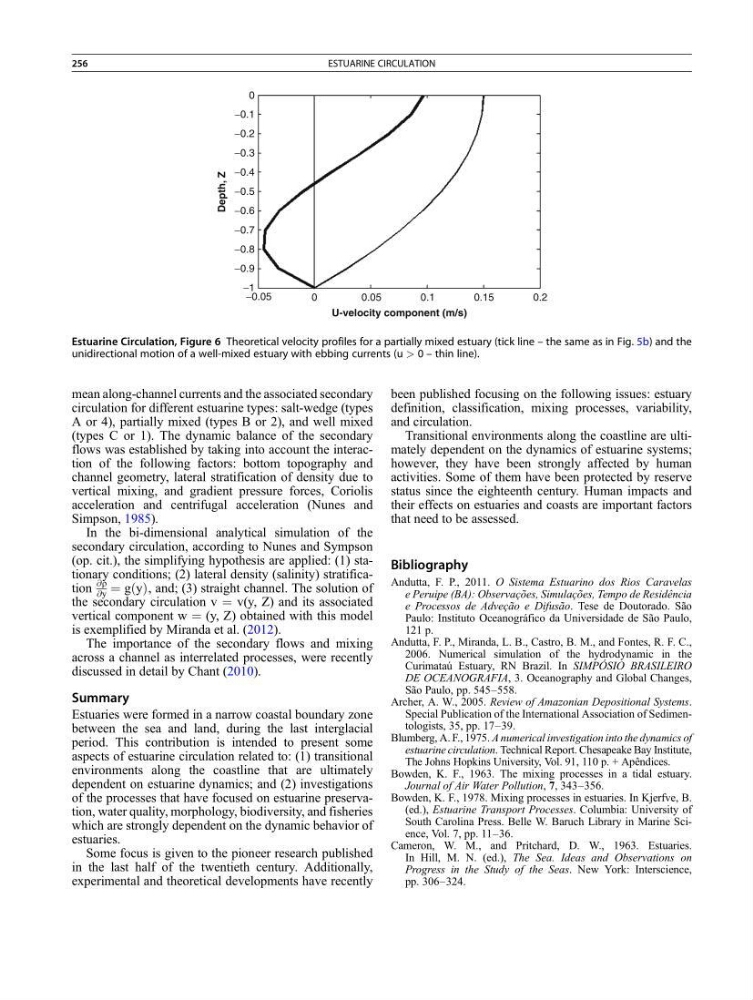
Estuarine Circulation, Figure 6 Theoretical velocity profiles for a partially mixed estuary (tick line – the same as in Fig. 5b) and the
unidirectional motion of a well-mixed estuary with ebbing currents (u > 0 – thin line).
256
ESTUARINE CIRCULATION
circulation for different estuarine types: salt-wedge (types
A or 4), partially mixed (types B or 2), and well mixed
(types C or 1). The dynamic balance of the secondary
flows was established by taking into account the interaction of the following factors: bottom topography and
channel geometry, lateral stratification of density due to
vertical mixing, and gradient pressure forces, Coriolis
acceleration and centrifugal acceleration (Nunes and
Simpson, 1985).
In the bi-dimensional analytical simulation of the
secondary circulation, according to Nunes and Sympson
(op. cit.), the simplifying hypothesis are applied: (1) stationary conditions; (2) lateral density (salinity) stratification
@r
@y ¼ g y
ð Þ, and; (3) straight channel. The solution of
the secondary circulation v ¼ v(y, Z) and its associated
vertical component w ¼ (y, Z) obtained with this model
is exemplified by Miranda et al. (2012).
The importance of the secondary flows and mixing
across a channel as interrelated processes, were recently
discussed in detail by Chant (2010).
Summary
Estuaries were formed in a narrow coastal boundary zone
between the sea and land, during the last interglacial
period. This contribution is intended to present some
aspects of estuarine circulation related to: (1) transitional
environments along the coastline that are ultimately
dependent on estuarine dynamics; and (2) investigations
of the processes that have focused on estuarine preservation, water quality, morphology, biodiversity, and fisheries
which are strongly dependent on the dynamic behavior of
estuaries.
Some focus is given to the pioneer research published
in the last half of the twentieth century. Additionally,
experimental and theoretical developments have recently
been published focusing on the following issues: estuary
definition, classification, mixing processes, variability,
and circulation.
Transitional environments along the coastline are ultimately dependent on the dynamics of estuarine systems;
however, they have been strongly affected by human
activities. Some of them have been protected by reserve
status since the eighteenth century. Human impacts and
their effects on estuaries and coasts are important factors
that need to be assessed.
Bibliography
Andutta, F. P., 2011. O Sistema Estuarino dos Rios Caravelas
e Peruipe (BA): Observações, Simulações, Tempo de Residência
e Processos de Adveção e Difusão. Tese de Doutorado. São
Paulo: Instituto Oceanográfico da Universidade de São Paulo,
121 p.
Andutta, F. P., Miranda, L. B., Castro, B. M., and Fontes, R. F. C.,
2006. Numerical simulation of the hydrodynamic in the
Curimataú Estuary, RN Brazil. In SIMPÓSIO BRASILEIRO
DE OCEANOGRAFIA, 3. Oceanography and Global Changes,
São Paulo, pp. 545–558.
Archer, A. W., 2005. Review of Amazonian Depositional Systems.
Special Publication of the International Association of Sedimentologists, 35, pp. 17–39.
Blumberg, A. F., 1975. A numerical investigation into the dynamics of
estuarine circulation. Technical Report. Chesapeake Bay Institute,
The Johns Hopkins University, Vol. 91, 110 p. + Apêndices.
Bowden, K. F., 1963. The mixing processes in a tidal estuary.
Journal of Air Water Pollution, 7, 343–356.
Bowden, K. F., 1978. Mixing processes in estuaries. In Kjerfve, B.
(ed.), Estuarine Transport Processes. Columbia: University of
South Carolina Press. Belle W. Baruch Library in Marine Science, Vol. 7, pp. 11–36.
Cameron, W. M., and Pritchard, D. W., 1963. Estuaries.
In Hill, M. N. (ed.), The Sea. Ideas and Observations on
Progress in the Study of the Seas. New York: Interscience,
pp. 306–324.
0
−0.1
−0.2
−0.3
−0.4
−0.5
−0.6
−0.7
−0.8
−0.9
−1
0.05
−0.05
0
0 . 1
0.15
0.2
U-velocity component (m/s)
Depth, Z
Estuarine Circulation, Figure 6 Theoretical velocity profiles for a partially mixed estuary (tick line – the same as in Fig. 5b) and the
unidirectional motion of a well-mixed estuary with ebbing currents (u > 0 – thin line).
256
ESTUARINE CIRCULATION