

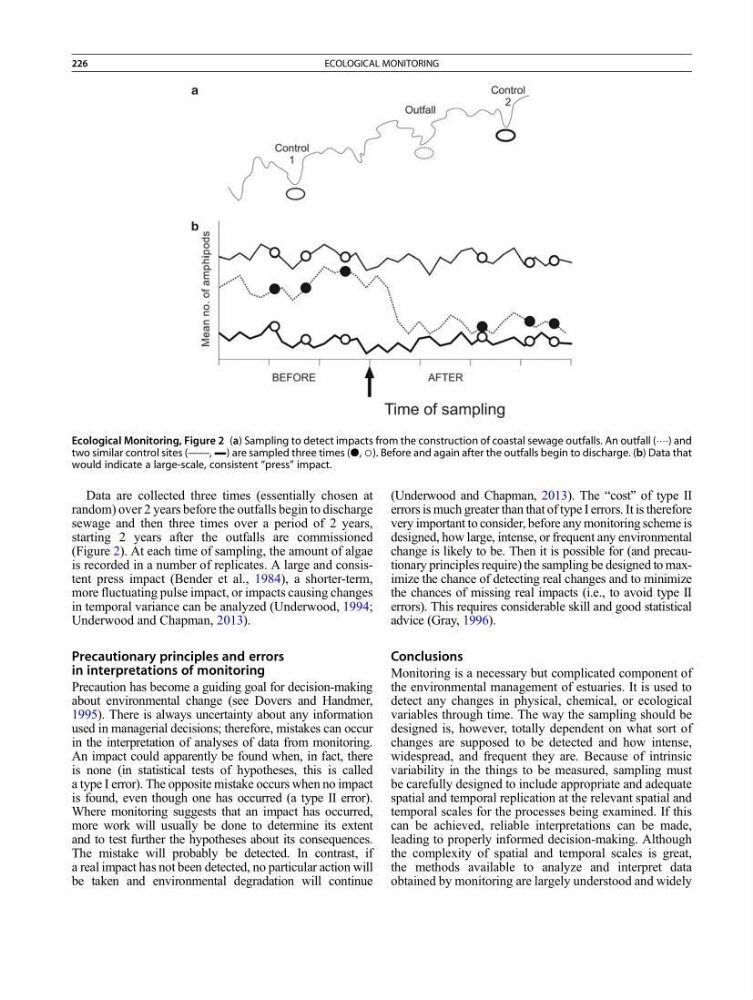
Data are collected three times (essentially chosen at
random) over 2 years before the outfalls begin to discharge
sewage and then three times over a period of 2 years,
starting 2 years after the outfalls are commissioned
(Figure 2). At each time of sampling, the amount of algae
is recorded in a number of replicates. A large and consistent press impact (Bender et al., 1984), a shorter-term,
more fluctuating pulse impact, or impacts causing changes
in temporal variance can be analyzed (Underwood, 1994;
Underwood and Chapman, 2013).
Precautionary principles and errors
in interpretations of monitoring
Precaution has become a guiding goal for decision-making
about environmental change (see Dovers and Handmer,
1995). There is always uncertainty about any information
used in managerial decisions; therefore, mistakes can occur
in the interpretation of analyses of data from monitoring.
An impact could apparently be found when, in fact, there
is none (in statistical tests of hypotheses, this is called
a type I error). The opposite mistake occurs when no impact
is found, even though one has occurred (a type II error).
Where monitoring suggests that an impact has occurred,
more work will usually be done to determine its extent
and to test further the hypotheses about its consequences.
The mistake will probably be detected. In contrast, if
a real impact has not been detected, no particular action will
be taken and environmental degradation will continue
(Underwood and Chapman, 2013). The “cost” of type II
errors is much greater than that of type I errors. It is therefore
very important to consider, before any monitoring scheme is
designed, how large, intense, or frequent any environmental
change is likely to be. Then it is possible for (and precautionary principles require) the sampling be designed to maximize the chance of detecting real changes and to minimize
the chances of missing real impacts (i.e., to avoid type II
errors). This requires considerable skill and good statistical
advice (Gray, 1996).
Conclusions
Monitoring is a necessary but complicated component of
the environmental management of estuaries. It is used to
detect any changes in physical, chemical, or ecological
variables through time. The way the sampling should be
designed is, however, totally dependent on what sort of
changes are supposed to be detected and how intense,
widespread, and frequent they are. Because of intrinsic
variability in the things to be measured, sampling must
be carefully designed to include appropriate and adequate
spatial and temporal replication at the relevant spatial and
temporal scales for the processes being examined. If this
can be achieved, reliable interpretations can be made,
leading to properly informed decision-making. Although
the complexity of spatial and temporal scales is great,
the methods available to analyze and interpret data
obtained by monitoring are largely understood and widely
Ecological Monitoring, Figure 2 (a) Sampling to detect impacts from the construction of coastal sewage outfalls. An outfall (ÁÁÁÁ) and
two similar control sites (——, ▬) are sampled three times (●, ○). Before and again after the outfalls begin to discharge. (b) Data that
would indicate a large-scale, consistent “press” impact.
226
ECOLOGICAL MONITORING
random) over 2 years before the outfalls begin to discharge
sewage and then three times over a period of 2 years,
starting 2 years after the outfalls are commissioned
(Figure 2). At each time of sampling, the amount of algae
is recorded in a number of replicates. A large and consistent press impact (Bender et al., 1984), a shorter-term,
more fluctuating pulse impact, or impacts causing changes
in temporal variance can be analyzed (Underwood, 1994;
Underwood and Chapman, 2013).
Precautionary principles and errors
in interpretations of monitoring
Precaution has become a guiding goal for decision-making
about environmental change (see Dovers and Handmer,
1995). There is always uncertainty about any information
used in managerial decisions; therefore, mistakes can occur
in the interpretation of analyses of data from monitoring.
An impact could apparently be found when, in fact, there
is none (in statistical tests of hypotheses, this is called
a type I error). The opposite mistake occurs when no impact
is found, even though one has occurred (a type II error).
Where monitoring suggests that an impact has occurred,
more work will usually be done to determine its extent
and to test further the hypotheses about its consequences.
The mistake will probably be detected. In contrast, if
a real impact has not been detected, no particular action will
be taken and environmental degradation will continue
(Underwood and Chapman, 2013). The “cost” of type II
errors is much greater than that of type I errors. It is therefore
very important to consider, before any monitoring scheme is
designed, how large, intense, or frequent any environmental
change is likely to be. Then it is possible for (and precautionary principles require) the sampling be designed to maximize the chance of detecting real changes and to minimize
the chances of missing real impacts (i.e., to avoid type II
errors). This requires considerable skill and good statistical
advice (Gray, 1996).
Conclusions
Monitoring is a necessary but complicated component of
the environmental management of estuaries. It is used to
detect any changes in physical, chemical, or ecological
variables through time. The way the sampling should be
designed is, however, totally dependent on what sort of
changes are supposed to be detected and how intense,
widespread, and frequent they are. Because of intrinsic
variability in the things to be measured, sampling must
be carefully designed to include appropriate and adequate
spatial and temporal replication at the relevant spatial and
temporal scales for the processes being examined. If this
can be achieved, reliable interpretations can be made,
leading to properly informed decision-making. Although
the complexity of spatial and temporal scales is great,
the methods available to analyze and interpret data
obtained by monitoring are largely understood and widely
Ecological Monitoring, Figure 2 (a) Sampling to detect impacts from the construction of coastal sewage outfalls. An outfall (ÁÁÁÁ) and
two similar control sites (——, ▬) are sampled three times (●, ○). Before and again after the outfalls begin to discharge. (b) Data that
would indicate a large-scale, consistent “press” impact.
226
ECOLOGICAL MONITORING