

Appropriate temporal replication
Monitoring to detect temporal changes requires replication to
measure temporal variability (Stewart-Oaten et al., 1986).
Seasonal patterns of abundance are often measured
by sampling a number of replicates once in each season,
using replicates taken at the same time in the sites sampled.
The variation among replicates in each sample is spatial
variation, because the replicates are all taken at one time, even
though spatially scattered. Seasonal patterns are not being
contrasted against temporal variation within each season.
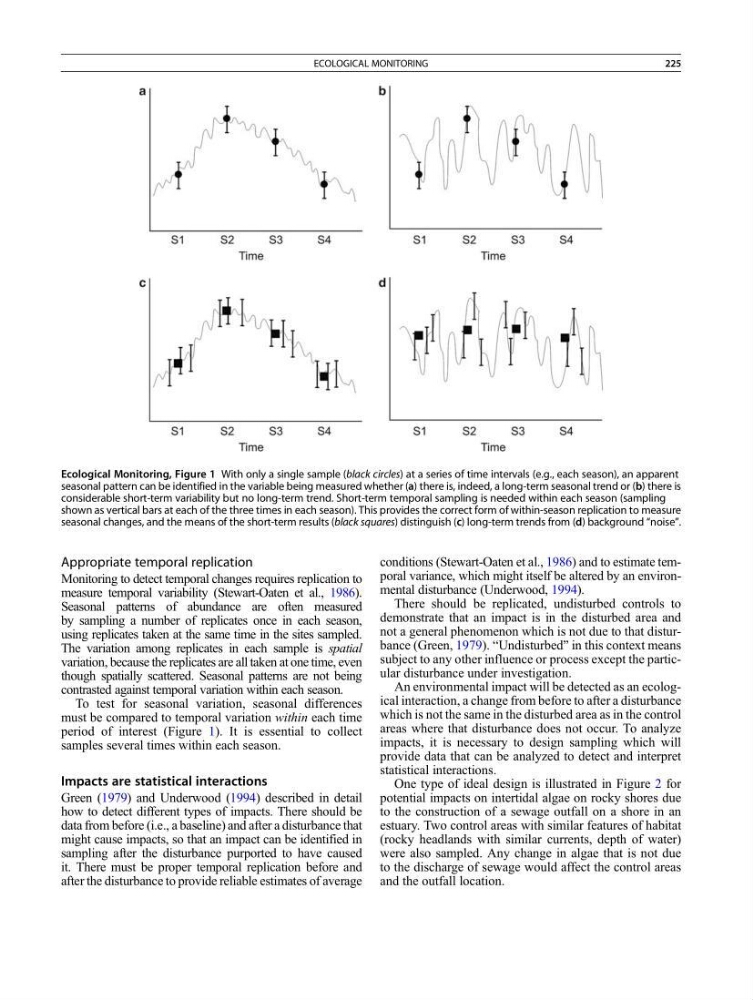
To test for seasonal variation, seasonal differences
must be compared to temporal variation within each time
period of interest (Figure 1). It is essential to collect
samples several times within each season.
Impacts are statistical interactions
Green (1979) and Underwood (1994) described in detail
how to detect different types of impacts. There should be
data from before (i.e., a baseline) and after a disturbance that
might cause impacts, so that an impact can be identified in
sampling after the disturbance purported to have caused
it. There must be proper temporal replication before and
after the disturbance to provide reliable estimates of average
conditions (Stewart-Oaten et al., 1986) and to estimate temporal variance, which might itself be altered by an environmental disturbance (Underwood, 1994).
There should be replicated, undisturbed controls to
demonstrate that an impact is in the disturbed area and
not a general phenomenon which is not due to that disturbance (Green, 1979). “Undisturbed” in this context means
subject to any other influence or process except the particular disturbance under investigation.
An environmental impact will be detected as an ecological interaction, a change from before to after a disturbance
which is not the same in the disturbed area as in the control
areas where that disturbance does not occur. To analyze
impacts, it is necessary to design sampling which will
provide data that can be analyzed to detect and interpret
statistical interactions.
One type of ideal design is illustrated in Figure 2 for
potential impacts on intertidal algae on rocky shores due
to the construction of a sewage outfall on a shore in an
estuary. Two control areas with similar features of habitat
(rocky headlands with similar currents, depth of water)
were also sampled. Any change in algae that is not due
to the discharge of sewage would affect the control areas
and the outfall location.
Ecological Monitoring, Figure 1 With only a single sample (black circles) at a series of time intervals (e.g., each season), an apparent
seasonal pattern can be identified in the variable being measured whether (a) there is, indeed, a long-term seasonal trend or (b) there is
considerable short-term variability but no long-term trend. Short-term temporal sampling is needed within each season (sampling
shown as vertical bars at each of the three times in each season). This provides the correct form of within-season replication to measure
seasonal changes, and the means of the short-term results (black squares) distinguish (c) long-term trends from (d) background “noise”.
ECOLOGICAL MONITORING
225
Monitoring to detect temporal changes requires replication to
measure temporal variability (Stewart-Oaten et al., 1986).
Seasonal patterns of abundance are often measured
by sampling a number of replicates once in each season,
using replicates taken at the same time in the sites sampled.
The variation among replicates in each sample is spatial
variation, because the replicates are all taken at one time, even
though spatially scattered. Seasonal patterns are not being
contrasted against temporal variation within each season.
To test for seasonal variation, seasonal differences
must be compared to temporal variation within each time
period of interest (Figure 1). It is essential to collect
samples several times within each season.
Impacts are statistical interactions
Green (1979) and Underwood (1994) described in detail
how to detect different types of impacts. There should be
data from before (i.e., a baseline) and after a disturbance that
might cause impacts, so that an impact can be identified in
sampling after the disturbance purported to have caused
it. There must be proper temporal replication before and
after the disturbance to provide reliable estimates of average
conditions (Stewart-Oaten et al., 1986) and to estimate temporal variance, which might itself be altered by an environmental disturbance (Underwood, 1994).
There should be replicated, undisturbed controls to
demonstrate that an impact is in the disturbed area and
not a general phenomenon which is not due to that disturbance (Green, 1979). “Undisturbed” in this context means
subject to any other influence or process except the particular disturbance under investigation.
An environmental impact will be detected as an ecological interaction, a change from before to after a disturbance
which is not the same in the disturbed area as in the control
areas where that disturbance does not occur. To analyze
impacts, it is necessary to design sampling which will
provide data that can be analyzed to detect and interpret
statistical interactions.
One type of ideal design is illustrated in Figure 2 for
potential impacts on intertidal algae on rocky shores due
to the construction of a sewage outfall on a shore in an
estuary. Two control areas with similar features of habitat
(rocky headlands with similar currents, depth of water)
were also sampled. Any change in algae that is not due
to the discharge of sewage would affect the control areas
and the outfall location.
Ecological Monitoring, Figure 1 With only a single sample (black circles) at a series of time intervals (e.g., each season), an apparent
seasonal pattern can be identified in the variable being measured whether (a) there is, indeed, a long-term seasonal trend or (b) there is
considerable short-term variability but no long-term trend. Short-term temporal sampling is needed within each season (sampling
shown as vertical bars at each of the three times in each season). This provides the correct form of within-season replication to measure
seasonal changes, and the means of the short-term results (black squares) distinguish (c) long-term trends from (d) background “noise”.
ECOLOGICAL MONITORING
225