

functional groups (e.g., diatoms and dinoflagellates,
mesozooplankton, and microzooplankton), biogeochemical cycling of multiple carbon and nutrient pools,
dissolved oxygen, suspended sediments, and multiple
consumers including mesozooplankton and microzooplankton, benthic infauna, and fish (e.g., Figure 2).
These heuristic models began to be used to address
management questions in the 1980s and 1990s, particularly related to the effect of anthropogenic nutrient enrichment on estuarine eutrophication (e.g., HydroQual, 1987;
HydroQual, 1991; Cerco and Cole, 1994; HydroQual
and Normandeau Associates, 1995). The use of models
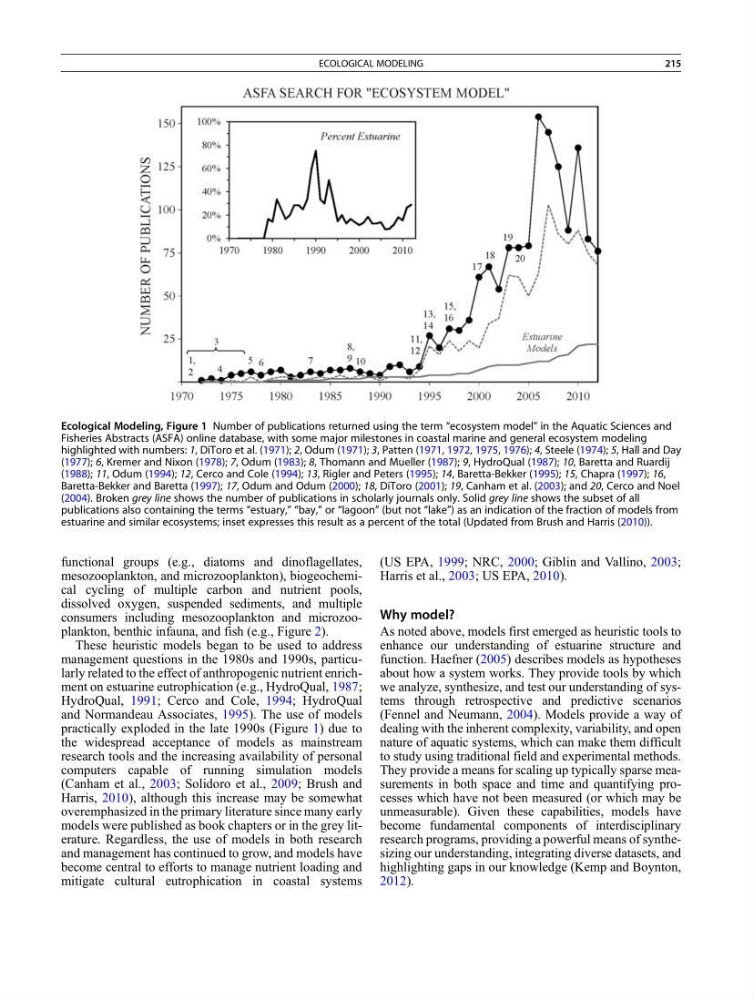
practically exploded in the late 1990s (Figure 1) due to
the widespread acceptance of models as mainstream
research tools and the increasing availability of personal
computers capable of running simulation models
(Canham et al., 2003; Solidoro et al., 2009; Brush and
Harris, 2010), although this increase may be somewhat
overemphasized in the primary literature since many early
models were published as book chapters or in the grey literature. Regardless, the use of models in both research
and management has continued to grow, and models have
become central to efforts to manage nutrient loading and
mitigate cultural eutrophication in coastal systems
(US EPA, 1999; NRC, 2000; Giblin and Vallino, 2003;
Harris et al., 2003; US EPA, 2010).
Why model?
As noted above, models first emerged as heuristic tools to
enhance our understanding of estuarine structure and
function. Haefner (2005) describes models as hypotheses
about how a system works. They provide tools by which
we analyze, synthesize, and test our understanding of systems through retrospective and predictive scenarios
(Fennel and Neumann, 2004). Models provide a way of
dealing with the inherent complexity, variability, and open
nature of aquatic systems, which can make them difficult
to study using traditional field and experimental methods.
They provide a means for scaling up typically sparse measurements in both space and time and quantifying processes which have not been measured (or which may be
unmeasurable). Given these capabilities, models have
become fundamental components of interdisciplinary
research programs, providing a powerful means of synthesizing our understanding, integrating diverse datasets, and
highlighting gaps in our knowledge (Kemp and Boynton,
2012).
Ecological Modeling, Figure 1 Number of publications returned using the term “ecosystem model” in the Aquatic Sciences and
Fisheries Abstracts (ASFA) online database, with some major milestones in coastal marine and general ecosystem modeling
highlighted with numbers: 1, DiToro et al. (1971); 2, Odum (1971); 3, Patten (1971, 1972, 1975, 1976); 4, Steele (1974); 5, Hall and Day
(1977); 6, Kremer and Nixon (1978); 7, Odum (1983); 8, Thomann and Mueller (1987); 9, HydroQual (1987); 10, Baretta and Ruardij
(1988); 11, Odum (1994); 12, Cerco and Cole (1994); 13, Rigler and Peters (1995); 14, Baretta-Bekker (1995); 15, Chapra (1997); 16,
Baretta-Bekker and Baretta (1997); 17, Odum and Odum (2000); 18, DiToro (2001); 19, Canham et al. (2003); and 20, Cerco and Noel
(2004). Broken grey line shows the number of publications in scholarly journals only. Solid grey line shows the subset of all
publications also containing the terms “estuary,” “bay,” or “lagoon” (but not “lake”) as an indication of the fraction of models from
estuarine and similar ecosystems; inset expresses this result as a percent of the total (Updated from Brush and Harris (2010)).
ECOLOGICAL MODELING
215
mesozooplankton, and microzooplankton), biogeochemical cycling of multiple carbon and nutrient pools,
dissolved oxygen, suspended sediments, and multiple
consumers including mesozooplankton and microzooplankton, benthic infauna, and fish (e.g., Figure 2).
These heuristic models began to be used to address
management questions in the 1980s and 1990s, particularly related to the effect of anthropogenic nutrient enrichment on estuarine eutrophication (e.g., HydroQual, 1987;
HydroQual, 1991; Cerco and Cole, 1994; HydroQual
and Normandeau Associates, 1995). The use of models
practically exploded in the late 1990s (Figure 1) due to
the widespread acceptance of models as mainstream
research tools and the increasing availability of personal
computers capable of running simulation models
(Canham et al., 2003; Solidoro et al., 2009; Brush and
Harris, 2010), although this increase may be somewhat
overemphasized in the primary literature since many early
models were published as book chapters or in the grey literature. Regardless, the use of models in both research
and management has continued to grow, and models have
become central to efforts to manage nutrient loading and
mitigate cultural eutrophication in coastal systems
(US EPA, 1999; NRC, 2000; Giblin and Vallino, 2003;
Harris et al., 2003; US EPA, 2010).
Why model?
As noted above, models first emerged as heuristic tools to
enhance our understanding of estuarine structure and
function. Haefner (2005) describes models as hypotheses
about how a system works. They provide tools by which
we analyze, synthesize, and test our understanding of systems through retrospective and predictive scenarios
(Fennel and Neumann, 2004). Models provide a way of
dealing with the inherent complexity, variability, and open
nature of aquatic systems, which can make them difficult
to study using traditional field and experimental methods.
They provide a means for scaling up typically sparse measurements in both space and time and quantifying processes which have not been measured (or which may be
unmeasurable). Given these capabilities, models have
become fundamental components of interdisciplinary
research programs, providing a powerful means of synthesizing our understanding, integrating diverse datasets, and
highlighting gaps in our knowledge (Kemp and Boynton,
2012).
Ecological Modeling, Figure 1 Number of publications returned using the term “ecosystem model” in the Aquatic Sciences and
Fisheries Abstracts (ASFA) online database, with some major milestones in coastal marine and general ecosystem modeling
highlighted with numbers: 1, DiToro et al. (1971); 2, Odum (1971); 3, Patten (1971, 1972, 1975, 1976); 4, Steele (1974); 5, Hall and Day
(1977); 6, Kremer and Nixon (1978); 7, Odum (1983); 8, Thomann and Mueller (1987); 9, HydroQual (1987); 10, Baretta and Ruardij
(1988); 11, Odum (1994); 12, Cerco and Cole (1994); 13, Rigler and Peters (1995); 14, Baretta-Bekker (1995); 15, Chapra (1997); 16,
Baretta-Bekker and Baretta (1997); 17, Odum and Odum (2000); 18, DiToro (2001); 19, Canham et al. (2003); and 20, Cerco and Noel
(2004). Broken grey line shows the number of publications in scholarly journals only. Solid grey line shows the subset of all
publications also containing the terms “estuary,” “bay,” or “lagoon” (but not “lake”) as an indication of the fraction of models from
estuarine and similar ecosystems; inset expresses this result as a percent of the total (Updated from Brush and Harris (2010)).
ECOLOGICAL MODELING
215