

expensive option, but in recent years, more emphasis has
been placed on keeping material dredged from coastal
areas within the littoral zone, when its characteristics are
suitable, to avoid loss of sediments from beaches.
In some cases, the dredged material contains contaminants that must be sequestered. Often this material is
placed within an upland confined disposal facility that is
dewatered as the material settles (U.S. Army Corps of
Engineers, 1987; PIANC, 2002). It can also be placed in
a pit underwater and capped (U.S. Army Corps of Engineers, 1998). Vellinga (1997) and Bray (2008) discuss
the handling of dredged material containing contaminants.
The problem is unfortunately quite common because
many of the oldest and largest cities in the world are
closely tied to ports and waterways.
Turbidity resulting from dredging activities is often
a concern and may restrict available operating times for
dredging. Other environmental concerns arise at selected
locations and times. In the southeastern United States,
for example, dredging is restricted during periods when
marine turtles are likely to be in the vicinity of dredging
equipment. Many tidal inlets feature shipwrecks that in
some instances influence dredging plans or are discovered
during dredging.
Summary
Given the large human populations worldwide that reside
in coastal areas, and the increasing internationalization
and magnitude of commerce, dredging is likely to remain
an important global industry. Port capacities will need
to continue to be increased, and many ports have the
potential to be seriously impacted by relative sea level
rise. Dredging schemes will need to be continually
improved to increase efficiency and reduce environmental impacts.
Bibliography
Bray, N., 2008. Environmental Aspects of Dredging. International
Association of Dredging. The Hague/Leiden, The Netherlands:
Companies/Central Dredging Association/Taylor and Francis.
Bray, N., and Cohen, M. (eds.), 2010. Dredging for Development,
6th edn. The Hague, Netherlands: Joint publication of International Association of Dredging Companies (IADC) and International Association of Ports and Harbors (IAPH).
Bray, N., Bates, A. D., and Land, J. M., Eds., 1996. Dredging:
A Handbook for Engineers, 2nd edn. Butterworth-Heinemann.
Herbich, J. B. (ed.), 1992. Handbook of Dredging Engineering.
New York: McGraw-Hill.
Huston, J., 1986. Hydraulic Dredging, Principles, Equipment,
Procedures and Methods. Cambridge, MA: Cornell Maritime
Press.
PIANC, 2002. Environmental Guidelines for Aquatic, Nearshore
and Upland Confined Disposal Facilities for Contaminated
Dredged Material. Brussels, Belgium: EnviCom Working
Group 05, PIANC.
PIANC, 2009. Dredging Management Practices for the Environment – A Structured Selection Approach. EnviCom Working
Group Report 100, Brussels, Belgium.
U.S. Army Corps of Engineers, 1983. Engineering and Design –
Dredging and Dredged Material Disposal. EM 1110-2-5025,
CECW-EH-D, Department of the Army, Washington, DC.
U.S. Army Corps of Engineers, 1987. Engineering and Design –
Confined Disposal of Dredged Material. EM 1110-2-5027,
CECW-EH-D, Department of the Army, Washington, DC.
U.S. Army Corps of Engineers, 1998. Guidelines for subaqueous
dredged material capping. Technical report DOER-1, Dredging
Operations and Environmental Research Program, Waterways
Experiment Station, Vicksburg, MS.
van de Kreeke, J., 1992. Stability of tidal inlets; Escoffier’s analysis.
Shore and Beach, 60(1), 9–12.
Vellinga, T., 1997. Handling and treatment of contaminated
dredged material from ports and inland waterways. Report of
Working Group 17 of PTC 1, International Navigation Association, Brussels, Belgium.
Cross-references
Anthropogenic Impacts
Dredge and Fill
Mass Physical Sediment Properties
Sand Mining/Beach Sand Mining
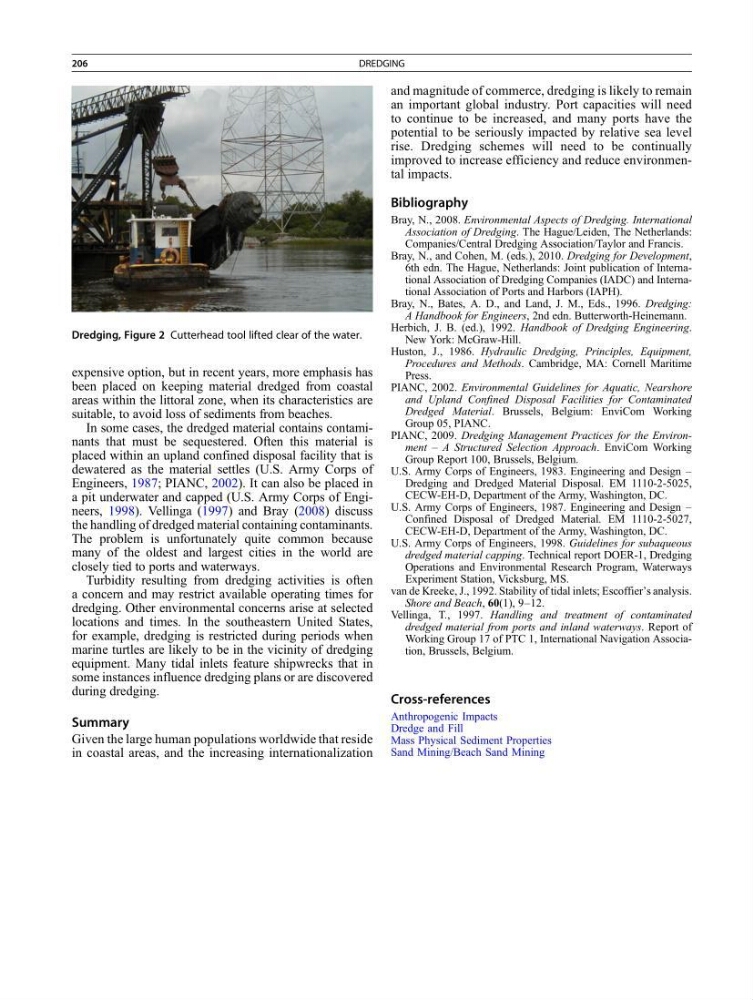
Dredging, Figure 2 Cutterhead tool lifted clear of the water.
206
DREDGING
been placed on keeping material dredged from coastal
areas within the littoral zone, when its characteristics are
suitable, to avoid loss of sediments from beaches.
In some cases, the dredged material contains contaminants that must be sequestered. Often this material is
placed within an upland confined disposal facility that is
dewatered as the material settles (U.S. Army Corps of
Engineers, 1987; PIANC, 2002). It can also be placed in
a pit underwater and capped (U.S. Army Corps of Engineers, 1998). Vellinga (1997) and Bray (2008) discuss
the handling of dredged material containing contaminants.
The problem is unfortunately quite common because
many of the oldest and largest cities in the world are
closely tied to ports and waterways.
Turbidity resulting from dredging activities is often
a concern and may restrict available operating times for
dredging. Other environmental concerns arise at selected
locations and times. In the southeastern United States,
for example, dredging is restricted during periods when
marine turtles are likely to be in the vicinity of dredging
equipment. Many tidal inlets feature shipwrecks that in
some instances influence dredging plans or are discovered
during dredging.
Summary
Given the large human populations worldwide that reside
in coastal areas, and the increasing internationalization
and magnitude of commerce, dredging is likely to remain
an important global industry. Port capacities will need
to continue to be increased, and many ports have the
potential to be seriously impacted by relative sea level
rise. Dredging schemes will need to be continually
improved to increase efficiency and reduce environmental impacts.
Bibliography
Bray, N., 2008. Environmental Aspects of Dredging. International
Association of Dredging. The Hague/Leiden, The Netherlands:
Companies/Central Dredging Association/Taylor and Francis.
Bray, N., and Cohen, M. (eds.), 2010. Dredging for Development,
6th edn. The Hague, Netherlands: Joint publication of International Association of Dredging Companies (IADC) and International Association of Ports and Harbors (IAPH).
Bray, N., Bates, A. D., and Land, J. M., Eds., 1996. Dredging:
A Handbook for Engineers, 2nd edn. Butterworth-Heinemann.
Herbich, J. B. (ed.), 1992. Handbook of Dredging Engineering.
New York: McGraw-Hill.
Huston, J., 1986. Hydraulic Dredging, Principles, Equipment,
Procedures and Methods. Cambridge, MA: Cornell Maritime
Press.
PIANC, 2002. Environmental Guidelines for Aquatic, Nearshore
and Upland Confined Disposal Facilities for Contaminated
Dredged Material. Brussels, Belgium: EnviCom Working
Group 05, PIANC.
PIANC, 2009. Dredging Management Practices for the Environment – A Structured Selection Approach. EnviCom Working
Group Report 100, Brussels, Belgium.
U.S. Army Corps of Engineers, 1983. Engineering and Design –
Dredging and Dredged Material Disposal. EM 1110-2-5025,
CECW-EH-D, Department of the Army, Washington, DC.
U.S. Army Corps of Engineers, 1987. Engineering and Design –
Confined Disposal of Dredged Material. EM 1110-2-5027,
CECW-EH-D, Department of the Army, Washington, DC.
U.S. Army Corps of Engineers, 1998. Guidelines for subaqueous
dredged material capping. Technical report DOER-1, Dredging
Operations and Environmental Research Program, Waterways
Experiment Station, Vicksburg, MS.
van de Kreeke, J., 1992. Stability of tidal inlets; Escoffier’s analysis.
Shore and Beach, 60(1), 9–12.
Vellinga, T., 1997. Handling and treatment of contaminated
dredged material from ports and inland waterways. Report of
Working Group 17 of PTC 1, International Navigation Association, Brussels, Belgium.
Cross-references
Anthropogenic Impacts
Dredge and Fill
Mass Physical Sediment Properties
Sand Mining/Beach Sand Mining
Dredging, Figure 2 Cutterhead tool lifted clear of the water.
206
DREDGING