

DISSOLVED OXYGEN
Christopher F. Deacutis
Division of Fish & Wildlife, Jamestown, RI, USA
Synonyms
Elemental oxygen; Dioxygen; DO; O 2
Definition
Dissolved oxygen (DO) is the amount of elemental
oxygen (chemical symbol O 2 , molecular wt 31.99 g/mol)
dissolved in fresh or salt waters.
Controlling factors of dissolved oxygen
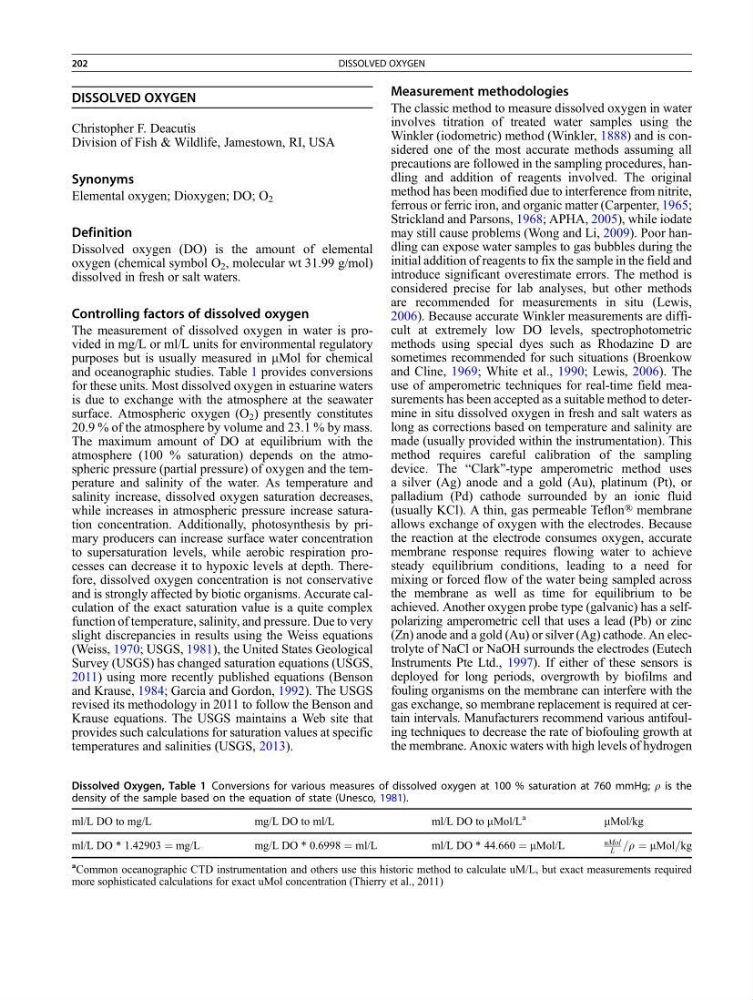
The measurement of dissolved oxygen in water is provided in mg/L or ml/L units for environmental regulatory
purposes but is usually measured in mMol for chemical
and oceanographic studies. Table 1 provides conversions
for these units. Most dissolved oxygen in estuarine waters
is due to exchange with the atmosphere at the seawater
surface. Atmospheric oxygen (O 2 ) presently constitutes
20.9 % of the atmosphere by volume and 23.1 % by mass.
The maximum amount of DO at equilibrium with the
atmosphere (100 % saturation) depends on the atmospheric pressure (partial pressure) of oxygen and the temperature and salinity of the water. As temperature and
salinity increase, dissolved oxygen saturation decreases,
while increases in atmospheric pressure increase saturation concentration. Additionally, photosynthesis by primary producers can increase surface water concentration
to supersaturation levels, while aerobic respiration processes can decrease it to hypoxic levels at depth. Therefore, dissolved oxygen concentration is not conservative
and is strongly affected by biotic organisms. Accurate calculation of the exact saturation value is a quite complex
function of temperature, salinity, and pressure. Due to very
slight discrepancies in results using the Weiss equations
(Weiss, 1970; USGS, 1981), the United States Geological
Survey (USGS) has changed saturation equations (USGS,
2011) using more recently published equations (Benson
and Krause, 1984; Garcia and Gordon, 1992). The USGS
revised its methodology in 2011 to follow the Benson and
Krause equations. The USGS maintains a Web site that
provides such calculations for saturation values at specific
temperatures and salinities (USGS, 2013).
Measurement methodologies
The classic method to measure dissolved oxygen in water
involves titration of treated water samples using the
Winkler (iodometric) method (Winkler, 1888) and is considered one of the most accurate methods assuming all
precautions are followed in the sampling procedures, handling and addition of reagents involved. The original
method has been modified due to interference from nitrite,
ferrous or ferric iron, and organic matter (Carpenter, 1965;
Strickland and Parsons, 1968; APHA, 2005), while iodate
may still cause problems (Wong and Li, 2009). Poor handling can expose water samples to gas bubbles during the
initial addition of reagents to fix the sample in the field and
introduce significant overestimate errors. The method is
considered precise for lab analyses, but other methods
are recommended for measurements in situ (Lewis,
2006). Because accurate Winkler measurements are difficult at extremely low DO levels, spectrophotometric
methods using special dyes such as Rhodazine D are
sometimes recommended for such situations (Broenkow
and Cline, 1969; White et al., 1990; Lewis, 2006). The
use of amperometric techniques for real-time field measurements has been accepted as a suitable method to determine in situ dissolved oxygen in fresh and salt waters as
long as corrections based on temperature and salinity are
made (usually provided within the instrumentation). This
method requires careful calibration of the sampling
device. The “Clark”-type amperometric method uses
a silver (Ag) anode and a gold (Au), platinum (Pt), or
palladium (Pd) cathode surrounded by an ionic fluid
(usually KCl). A thin, gas permeable Teflon® membrane
allows exchange of oxygen with the electrodes. Because
the reaction at the electrode consumes oxygen, accurate
membrane response requires flowing water to achieve
steady equilibrium conditions, leading to a need for
mixing or forced flow of the water being sampled across
the membrane as well as time for equilibrium to be
achieved. Another oxygen probe type (galvanic) has a selfpolarizing amperometric cell that uses a lead (Pb) or zinc
(Zn) anode and a gold (Au) or silver (Ag) cathode. An electrolyte of NaCl or NaOH surrounds the electrodes (Eutech
Instruments Pte Ltd., 1997). If either of these sensors is
deployed for long periods, overgrowth by biofilms and
fouling organisms on the membrane can interfere with the
gas exchange, so membrane replacement is required at certain intervals. Manufacturers recommend various antifouling techniques to decrease the rate of biofouling growth at
the membrane. Anoxic waters with high levels of hydrogen
Dissolved Oxygen, Table 1 Conversions for various measures of dissolved oxygen at 100 % saturation at 760 mmHg; r is the
density of the sample based on the equation of state (Unesco, 1981).
ml/L DO to mg/L
mg/L DO to ml/L
ml/L DO to mMol/L
a
mMol/kg
ml/L DO * 1.42903 ¼ mg/L
mg/L DO * 0.6998 ¼ ml/L
ml/L DO * 44.660 ¼ mMol/L
uMol
L =r ¼ mMol=kg
a
Common oceanographic CTD instrumentation and others use this historic method to calculate uM/L, but exact measurements required
more sophisticated calculations for exact uMol concentration (Thierry et al., 2011)
202
DISSOLVED OXYGEN
Christopher F. Deacutis
Division of Fish & Wildlife, Jamestown, RI, USA
Synonyms
Elemental oxygen; Dioxygen; DO; O 2
Definition
Dissolved oxygen (DO) is the amount of elemental
oxygen (chemical symbol O 2 , molecular wt 31.99 g/mol)
dissolved in fresh or salt waters.
Controlling factors of dissolved oxygen
The measurement of dissolved oxygen in water is provided in mg/L or ml/L units for environmental regulatory
purposes but is usually measured in mMol for chemical
and oceanographic studies. Table 1 provides conversions
for these units. Most dissolved oxygen in estuarine waters
is due to exchange with the atmosphere at the seawater
surface. Atmospheric oxygen (O 2 ) presently constitutes
20.9 % of the atmosphere by volume and 23.1 % by mass.
The maximum amount of DO at equilibrium with the
atmosphere (100 % saturation) depends on the atmospheric pressure (partial pressure) of oxygen and the temperature and salinity of the water. As temperature and
salinity increase, dissolved oxygen saturation decreases,
while increases in atmospheric pressure increase saturation concentration. Additionally, photosynthesis by primary producers can increase surface water concentration
to supersaturation levels, while aerobic respiration processes can decrease it to hypoxic levels at depth. Therefore, dissolved oxygen concentration is not conservative
and is strongly affected by biotic organisms. Accurate calculation of the exact saturation value is a quite complex
function of temperature, salinity, and pressure. Due to very
slight discrepancies in results using the Weiss equations
(Weiss, 1970; USGS, 1981), the United States Geological
Survey (USGS) has changed saturation equations (USGS,
2011) using more recently published equations (Benson
and Krause, 1984; Garcia and Gordon, 1992). The USGS
revised its methodology in 2011 to follow the Benson and
Krause equations. The USGS maintains a Web site that
provides such calculations for saturation values at specific
temperatures and salinities (USGS, 2013).
Measurement methodologies
The classic method to measure dissolved oxygen in water
involves titration of treated water samples using the
Winkler (iodometric) method (Winkler, 1888) and is considered one of the most accurate methods assuming all
precautions are followed in the sampling procedures, handling and addition of reagents involved. The original
method has been modified due to interference from nitrite,
ferrous or ferric iron, and organic matter (Carpenter, 1965;
Strickland and Parsons, 1968; APHA, 2005), while iodate
may still cause problems (Wong and Li, 2009). Poor handling can expose water samples to gas bubbles during the
initial addition of reagents to fix the sample in the field and
introduce significant overestimate errors. The method is
considered precise for lab analyses, but other methods
are recommended for measurements in situ (Lewis,
2006). Because accurate Winkler measurements are difficult at extremely low DO levels, spectrophotometric
methods using special dyes such as Rhodazine D are
sometimes recommended for such situations (Broenkow
and Cline, 1969; White et al., 1990; Lewis, 2006). The
use of amperometric techniques for real-time field measurements has been accepted as a suitable method to determine in situ dissolved oxygen in fresh and salt waters as
long as corrections based on temperature and salinity are
made (usually provided within the instrumentation). This
method requires careful calibration of the sampling
device. The “Clark”-type amperometric method uses
a silver (Ag) anode and a gold (Au), platinum (Pt), or
palladium (Pd) cathode surrounded by an ionic fluid
(usually KCl). A thin, gas permeable Teflon® membrane
allows exchange of oxygen with the electrodes. Because
the reaction at the electrode consumes oxygen, accurate
membrane response requires flowing water to achieve
steady equilibrium conditions, leading to a need for
mixing or forced flow of the water being sampled across
the membrane as well as time for equilibrium to be
achieved. Another oxygen probe type (galvanic) has a selfpolarizing amperometric cell that uses a lead (Pb) or zinc
(Zn) anode and a gold (Au) or silver (Ag) cathode. An electrolyte of NaCl or NaOH surrounds the electrodes (Eutech
Instruments Pte Ltd., 1997). If either of these sensors is
deployed for long periods, overgrowth by biofilms and
fouling organisms on the membrane can interfere with the
gas exchange, so membrane replacement is required at certain intervals. Manufacturers recommend various antifouling techniques to decrease the rate of biofouling growth at
the membrane. Anoxic waters with high levels of hydrogen
Dissolved Oxygen, Table 1 Conversions for various measures of dissolved oxygen at 100 % saturation at 760 mmHg; r is the
density of the sample based on the equation of state (Unesco, 1981).
ml/L DO to mg/L
mg/L DO to ml/L
ml/L DO to mMol/L
a
mMol/kg
ml/L DO * 1.42903 ¼ mg/L
mg/L DO * 0.6998 ¼ ml/L
ml/L DO * 44.660 ¼ mMol/L
uMol
L =r ¼ mMol=kg
a
Common oceanographic CTD instrumentation and others use this historic method to calculate uM/L, but exact measurements required
more sophisticated calculations for exact uMol concentration (Thierry et al., 2011)
202
DISSOLVED OXYGEN