

of these high surface area minerals can greatly reduce the
adsorption capabilities of the sediment. Adsorption and
desorption reactions can also occur due to changing pH
and Eh conditions. Ion exchange can occur in clays, altering their composition. Authigenic minerals, including
phosphates, carbonates, and sulfides, may precipitate out
of solution. Some precipitates can cement sediment
grains, reducing the ratio of interstitial water to sediment.
During later stages of diagenesis that occur with greater
burial, compaction and heating of sediments can lead to
the loss of water from hydrous minerals, cementation of
sediments, and lithification of sediments. As a result, the
physical structure and chemical composition of buried
sediments and sedimentary rocks depends both on the initial composition of the material deposited and the
diagenesis that occurs during burial.
Bibliography
Berner, R. A., 1980. Early Diagenesis: A Theoretical Approach.
Princeton, NJ: Princeton University Press.
Burdige, D. J., 2007. Preservation of organic matter in marine sediments: controls, mechanisms, and an imbalance in sediment
organic carbon budgets? Chemical Reviews, 107, 467–485.
Froelich, P. N., Klinkhammer, G. P., Bender, M. L., Luedtke, N. A.,
Heath, G. R., Cullen, D., Dauphin, P., Hammond, D., Hartman,
B., and Maynard, V., 1979. Early oxidation of organic matter
in pelagic sediments of the eastern equatorial Atlantic: suboxic
diagenesis. Geochimica Cosmochimica Acta, 43, 1075–1090.
Cross-references
Anoxia, Hypoxia, and Dead Zones
Sediment Toxicity
DIFFUSION
Murat Aksel
Civil Engineering Department, Istanbul Kultur University
Atakoy Campus, Bakirkoy, Istanbul, Turkey
Synonyms
Scatter
Definition
Diffusion is defined as free or random movement of molecules from a higher concentrated to lower concentrated
region. Concentration gradients are part of this random
movement.
Description
Lewis (1997) defined two criteria for molecular motion
to be considered diffusion. First, the number of molecules moving in two directions (from high to low or vice
versa) must be equal. The occurrence of an unbalanced
condition is called advection. The second criterion is
the occurrence of a concentration gradient between two
regions.
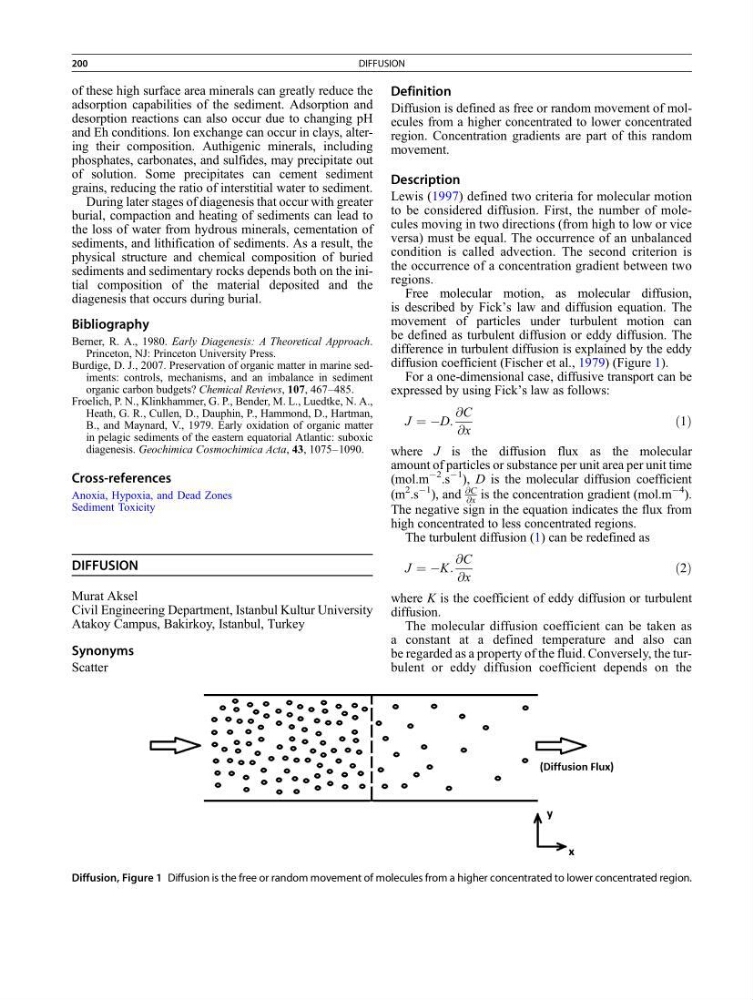
Free molecular motion, as molecular diffusion,
is described by Fick’s law and diffusion equation. The
movement of particles under turbulent motion can
be defined as turbulent diffusion or eddy diffusion. The
difference in turbulent diffusion is explained by the eddy
diffusion coefficient (Fischer et al., 1979) (Figure 1).
For a one-dimensional case, diffusive transport can be
expressed by using Fick’s law as follows:
J ¼ ÀD:
@C
@x
ð1Þ
where J is the diffusion flux as the molecular
amount of particles or substance per unit area per unit time
(mol.m
À2 .s
À1
), D is the molecular diffusion coefficient
(m
2
.s
À1 ), and
@C
@x is the concentration gradient (mol.m
À4
).
The negative sign in the equation indicates the flux from
high concentrated to less concentrated regions.
The turbulent diffusion (1) can be redefined as
J ¼ ÀK:
@C
@x
ð2Þ
where K is the coefficient of eddy diffusion or turbulent
diffusion.
The molecular diffusion coefficient can be taken as
a constant at a defined temperature and also can
be regarded as a property of the fluid. Conversely, the turbulent or eddy diffusion coefficient depends on the
Diffusion, Figure 1 Diffusion is the free or random movement of molecules from a higher concentrated to lower concentrated region.
200
DIFFUSION
adsorption capabilities of the sediment. Adsorption and
desorption reactions can also occur due to changing pH
and Eh conditions. Ion exchange can occur in clays, altering their composition. Authigenic minerals, including
phosphates, carbonates, and sulfides, may precipitate out
of solution. Some precipitates can cement sediment
grains, reducing the ratio of interstitial water to sediment.
During later stages of diagenesis that occur with greater
burial, compaction and heating of sediments can lead to
the loss of water from hydrous minerals, cementation of
sediments, and lithification of sediments. As a result, the
physical structure and chemical composition of buried
sediments and sedimentary rocks depends both on the initial composition of the material deposited and the
diagenesis that occurs during burial.
Bibliography
Berner, R. A., 1980. Early Diagenesis: A Theoretical Approach.
Princeton, NJ: Princeton University Press.
Burdige, D. J., 2007. Preservation of organic matter in marine sediments: controls, mechanisms, and an imbalance in sediment
organic carbon budgets? Chemical Reviews, 107, 467–485.
Froelich, P. N., Klinkhammer, G. P., Bender, M. L., Luedtke, N. A.,
Heath, G. R., Cullen, D., Dauphin, P., Hammond, D., Hartman,
B., and Maynard, V., 1979. Early oxidation of organic matter
in pelagic sediments of the eastern equatorial Atlantic: suboxic
diagenesis. Geochimica Cosmochimica Acta, 43, 1075–1090.
Cross-references
Anoxia, Hypoxia, and Dead Zones
Sediment Toxicity
DIFFUSION
Murat Aksel
Civil Engineering Department, Istanbul Kultur University
Atakoy Campus, Bakirkoy, Istanbul, Turkey
Synonyms
Scatter
Definition
Diffusion is defined as free or random movement of molecules from a higher concentrated to lower concentrated
region. Concentration gradients are part of this random
movement.
Description
Lewis (1997) defined two criteria for molecular motion
to be considered diffusion. First, the number of molecules moving in two directions (from high to low or vice
versa) must be equal. The occurrence of an unbalanced
condition is called advection. The second criterion is
the occurrence of a concentration gradient between two
regions.
Free molecular motion, as molecular diffusion,
is described by Fick’s law and diffusion equation. The
movement of particles under turbulent motion can
be defined as turbulent diffusion or eddy diffusion. The
difference in turbulent diffusion is explained by the eddy
diffusion coefficient (Fischer et al., 1979) (Figure 1).
For a one-dimensional case, diffusive transport can be
expressed by using Fick’s law as follows:
J ¼ ÀD:
@C
@x
ð1Þ
where J is the diffusion flux as the molecular
amount of particles or substance per unit area per unit time
(mol.m
À2 .s
À1
), D is the molecular diffusion coefficient
(m
2
.s
À1 ), and
@C
@x is the concentration gradient (mol.m
À4
).
The negative sign in the equation indicates the flux from
high concentrated to less concentrated regions.
The turbulent diffusion (1) can be redefined as
J ¼ ÀK:
@C
@x
ð2Þ
where K is the coefficient of eddy diffusion or turbulent
diffusion.
The molecular diffusion coefficient can be taken as
a constant at a defined temperature and also can
be regarded as a property of the fluid. Conversely, the turbulent or eddy diffusion coefficient depends on the
Diffusion, Figure 1 Diffusion is the free or random movement of molecules from a higher concentrated to lower concentrated region.
200
DIFFUSION