

“marine snow” (Alldredge and Silver, 1988) and the attendant “microbial loop” driven by dissolved organic matter
(POM) (Pomeroy, 1974; Azam et al., 1983), even presumed autotrophically dominated ocean food webs were
found to have highly integrated detritus pathways
(Figure 2b). While detritus has long been considered to
be a major driver of food web pathways in estuarine sediments (e.g., Newell and Field, 1983), it also became even
more relevant to estuaries overall (Crump et al., 2012),
especially with increased understanding of gravitational
circulation processes that promote estuarine turbidity
maxima as “biogeochemical reactors” (Baross et al.,
1994; Savoye et al., 2012). What has become increasingly
obvious from the more recent application of isotope and
other biomarker sampling and experimentation in estuaries is that although detritus fuels and may even dominate
many estuarine food webs, the extent to which it does
varies considerably as a function of the type and region
of estuary and the time frame (Odum, 1984; Peterson
et al., 1985; Peterson and Howarth, 1987; Deegan and
Garritt, 1997; Akin and Winemiller, 2006).
In many respects, estuaries have often been the nexus of
the debate about the role of detritus food webs, touching
on the core of many fundamental issues in ecological theory such as labile versus refractory organic matter sources
(Mann, 1988); the importance of allochthonous, spatial
subsidies (Polis et al., 1997); outwelling (Childers et al.,
2000); compartmentalization (Raffaelli and Hall, 1992);
community stability (Huxel and McCann, 1998); and
top-down versus bottom-up control on food web structure
(Power, 1992). While the prominence of detritus in estuarine food webs is less debatable, its role in shaping estuarine ecosystem dynamics and regulating the productivity
of important consumers such as commercial fisheries is
still somewhat controversial.
Bibliography
Akin, S., and Winemiller, K. O., 2006. Seasonal variation in food
web composition and structure in a temperate tidal estuary.
Estuaries and Coasts, 29, 552–567.
Alldredge, A. L., and Silver, M. W., 1988. Characteristics, dynamics
and significance of marine snow. Progress in Oceanography, 20,
41–82.
Azam, F., Fenchel, T., Field, J. G., Gray, J. S., Meyer-Reil, L. A.,
and Thingstad, F., 1983. The ecological role of water-column
microbes in the sea. Marine Ecology Progress Series, 10,
257–263.
Baross, J. A., Crump, B., and Simenstad, C. A., 1994. Elevated
microbial loop activities in the Columbia River estuarine turbidity maxima. In Dyer, K., and Orth, B. (eds.), Changing Particle
Flux in Estuaries: Implications from Science to Management,
ECSA22/ERF Symposium, Plymouth, September 1992.
Fredensborg: Olsen & Olsen Press, pp. 459–464.
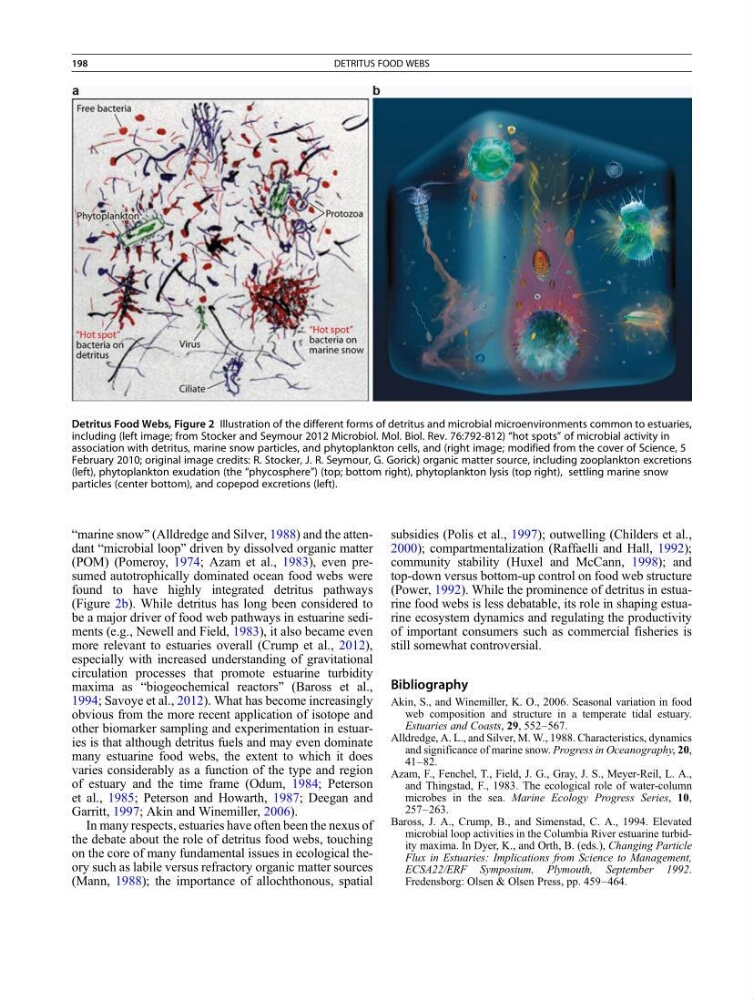
Detritus Food Webs, Figure 2 Illustration of the different forms of detritus and microbial microenvironments common to estuaries,
including (left image; from Stocker and Seymour 2012 Microbiol. Mol. Biol. Rev. 76:792-812) “hot spots” of microbial activity in
association with detritus, marine snow particles, and phytoplankton cells, and (right image; modified from the cover of Science, 5
February 2010; original image credits: R. Stocker, J. R. Seymour, G. Gorick) organic matter source, including zooplankton excretions
(left), phytoplankton exudation (the “phycosphere”) (top; bottom right), phytoplankton lysis (top right), settling marine snow
particles (center bottom), and copepod excretions (left).
198
DETRITUS FOOD WEBS
(POM) (Pomeroy, 1974; Azam et al., 1983), even presumed autotrophically dominated ocean food webs were
found to have highly integrated detritus pathways
(Figure 2b). While detritus has long been considered to
be a major driver of food web pathways in estuarine sediments (e.g., Newell and Field, 1983), it also became even
more relevant to estuaries overall (Crump et al., 2012),
especially with increased understanding of gravitational
circulation processes that promote estuarine turbidity
maxima as “biogeochemical reactors” (Baross et al.,
1994; Savoye et al., 2012). What has become increasingly
obvious from the more recent application of isotope and
other biomarker sampling and experimentation in estuaries is that although detritus fuels and may even dominate
many estuarine food webs, the extent to which it does
varies considerably as a function of the type and region
of estuary and the time frame (Odum, 1984; Peterson
et al., 1985; Peterson and Howarth, 1987; Deegan and
Garritt, 1997; Akin and Winemiller, 2006).
In many respects, estuaries have often been the nexus of
the debate about the role of detritus food webs, touching
on the core of many fundamental issues in ecological theory such as labile versus refractory organic matter sources
(Mann, 1988); the importance of allochthonous, spatial
subsidies (Polis et al., 1997); outwelling (Childers et al.,
2000); compartmentalization (Raffaelli and Hall, 1992);
community stability (Huxel and McCann, 1998); and
top-down versus bottom-up control on food web structure
(Power, 1992). While the prominence of detritus in estuarine food webs is less debatable, its role in shaping estuarine ecosystem dynamics and regulating the productivity
of important consumers such as commercial fisheries is
still somewhat controversial.
Bibliography
Akin, S., and Winemiller, K. O., 2006. Seasonal variation in food
web composition and structure in a temperate tidal estuary.
Estuaries and Coasts, 29, 552–567.
Alldredge, A. L., and Silver, M. W., 1988. Characteristics, dynamics
and significance of marine snow. Progress in Oceanography, 20,
41–82.
Azam, F., Fenchel, T., Field, J. G., Gray, J. S., Meyer-Reil, L. A.,
and Thingstad, F., 1983. The ecological role of water-column
microbes in the sea. Marine Ecology Progress Series, 10,
257–263.
Baross, J. A., Crump, B., and Simenstad, C. A., 1994. Elevated
microbial loop activities in the Columbia River estuarine turbidity maxima. In Dyer, K., and Orth, B. (eds.), Changing Particle
Flux in Estuaries: Implications from Science to Management,
ECSA22/ERF Symposium, Plymouth, September 1992.
Fredensborg: Olsen & Olsen Press, pp. 459–464.
Detritus Food Webs, Figure 2 Illustration of the different forms of detritus and microbial microenvironments common to estuaries,
including (left image; from Stocker and Seymour 2012 Microbiol. Mol. Biol. Rev. 76:792-812) “hot spots” of microbial activity in
association with detritus, marine snow particles, and phytoplankton cells, and (right image; modified from the cover of Science, 5
February 2010; original image credits: R. Stocker, J. R. Seymour, G. Gorick) organic matter source, including zooplankton excretions
(left), phytoplankton exudation (the “phycosphere”) (top; bottom right), phytoplankton lysis (top right), settling marine snow
particles (center bottom), and copepod excretions (left).
198
DETRITUS FOOD WEBS