

DETRITUS FOOD WEBS
Charles A. Simenstad
School of Aquatic and Fishery Sciences, University of
Washington, Seattle, WA, USA
Synonyms
Decomposer food web food; Detritus cycle; Microbial
loop
Definition
Food webs or portions thereof that are based on the
decomposed particles of dead plants and animals, mediated by saprotrophic and scavenger organisms that break
down organic matter into its constituent compounds.
Summary
While the basic photosynthetic production processes
supporting all but extremophile-based food webs do not
differ among most ecosystems, from an energy flow perspective (see Food Web/Trophic Dynamics), the pathways
whereby organic compounds reach metazoan consumer
organisms can be both intricate and often confusing. This
is especially the case in estuaries, wherein diverse living
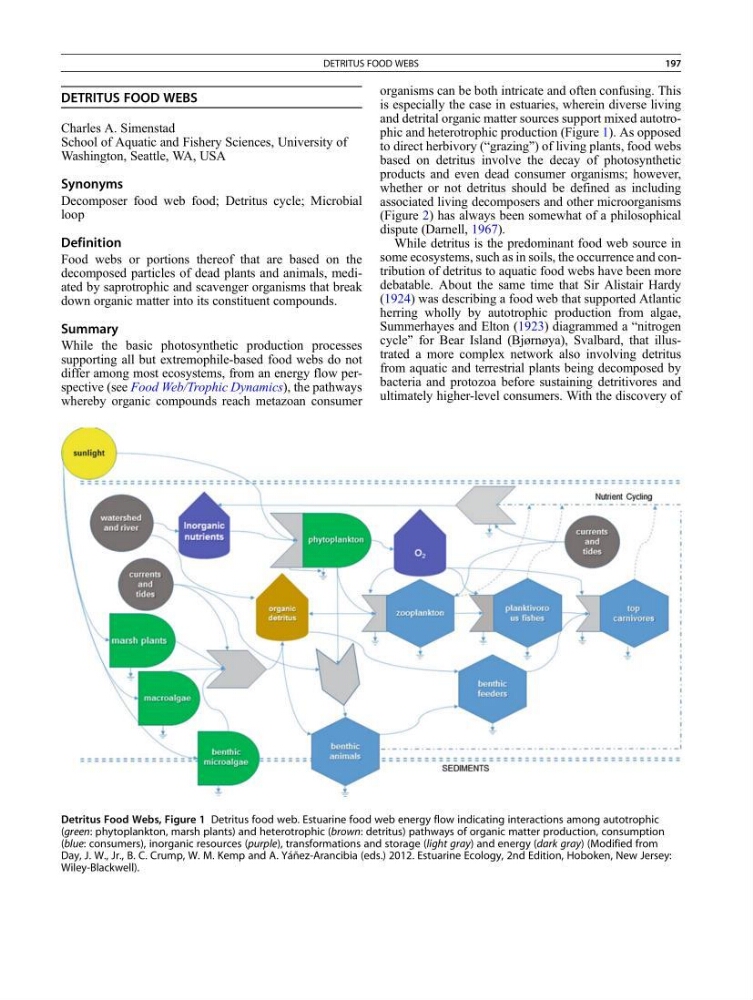
and detrital organic matter sources support mixed autotrophic and heterotrophic production (Figure 1). As opposed
to direct herbivory (“grazing”) of living plants, food webs
based on detritus involve the decay of photosynthetic
products and even dead consumer organisms; however,
whether or not detritus should be defined as including
associated living decomposers and other microorganisms
(Figure 2) has always been somewhat of a philosophical
dispute (Darnell, 1967).
While detritus is the predominant food web source in
some ecosystems, such as in soils, the occurrence and contribution of detritus to aquatic food webs have been more
debatable. About the same time that Sir Alistair Hardy
(1924) was describing a food web that supported Atlantic
herring wholly by autotrophic production from algae,
Summerhayes and Elton (1923) diagrammed a “nitrogen
cycle” for Bear Island (Bjørnøya), Svalbard, that illustrated a more complex network also involving detritus
from aquatic and terrestrial plants being decomposed by
bacteria and protozoa before sustaining detritivores and
ultimately higher-level consumers. With the discovery of
Detritus Food Webs, Figure 1 Detritus food web. Estuarine food web energy flow indicating interactions among autotrophic
(green: phytoplankton, marsh plants) and heterotrophic (brown: detritus) pathways of organic matter production, consumption
(blue: consumers), inorganic resources (purple), transformations and storage (light gray) and energy (dark gray) (Modified from
Day, J. W., Jr., B. C. Crump, W. M. Kemp and A. Ya ´n ˜ ez-Arancibia (eds.) 2012. Estuarine Ecology, 2nd Edition, Hoboken, New Jersey:
Wiley-Blackwell).
DETRITUS FOOD WEBS
197
Charles A. Simenstad
School of Aquatic and Fishery Sciences, University of
Washington, Seattle, WA, USA
Synonyms
Decomposer food web food; Detritus cycle; Microbial
loop
Definition
Food webs or portions thereof that are based on the
decomposed particles of dead plants and animals, mediated by saprotrophic and scavenger organisms that break
down organic matter into its constituent compounds.
Summary
While the basic photosynthetic production processes
supporting all but extremophile-based food webs do not
differ among most ecosystems, from an energy flow perspective (see Food Web/Trophic Dynamics), the pathways
whereby organic compounds reach metazoan consumer
organisms can be both intricate and often confusing. This
is especially the case in estuaries, wherein diverse living
and detrital organic matter sources support mixed autotrophic and heterotrophic production (Figure 1). As opposed
to direct herbivory (“grazing”) of living plants, food webs
based on detritus involve the decay of photosynthetic
products and even dead consumer organisms; however,
whether or not detritus should be defined as including
associated living decomposers and other microorganisms
(Figure 2) has always been somewhat of a philosophical
dispute (Darnell, 1967).
While detritus is the predominant food web source in
some ecosystems, such as in soils, the occurrence and contribution of detritus to aquatic food webs have been more
debatable. About the same time that Sir Alistair Hardy
(1924) was describing a food web that supported Atlantic
herring wholly by autotrophic production from algae,
Summerhayes and Elton (1923) diagrammed a “nitrogen
cycle” for Bear Island (Bjørnøya), Svalbard, that illustrated a more complex network also involving detritus
from aquatic and terrestrial plants being decomposed by
bacteria and protozoa before sustaining detritivores and
ultimately higher-level consumers. With the discovery of
Detritus Food Webs, Figure 1 Detritus food web. Estuarine food web energy flow indicating interactions among autotrophic
(green: phytoplankton, marsh plants) and heterotrophic (brown: detritus) pathways of organic matter production, consumption
(blue: consumers), inorganic resources (purple), transformations and storage (light gray) and energy (dark gray) (Modified from
Day, J. W., Jr., B. C. Crump, W. M. Kemp and A. Ya ´n ˜ ez-Arancibia (eds.) 2012. Estuarine Ecology, 2nd Edition, Hoboken, New Jersey:
Wiley-Blackwell).
DETRITUS FOOD WEBS
197