

Figure 6 shows a simplified and idealized grossshoaled stratigraphy of deltas formed in sand-dominated,
mixed sand-and-mud, and mud-dominated settings under
hydrodynamics conditions of fluvial dominated, wave
dominated, or tide dominated. The complications in stratigraphy due to lateral deltaic morphologic variation are
not shown here. The sand-dominated deltas need not be
exclusively sandy but may have a minor component of
mud, and similarly, mud-dominated deltas need not be
exclusively muddy but may have a minor component of
sand. Sand in mud-dominated deltas can be exogenic
(riverine sources) or endogenic (generated biogenically).
Microstratigraphic details of the various facies and
subfacies of deltas in these different hydrodynamic
environments can be found in Dalrymple et al. (1992),
Allen and Posamentier (1993), and Semeniuk (this
volume on “Stratigraphy of Estuaries”).
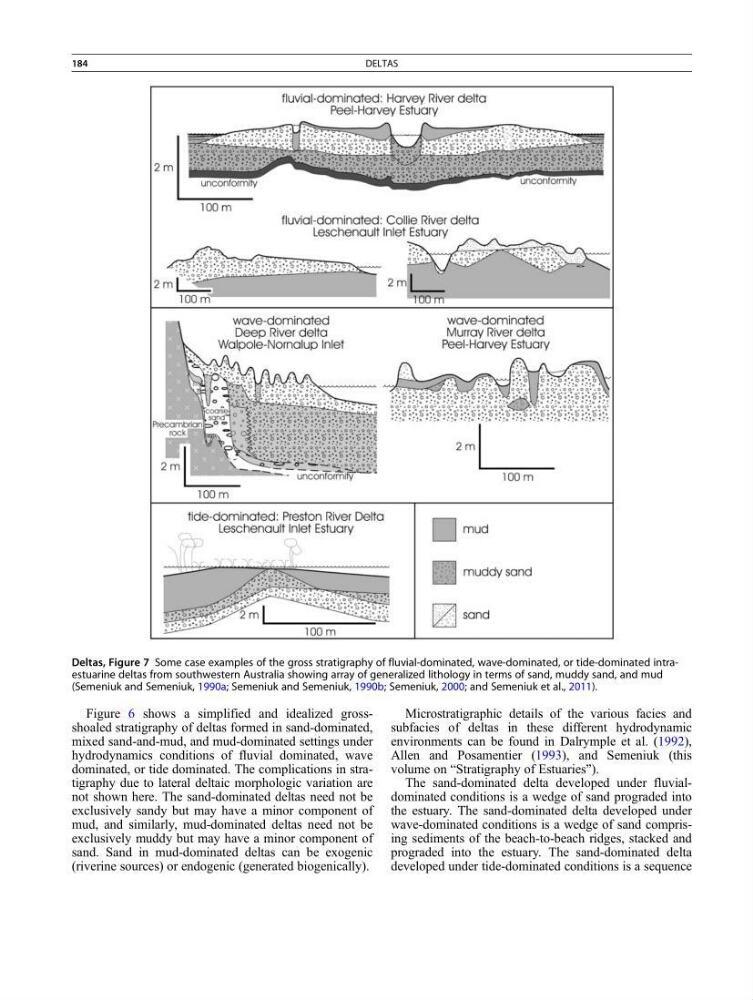
The sand-dominated delta developed under fluvialdominated conditions is a wedge of sand prograded into
the estuary. The sand-dominated delta developed under
wave-dominated conditions is a wedge of sand comprising sediments of the beach-to-beach ridges, stacked and
prograded into the estuary. The sand-dominated delta
developed under tide-dominated conditions is a sequence
Deltas, Figure 7 Some case examples of the gross stratigraphy of fluvial-dominated, wave-dominated, or tide-dominated intraestuarine deltas from southwestern Australia showing array of generalized lithology in terms of sand, muddy sand, and mud
(Semeniuk and Semeniuk, 1990a; Semeniuk and Semeniuk, 1990b; Semeniuk, 2000; and Semeniuk et al., 2011).
184
DELTAS
mixed sand-and-mud, and mud-dominated settings under
hydrodynamics conditions of fluvial dominated, wave
dominated, or tide dominated. The complications in stratigraphy due to lateral deltaic morphologic variation are
not shown here. The sand-dominated deltas need not be
exclusively sandy but may have a minor component of
mud, and similarly, mud-dominated deltas need not be
exclusively muddy but may have a minor component of
sand. Sand in mud-dominated deltas can be exogenic
(riverine sources) or endogenic (generated biogenically).
Microstratigraphic details of the various facies and
subfacies of deltas in these different hydrodynamic
environments can be found in Dalrymple et al. (1992),
Allen and Posamentier (1993), and Semeniuk (this
volume on “Stratigraphy of Estuaries”).
The sand-dominated delta developed under fluvialdominated conditions is a wedge of sand prograded into
the estuary. The sand-dominated delta developed under
wave-dominated conditions is a wedge of sand comprising sediments of the beach-to-beach ridges, stacked and
prograded into the estuary. The sand-dominated delta
developed under tide-dominated conditions is a sequence
Deltas, Figure 7 Some case examples of the gross stratigraphy of fluvial-dominated, wave-dominated, or tide-dominated intraestuarine deltas from southwestern Australia showing array of generalized lithology in terms of sand, muddy sand, and mud
(Semeniuk and Semeniuk, 1990a; Semeniuk and Semeniuk, 1990b; Semeniuk, 2000; and Semeniuk et al., 2011).
184
DELTAS