

determines the supply and composition of sediment delivery. Whether the delta is sand, mixed sand and mud, or
mud-dominated, how much gravel is present and the type
of shoaling stratigraphy that is developed are factors
dependent not only on provenance but also on the hydrodynamic factors at the interface of river and estuary.
The effects of seasonality and strength of river flow, the
magnitude of the tides, and the influence of wind in generating wind waves and circulation currents on intraestuarine deltaic stratigraphy are expressed in the dominant grain size which results in, by the way in which the
gravel, sand, and mud are separated into different deltaic
environments, the distance the gravel, sand, and mud are
transported from the river mouth, the types of sedimentological mechanisms that occur, and the range of sedimentary structures that are generated. Differences can result in
upward shoaling, sediment interlayering, the development
of environment-specific sedimentary structures, and the
micro-stratigraphic and macro-stratigraphic sequences.
Climate plays a part in the development of deltaic stratigraphic sequences in that rainfall and evaporation can
determine the nature of the high-tidal and supratidal lithologies (whether they are vegetated and replete with plant
root bioturbation or are mud-cracked and have generated
mud chips or contain evaporite minerals) and if organic
matter-enriched sediment and/or peat forms the upper part
of the stratigraphy. Climate also determines the nature of
biota that colonize deltaic environments. The composition
of these biota varies according to biogeographic setting,
the occurrence of the biota relative to supratidal, tidal
zones, and the subtidal and substrate type. The biota influence sedimentation and generation of lithotypes through
shell and test production, root-structuring by trees, sedges,
rushes and other salt marsh plants, bioturbation by plants
and animals, and production of organic matter. Shell material contributes to the gravel and sand fraction in sediments and, through winnowing during wave action and
storms, may be concentrated into sheets, lenses, and
cheniers in mud-dominated sediments. The range of biota
that directly contributes material to the lithotype or alter
sedimentary structures by bioturbation and rootstructuring include mangroves in tidal tropical environments, rushes, sedges, samphire, and other salt marsh
plants in tidal tropical and subtropical environments, various crustacean-polychaete-mollusc assemblages in tidal
tropical and subtropical environments, and wetland forests, sedges, and grasses in subaerial deltaic environments.
Biota in intra-estuarine deltas are also described in
Semeniuk and Semeniuk (this volume) in their description
of Estuarine Deltaic Wetlands.
The stratigraphy of deltas within estuaries
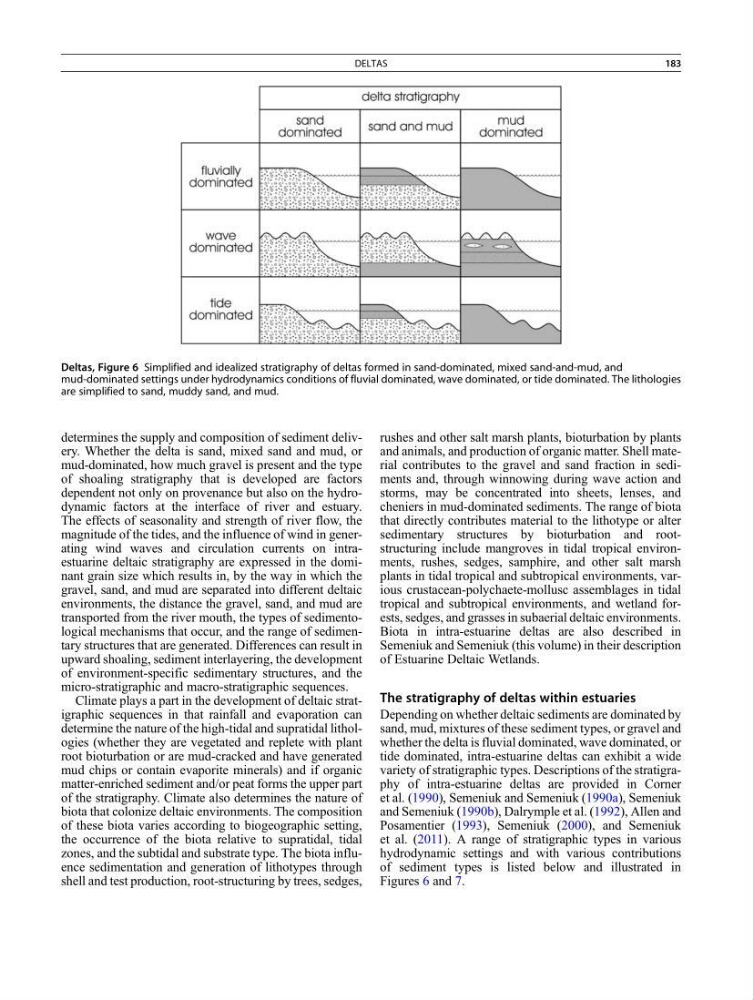
Depending on whether deltaic sediments are dominated by
sand, mud, mixtures of these sediment types, or gravel and
whether the delta is fluvial dominated, wave dominated, or
tide dominated, intra-estuarine deltas can exhibit a wide
variety of stratigraphic types. Descriptions of the stratigraphy of intra-estuarine deltas are provided in Corner
et al. (1990), Semeniuk and Semeniuk (1990a), Semeniuk
and Semeniuk (1990b), Dalrymple et al. (1992), Allen and
Posamentier (1993), Semeniuk (2000), and Semeniuk
et al. (2011). A range of stratigraphic types in various
hydrodynamic settings and with various contributions
of sediment types is listed below and illustrated in
Figures 6 and 7.
Deltas, Figure 6 Simplified and idealized stratigraphy of deltas formed in sand-dominated, mixed sand-and-mud, and
mud-dominated settings under hydrodynamics conditions of fluvial dominated, wave dominated, or tide dominated. The lithologies
are simplified to sand, muddy sand, and mud.
DELTAS
183
mud-dominated, how much gravel is present and the type
of shoaling stratigraphy that is developed are factors
dependent not only on provenance but also on the hydrodynamic factors at the interface of river and estuary.
The effects of seasonality and strength of river flow, the
magnitude of the tides, and the influence of wind in generating wind waves and circulation currents on intraestuarine deltaic stratigraphy are expressed in the dominant grain size which results in, by the way in which the
gravel, sand, and mud are separated into different deltaic
environments, the distance the gravel, sand, and mud are
transported from the river mouth, the types of sedimentological mechanisms that occur, and the range of sedimentary structures that are generated. Differences can result in
upward shoaling, sediment interlayering, the development
of environment-specific sedimentary structures, and the
micro-stratigraphic and macro-stratigraphic sequences.
Climate plays a part in the development of deltaic stratigraphic sequences in that rainfall and evaporation can
determine the nature of the high-tidal and supratidal lithologies (whether they are vegetated and replete with plant
root bioturbation or are mud-cracked and have generated
mud chips or contain evaporite minerals) and if organic
matter-enriched sediment and/or peat forms the upper part
of the stratigraphy. Climate also determines the nature of
biota that colonize deltaic environments. The composition
of these biota varies according to biogeographic setting,
the occurrence of the biota relative to supratidal, tidal
zones, and the subtidal and substrate type. The biota influence sedimentation and generation of lithotypes through
shell and test production, root-structuring by trees, sedges,
rushes and other salt marsh plants, bioturbation by plants
and animals, and production of organic matter. Shell material contributes to the gravel and sand fraction in sediments and, through winnowing during wave action and
storms, may be concentrated into sheets, lenses, and
cheniers in mud-dominated sediments. The range of biota
that directly contributes material to the lithotype or alter
sedimentary structures by bioturbation and rootstructuring include mangroves in tidal tropical environments, rushes, sedges, samphire, and other salt marsh
plants in tidal tropical and subtropical environments, various crustacean-polychaete-mollusc assemblages in tidal
tropical and subtropical environments, and wetland forests, sedges, and grasses in subaerial deltaic environments.
Biota in intra-estuarine deltas are also described in
Semeniuk and Semeniuk (this volume) in their description
of Estuarine Deltaic Wetlands.
The stratigraphy of deltas within estuaries
Depending on whether deltaic sediments are dominated by
sand, mud, mixtures of these sediment types, or gravel and
whether the delta is fluvial dominated, wave dominated, or
tide dominated, intra-estuarine deltas can exhibit a wide
variety of stratigraphic types. Descriptions of the stratigraphy of intra-estuarine deltas are provided in Corner
et al. (1990), Semeniuk and Semeniuk (1990a), Semeniuk
and Semeniuk (1990b), Dalrymple et al. (1992), Allen and
Posamentier (1993), Semeniuk (2000), and Semeniuk
et al. (2011). A range of stratigraphic types in various
hydrodynamic settings and with various contributions
of sediment types is listed below and illustrated in
Figures 6 and 7.
Deltas, Figure 6 Simplified and idealized stratigraphy of deltas formed in sand-dominated, mixed sand-and-mud, and
mud-dominated settings under hydrodynamics conditions of fluvial dominated, wave dominated, or tide dominated. The lithologies
are simplified to sand, muddy sand, and mud.
DELTAS
183