

be that the next landward feature is another coastal barrier
or ancient rocks. In this use of the term, it is merely
a barrier between the water and other land or landforms,
and it is likely consistent with the original use of the term
(Johnson, 1919).
Description
In the American literature, it has been common to refer
to a barrier as a barrier island, due to the predominance
of these types of barriers on the East Coast of the
USA. However, a barrier island is only one type of
a suite of types of coastal barriers. Dillenburg and Hesp
(2009) state that “a coastal barrier is a shore parallel structure, formed by an accumulation of sand, gravel, shells,
and small amounts of organic material due to the action
of waves, tides and winds” (p. 1). In some cases,
a barrier may not be shore parallel, particularly where spits
are forming (Zenkovich, 1967).
Hesp and Short (1999) define a coastal barrier as “a
shore-parallel, sub-aerial and sub-aqueous accumulation
of detrital sediment formed by waves, tides and aeolian
processes. It constitutes a definable coastal landform or
sequence of landforms which is clearly separate in age,
lithology, and/or form from adjacent, underlying or landward landforms. The barrier may block off or impound
drainage from the hinterland, but this is not
a prerequisite for definition as a barrier” (p. 308). Coastal
barriers may be progradational (building seawards),
retrogradational (eroding landwards), or stable (Morton,
1994), and they may be transgressive where sea level is
rising and regressive where sea level is falling (Hesp and
Short, 1999).
There are a variety of coastal barrier types and many
varying terms for these types. On an evolutionary continuum, coastal barriers range from barrier islands (i.e.,
a barrier separated from the mainland by a lagoon or sea
with no connections to the mainland at either end, thus
a true island) to attached barriers (i.e., barriers that are
attached to the mainland and may merely be a beach or
have dune fields which transgress or climb the mainland
terrain) (Figure 1). Where the barrier is predominantly
a beach and attached to the mainland, it has also been
termed a bayhead beach (Johnson, 1919) and mainland
beach (Roy et al., 1994). In between these types are various types such as barrier spits (barrier connected at one
end to the mainland) and bay barriers (barrier connected
at both ends and extending across a bay) (Shepard, 1960;
Dillenburg and Hesp, 2009).
The subaerial morphology of coastal barriers may range
from a beach and backshore, overwash terrace, overwash
fans and nebkha (discrete small dunes), beach and
foredune, beach and beach ridge, multiple foredunes
(relict foredune plains), beach ridge plains, foredune and
blowouts, parabolic dunefields and transgressive
dunefields, or combinations of these. All of the dune types
may be found on progradational, retrogradational, or
stable barriers.
Bibliography
Davis, W. M., 1912. Die Erklarende Beschreibung der Landformen.
Berlin: Teubner.
Dillenburg, S. R., and Hesp, P. A., 2009. Coastal barriers: an introduction. In Dillenburg, S. R., and Hesp, P. A. (eds.), Geology and
Geomorphology of Holocene Coastal Barriers of Brazil. Berlin:
Springer. Lecture Notes in Earth Sciences, Vol. 107, pp. 1–15.
Hesp, P. A., and Short, A. D., 1999. Barrier morphodynamics. In
Short, A. D. (ed.), Handbook of Beach and Shoreface
Morphodynamics. New York: Wiley, pp. 307–333.
Johnson, D. W., 1919. Shore Processes and Shoreline Development.
New York: Wiley.
Morton, R. A., 1994. Texas barriers. In Davis, R. A., Jr. (ed.),
Geology of Holocene Barrier Island Systems. New York:
Springer, pp. 75–114.
Roy, P. S., Cowell, P. J., Ferland, M. A., and Thom, B. G., 1994.
Wave dominated coasts. In Carter, R. W. G., and Woodroffe,
C. D. (eds.), Coastal Evolution, Late Quaternary Shoreline
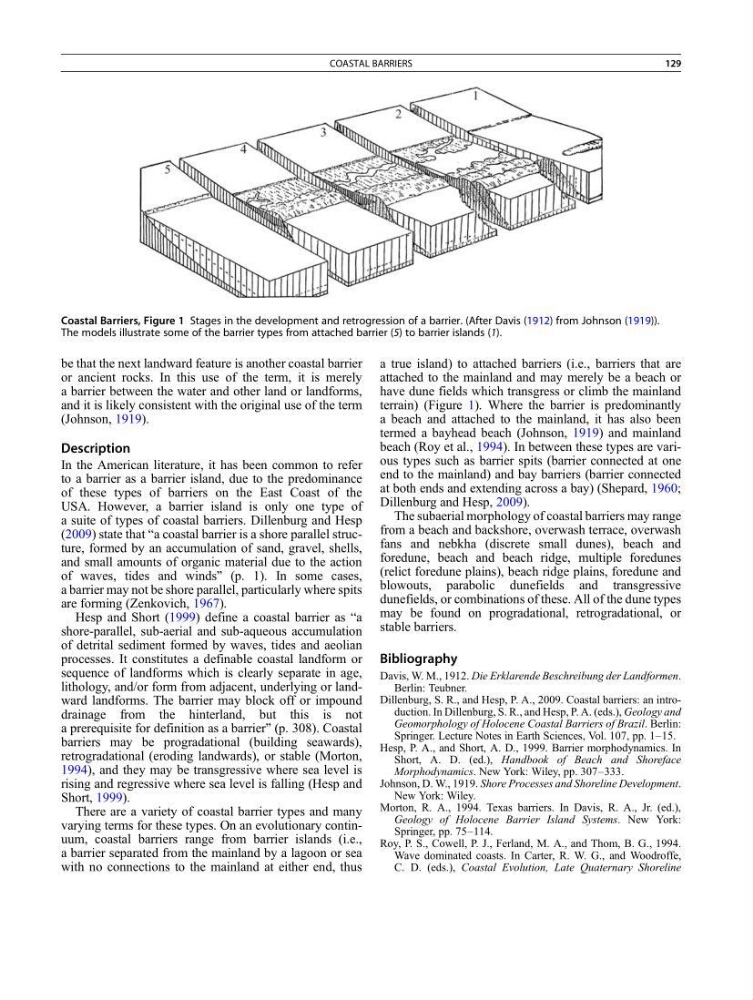
Coastal Barriers, Figure 1 Stages in the development and retrogression of a barrier. (After Davis (1912) from Johnson (1919)).
The models illustrate some of the barrier types from attached barrier (5) to barrier islands (1).
COASTAL BARRIERS
129
or ancient rocks. In this use of the term, it is merely
a barrier between the water and other land or landforms,
and it is likely consistent with the original use of the term
(Johnson, 1919).
Description
In the American literature, it has been common to refer
to a barrier as a barrier island, due to the predominance
of these types of barriers on the East Coast of the
USA. However, a barrier island is only one type of
a suite of types of coastal barriers. Dillenburg and Hesp
(2009) state that “a coastal barrier is a shore parallel structure, formed by an accumulation of sand, gravel, shells,
and small amounts of organic material due to the action
of waves, tides and winds” (p. 1). In some cases,
a barrier may not be shore parallel, particularly where spits
are forming (Zenkovich, 1967).
Hesp and Short (1999) define a coastal barrier as “a
shore-parallel, sub-aerial and sub-aqueous accumulation
of detrital sediment formed by waves, tides and aeolian
processes. It constitutes a definable coastal landform or
sequence of landforms which is clearly separate in age,
lithology, and/or form from adjacent, underlying or landward landforms. The barrier may block off or impound
drainage from the hinterland, but this is not
a prerequisite for definition as a barrier” (p. 308). Coastal
barriers may be progradational (building seawards),
retrogradational (eroding landwards), or stable (Morton,
1994), and they may be transgressive where sea level is
rising and regressive where sea level is falling (Hesp and
Short, 1999).
There are a variety of coastal barrier types and many
varying terms for these types. On an evolutionary continuum, coastal barriers range from barrier islands (i.e.,
a barrier separated from the mainland by a lagoon or sea
with no connections to the mainland at either end, thus
a true island) to attached barriers (i.e., barriers that are
attached to the mainland and may merely be a beach or
have dune fields which transgress or climb the mainland
terrain) (Figure 1). Where the barrier is predominantly
a beach and attached to the mainland, it has also been
termed a bayhead beach (Johnson, 1919) and mainland
beach (Roy et al., 1994). In between these types are various types such as barrier spits (barrier connected at one
end to the mainland) and bay barriers (barrier connected
at both ends and extending across a bay) (Shepard, 1960;
Dillenburg and Hesp, 2009).
The subaerial morphology of coastal barriers may range
from a beach and backshore, overwash terrace, overwash
fans and nebkha (discrete small dunes), beach and
foredune, beach and beach ridge, multiple foredunes
(relict foredune plains), beach ridge plains, foredune and
blowouts, parabolic dunefields and transgressive
dunefields, or combinations of these. All of the dune types
may be found on progradational, retrogradational, or
stable barriers.
Bibliography
Davis, W. M., 1912. Die Erklarende Beschreibung der Landformen.
Berlin: Teubner.
Dillenburg, S. R., and Hesp, P. A., 2009. Coastal barriers: an introduction. In Dillenburg, S. R., and Hesp, P. A. (eds.), Geology and
Geomorphology of Holocene Coastal Barriers of Brazil. Berlin:
Springer. Lecture Notes in Earth Sciences, Vol. 107, pp. 1–15.
Hesp, P. A., and Short, A. D., 1999. Barrier morphodynamics. In
Short, A. D. (ed.), Handbook of Beach and Shoreface
Morphodynamics. New York: Wiley, pp. 307–333.
Johnson, D. W., 1919. Shore Processes and Shoreline Development.
New York: Wiley.
Morton, R. A., 1994. Texas barriers. In Davis, R. A., Jr. (ed.),
Geology of Holocene Barrier Island Systems. New York:
Springer, pp. 75–114.
Roy, P. S., Cowell, P. J., Ferland, M. A., and Thom, B. G., 1994.
Wave dominated coasts. In Carter, R. W. G., and Woodroffe,
C. D. (eds.), Coastal Evolution, Late Quaternary Shoreline
Coastal Barriers, Figure 1 Stages in the development and retrogression of a barrier. (After Davis (1912) from Johnson (1919)).
The models illustrate some of the barrier types from attached barrier (5) to barrier islands (1).
COASTAL BARRIERS
129