

are critical to consider since mobile fauna (fishes and invertebrates) use multiple habitats either for feeding, refuge
(Micheli and Peterson, 1999; Harwell et al., 2011), or
because they must move with tidal exposure (Coen et al.,
1999a, 2006; ASMFC, 2007).
Shell alone once planted or aquaculture gear once
deployed (Erbland and Ozbay, 2008; Dumbauld et al.,
2009; Marenghi and Ozbay, 2010; Coen et al., 2011a)
immediately attracts a diverse assemblage of organisms
prior to oysters and other sessile organisms recruiting
(Luckenbach et al., 2005; Walters and Coen, 2006).
Mobile resident and transient species can be found immediately on these “artificial reef” structures (Dumbauld
et al., 1993; Wenner et al., 1996; Coen et al., 1999b,
2006; Lehnert and Allen, 2002; Tolley and Volety, 2005;
ASMFC, 2007; Gregalis et al., 2009; Humphries et al.,
2011a; Humphries et al., 2011b). With time, oysters and
mussels and other filter-feeding invertebrates (barnacles,
cnidarians, tunicates) (Haven and Morales-Alamo, 1966;
Dame et al., 2001; Newell, 2004; Luckenbach et al.,
2005; Walters and Coen, 2006; Coen et al., 2007;
Kellogg et al., 2013) then settle. Cumulatively, these filter
feeders can filter significant quantities of water, potentially improving water clarity/quality locally (Nelson
et al., 2004; Newell, 2004; Grizzle et al., 2006; Grizzle
et al., 2008a; zu Ermgassen, 2013a, b; La Peyre et al.,
2014b) through increased denitrification rates and
enhanced nutrient sequestration into the shells themselves
(Piehler and Smyth, 2011; Carmichael et al., 2012;
Higgins et al., 2011, 2013; Kellogg et al., 2013; Smyth
et al., 2013; Hollein and Zarnoch, 2014). They also form
a unique association with fringing salt marsh habitats
where the two habitats often abut (Meyer et al., 1997;
DeBlieu et al., 2005; Piazza et al., 2005; Coen et al.,
2006, 2007, 2011b). The other ecosystem services
discussed above are just coming into play outside of North
America, based on publications and presentations at meetings such as International Conference on Shellfish Restoration (ICSR, Coen pers. obs., http://www.oyster-restoration.
org/workshops-meetings-related-to-oyster-restoration/).
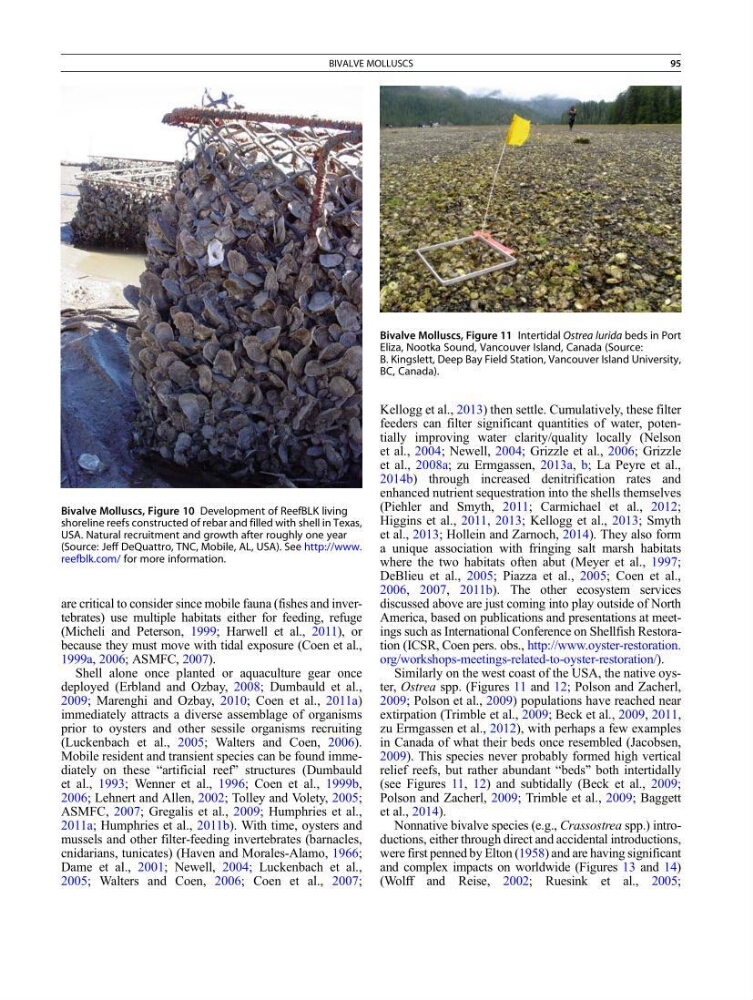
Similarly on the west coast of the USA, the native oyster, Ostrea spp. (Figures 11 and 12; Polson and Zacherl,
2009; Polson et al., 2009) populations have reached near
extirpation (Trimble et al., 2009; Beck et al., 2009, 2011,
zu Ermgassen et al., 2012), with perhaps a few examples
in Canada of what their beds once resembled (Jacobsen,
2009). This species never probably formed high vertical
relief reefs, but rather abundant “beds” both intertidally
(see Figures 11, 12) and subtidally (Beck et al., 2009;
Polson and Zacherl, 2009; Trimble et al., 2009; Baggett
et al., 2014).
Nonnative bivalve species (e.g., Crassostrea spp.) introductions, either through direct and accidental introductions,
were first penned by Elton (1958) and are having significant
and complex impacts on worldwide (Figures 13 and 14)
(Wolff and Reise, 2002; Ruesink et al., 2005;
Bivalve Molluscs, Figure 10 Development of ReefBLK living
shoreline reefs constructed of rebar and filled with shell in Texas,
USA. Natural recruitment and growth after roughly one year
(Source: Jeff DeQuattro, TNC, Mobile, AL, USA). See http://www.
reefblk.com/ for more information.
Bivalve Molluscs, Figure 11 Intertidal Ostrea lurida beds in Port
Eliza, Nootka Sound, Vancouver Island, Canada (Source:
B. Kingslett, Deep Bay Field Station, Vancouver Island University,
BC, Canada).
BIVALVE MOLLUSCS
95
(Micheli and Peterson, 1999; Harwell et al., 2011), or
because they must move with tidal exposure (Coen et al.,
1999a, 2006; ASMFC, 2007).
Shell alone once planted or aquaculture gear once
deployed (Erbland and Ozbay, 2008; Dumbauld et al.,
2009; Marenghi and Ozbay, 2010; Coen et al., 2011a)
immediately attracts a diverse assemblage of organisms
prior to oysters and other sessile organisms recruiting
(Luckenbach et al., 2005; Walters and Coen, 2006).
Mobile resident and transient species can be found immediately on these “artificial reef” structures (Dumbauld
et al., 1993; Wenner et al., 1996; Coen et al., 1999b,
2006; Lehnert and Allen, 2002; Tolley and Volety, 2005;
ASMFC, 2007; Gregalis et al., 2009; Humphries et al.,
2011a; Humphries et al., 2011b). With time, oysters and
mussels and other filter-feeding invertebrates (barnacles,
cnidarians, tunicates) (Haven and Morales-Alamo, 1966;
Dame et al., 2001; Newell, 2004; Luckenbach et al.,
2005; Walters and Coen, 2006; Coen et al., 2007;
Kellogg et al., 2013) then settle. Cumulatively, these filter
feeders can filter significant quantities of water, potentially improving water clarity/quality locally (Nelson
et al., 2004; Newell, 2004; Grizzle et al., 2006; Grizzle
et al., 2008a; zu Ermgassen, 2013a, b; La Peyre et al.,
2014b) through increased denitrification rates and
enhanced nutrient sequestration into the shells themselves
(Piehler and Smyth, 2011; Carmichael et al., 2012;
Higgins et al., 2011, 2013; Kellogg et al., 2013; Smyth
et al., 2013; Hollein and Zarnoch, 2014). They also form
a unique association with fringing salt marsh habitats
where the two habitats often abut (Meyer et al., 1997;
DeBlieu et al., 2005; Piazza et al., 2005; Coen et al.,
2006, 2007, 2011b). The other ecosystem services
discussed above are just coming into play outside of North
America, based on publications and presentations at meetings such as International Conference on Shellfish Restoration (ICSR, Coen pers. obs., http://www.oyster-restoration.
org/workshops-meetings-related-to-oyster-restoration/).
Similarly on the west coast of the USA, the native oyster, Ostrea spp. (Figures 11 and 12; Polson and Zacherl,
2009; Polson et al., 2009) populations have reached near
extirpation (Trimble et al., 2009; Beck et al., 2009, 2011,
zu Ermgassen et al., 2012), with perhaps a few examples
in Canada of what their beds once resembled (Jacobsen,
2009). This species never probably formed high vertical
relief reefs, but rather abundant “beds” both intertidally
(see Figures 11, 12) and subtidally (Beck et al., 2009;
Polson and Zacherl, 2009; Trimble et al., 2009; Baggett
et al., 2014).
Nonnative bivalve species (e.g., Crassostrea spp.) introductions, either through direct and accidental introductions,
were first penned by Elton (1958) and are having significant
and complex impacts on worldwide (Figures 13 and 14)
(Wolff and Reise, 2002; Ruesink et al., 2005;
Bivalve Molluscs, Figure 10 Development of ReefBLK living
shoreline reefs constructed of rebar and filled with shell in Texas,
USA. Natural recruitment and growth after roughly one year
(Source: Jeff DeQuattro, TNC, Mobile, AL, USA). See http://www.
reefblk.com/ for more information.
Bivalve Molluscs, Figure 11 Intertidal Ostrea lurida beds in Port
Eliza, Nootka Sound, Vancouver Island, Canada (Source:
B. Kingslett, Deep Bay Field Station, Vancouver Island University,
BC, Canada).
BIVALVE MOLLUSCS
95