

Norwegian "Grimlevand" with 60,000 t of oil in the mouth of the Elbe, but tugs
were able to pull them back into the navigation channel. In May 1977 it was the tanker "Classic", in December 1977 the Greek "Nicos J. Vardinoyannis" that run
aground in the Jade, but only about 100 t of oil were lost. In April 1978 the British
tanker "Camden" ran aground, but there was no oil leaking out, and there was again
no oil accident, when in February 1979 the "Esso Hawaii" stuck to the ground when
leaving Wilhelmshaven. In summary, the German coast had a really high number of
tanker groundings, but a surprising low oil pollution record. By the law of probability,
a fairly large oil spill is long overdue in the North Sea area.
How accidents happen and what consequences they can have can be learned from the
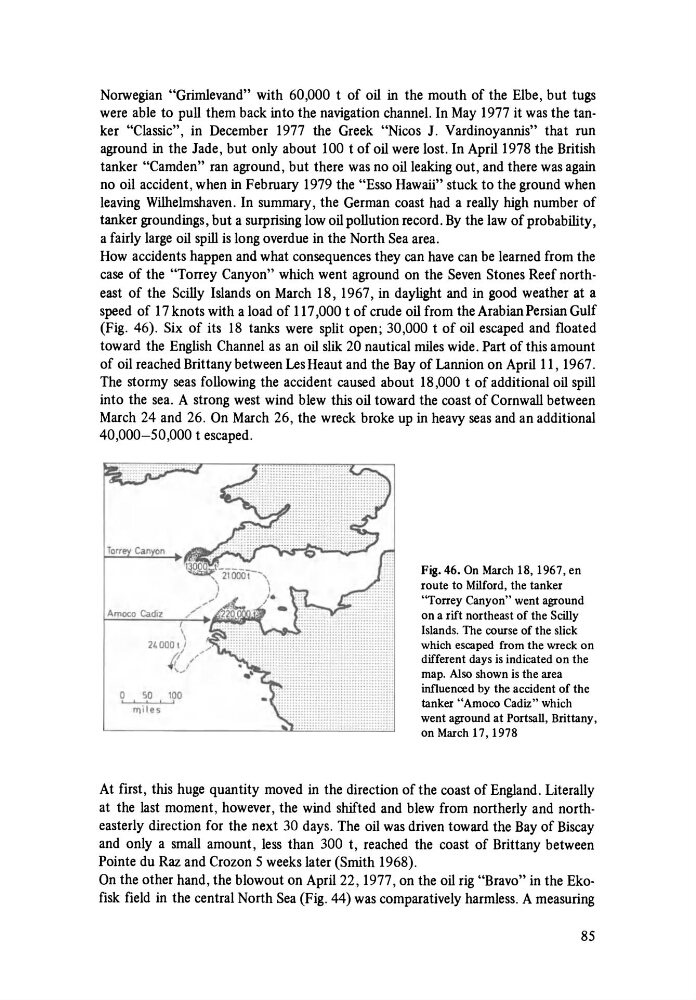
case of the "Torrey Canyon" which went aground on the Seven Stones Reef northeast of the Scilly Islands on March 18,1967, in daylight and in good weather at a
speed of 17 knots with a load of 117,000 t of crude oil from the Arabian Persian Gulf
(Fig. 46). Six of its 18 tanks were split open; 30,000 t of oil escaped and floated
toward the English Channel as an oil slik 20 nautical miles wide. Part of this amount
of oil reached Brittany between Les Heaut and the Bay of Lannion on April 11, 1967.
The stormy seas following the accident caused about 18,000 t of additional oil spill
into the sea. A strong west wind blew this oil toward the coast of Cornwall between
March 24 and 26. On March 26, the wreck broke up in heavy seas and an additional
40,000-50,000 t escaped.
Amoco Cadiz
\
\
2LOOO t I
/ (
1
~
I
~
r /
, j
9 . S,o I 190
miles
Fig. 46. On M:uch 18, 1967, en
route to Milford, the tanker
"Torrey Canyon" went aground
on a rift northeast of the Scilly
Islands. The course of the slick
which escaped from the wreck on
different days is indicated on the
map. Also shown is the :uea
influenced by the accident of the
tanker "Amoco Cadiz" which
went aground at Portsall, Brittany,
on M:uch 17, 1978
At first, this huge quantity moved in the direction of the coast of England. Literally
at the last moment, however, the wind shifted and blew from northerly and northeasterly direction for the next 30 days. The oil was driven toward the Bay of Biscay
and only a small amount, less than 300 t, reached the coast of Brittany between
Pointe du Raz and Crozon 5 weeks later (Smith 1968).
On the other hand, the blowout on April 22, 1977, on the oil rig "Bravo" in the Ekofisk field in the central North Sea (Fig. 44) was comparatively harmless. A measuring
85
were able to pull them back into the navigation channel. In May 1977 it was the tanker "Classic", in December 1977 the Greek "Nicos J. Vardinoyannis" that run
aground in the Jade, but only about 100 t of oil were lost. In April 1978 the British
tanker "Camden" ran aground, but there was no oil leaking out, and there was again
no oil accident, when in February 1979 the "Esso Hawaii" stuck to the ground when
leaving Wilhelmshaven. In summary, the German coast had a really high number of
tanker groundings, but a surprising low oil pollution record. By the law of probability,
a fairly large oil spill is long overdue in the North Sea area.
How accidents happen and what consequences they can have can be learned from the
case of the "Torrey Canyon" which went aground on the Seven Stones Reef northeast of the Scilly Islands on March 18,1967, in daylight and in good weather at a
speed of 17 knots with a load of 117,000 t of crude oil from the Arabian Persian Gulf
(Fig. 46). Six of its 18 tanks were split open; 30,000 t of oil escaped and floated
toward the English Channel as an oil slik 20 nautical miles wide. Part of this amount
of oil reached Brittany between Les Heaut and the Bay of Lannion on April 11, 1967.
The stormy seas following the accident caused about 18,000 t of additional oil spill
into the sea. A strong west wind blew this oil toward the coast of Cornwall between
March 24 and 26. On March 26, the wreck broke up in heavy seas and an additional
40,000-50,000 t escaped.
Amoco Cadiz
\
\
2LOOO t I
/ (
1
~
I
~
r /
, j
9 . S,o I 190
miles
Fig. 46. On M:uch 18, 1967, en
route to Milford, the tanker
"Torrey Canyon" went aground
on a rift northeast of the Scilly
Islands. The course of the slick
which escaped from the wreck on
different days is indicated on the
map. Also shown is the :uea
influenced by the accident of the
tanker "Amoco Cadiz" which
went aground at Portsall, Brittany,
on M:uch 17, 1978
At first, this huge quantity moved in the direction of the coast of England. Literally
at the last moment, however, the wind shifted and blew from northerly and northeasterly direction for the next 30 days. The oil was driven toward the Bay of Biscay
and only a small amount, less than 300 t, reached the coast of Brittany between
Pointe du Raz and Crozon 5 weeks later (Smith 1968).
On the other hand, the blowout on April 22, 1977, on the oil rig "Bravo" in the Ekofisk field in the central North Sea (Fig. 44) was comparatively harmless. A measuring
85