

80r-----~----._----._----_r__,
N
Q 60
'" on
'"
"0
E
.38 40
u
::l
o
[
~ 20
u
G,H,I
oM=~ __ L -____ L-____ ~ ____ ~~
o
7
14
TIME (days)
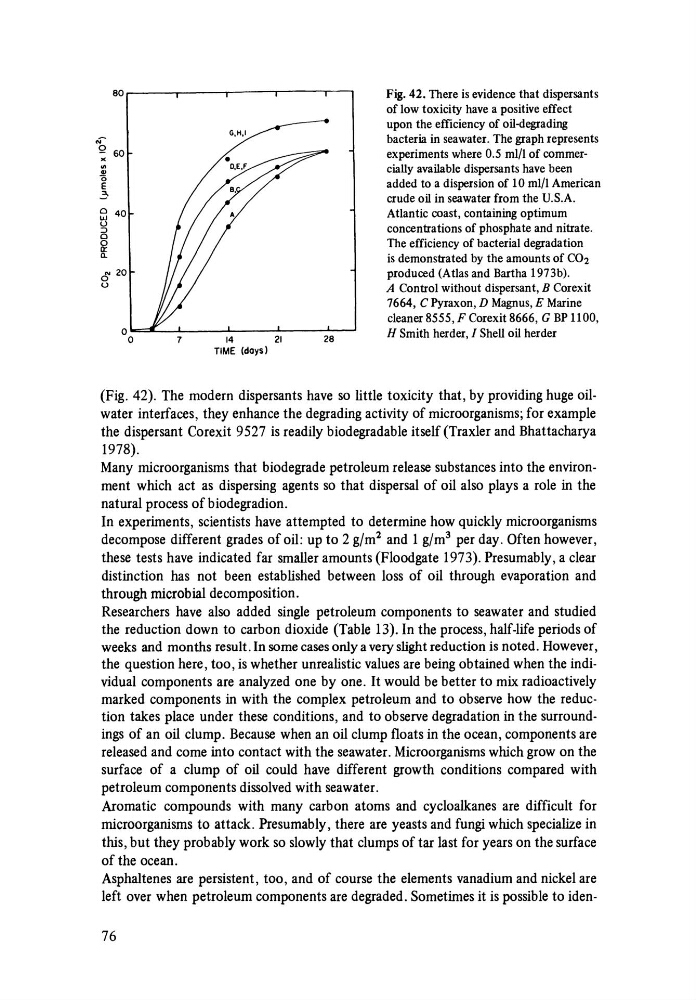
Fig, 42. There is evidence that dispersants
of low toxicity have a positive effect
upon the efficiency of oil-degrading
bacteria in seawater. The graph represents
experiments where 0.5 ml/l of commercially available dispersants have been
added to a dispersion of 10 ml/l American
crude oil in seawater from the U.S.A.
Atlantic coast, containing optimum
concentrations of phosphate and nitrate.
The efficiency of bacterial degradation
is demonstrated by the amounts of C02
produced (Atlas and Bartha 1973b).
A Control without dispersant, B Corexit
7664, C Pyraxon, D Magnus, E Marine
cleaner 8555, F Corexit 8666, G BP 1100,
H Smith herder, I Shell oil herder
(Fig. 42). The modern dispersants have so little toxicity that, by providing huge oilwater interfaces, they enhance the degrading activity of microorganisms; for example
the dispersant Corexit 9527 is readily biodegradable itself (Traxler and Bhattacharya
1978}.
Many microorganisms that biodegrade petroleum release substances into the environment which act as dispersing agents so that dispersal of oil also plays a role in the
natural process of biodegradion.
In experiments, scientists have attempted to determine how quickly microorganisms
decompose different grades of oil: up to 2 gJm 2 and 1 gJm 3 per day. Often however,
these tests have indicated far smaller amounts (Floodgate 1973). Presumably, a clear
distinction has not been established between loss of oil through evaporation and
through microbial decomposition.
Researchers have also added single petroleum components to seawater and studied
the reduction down to carbon dioxide (Table 13). In the process, half-life periods of
weeks and months result. In some cases only a very slight reduction is noted. However,
the question here, too, is whether unrealistic values are being obtained when the individual components are analyzed one by one. It would be better to mix radioactively
marked components in with the complex petroleum and to observe how the reduction takes place under these conditions, and to observe degradation in the surroundings of an oil clump. Because when an oil clump floats in the ocean, components are
released and come into contact with the seawater. Microorganisms which grow on the
surface of a clump of oil could have different growth conditions compared with
petroleum components dissolved with seawater.
Aromatic compounds with many carbon atoms and cycloalkanes are difficult for
microorganisms to attack. Presumably, there are yeasts and fungi which specialize in
this, but they probably work so slowly that clumps of tar last for years on the surface
of the ocean.
Asphaltenes are persistent, too, and of course the elements vanadium and nickel are
left over when petroleum components are degraded. Sometimes it is possible to iden76
N
Q 60
'" on
'"
"0
E
.38 40
u
::l
o
[
~ 20
u
G,H,I
oM=~ __ L -____ L-____ ~ ____ ~~
o
7
14
TIME (days)
Fig, 42. There is evidence that dispersants
of low toxicity have a positive effect
upon the efficiency of oil-degrading
bacteria in seawater. The graph represents
experiments where 0.5 ml/l of commercially available dispersants have been
added to a dispersion of 10 ml/l American
crude oil in seawater from the U.S.A.
Atlantic coast, containing optimum
concentrations of phosphate and nitrate.
The efficiency of bacterial degradation
is demonstrated by the amounts of C02
produced (Atlas and Bartha 1973b).
A Control without dispersant, B Corexit
7664, C Pyraxon, D Magnus, E Marine
cleaner 8555, F Corexit 8666, G BP 1100,
H Smith herder, I Shell oil herder
(Fig. 42). The modern dispersants have so little toxicity that, by providing huge oilwater interfaces, they enhance the degrading activity of microorganisms; for example
the dispersant Corexit 9527 is readily biodegradable itself (Traxler and Bhattacharya
1978}.
Many microorganisms that biodegrade petroleum release substances into the environment which act as dispersing agents so that dispersal of oil also plays a role in the
natural process of biodegradion.
In experiments, scientists have attempted to determine how quickly microorganisms
decompose different grades of oil: up to 2 gJm 2 and 1 gJm 3 per day. Often however,
these tests have indicated far smaller amounts (Floodgate 1973). Presumably, a clear
distinction has not been established between loss of oil through evaporation and
through microbial decomposition.
Researchers have also added single petroleum components to seawater and studied
the reduction down to carbon dioxide (Table 13). In the process, half-life periods of
weeks and months result. In some cases only a very slight reduction is noted. However,
the question here, too, is whether unrealistic values are being obtained when the individual components are analyzed one by one. It would be better to mix radioactively
marked components in with the complex petroleum and to observe how the reduction takes place under these conditions, and to observe degradation in the surroundings of an oil clump. Because when an oil clump floats in the ocean, components are
released and come into contact with the seawater. Microorganisms which grow on the
surface of a clump of oil could have different growth conditions compared with
petroleum components dissolved with seawater.
Aromatic compounds with many carbon atoms and cycloalkanes are difficult for
microorganisms to attack. Presumably, there are yeasts and fungi which specialize in
this, but they probably work so slowly that clumps of tar last for years on the surface
of the ocean.
Asphaltenes are persistent, too, and of course the elements vanadium and nickel are
left over when petroleum components are degraded. Sometimes it is possible to iden76