

to make a good growth of oil~egrading bacteria possible. For the decomposition of
1 mg of oil, the microorganisms require as much nitrogen as is normally contained in
a liter of coastal seawater. In addition they require 3.3 mg of oxygen which corresponds to the content in 0.41 of seawater. The amount of organic substances dissolved
in seawater also plays a role, possibly also the amount of suspended particles in seawater to which bacteria can attach themselves. Because the amount of nutrients is
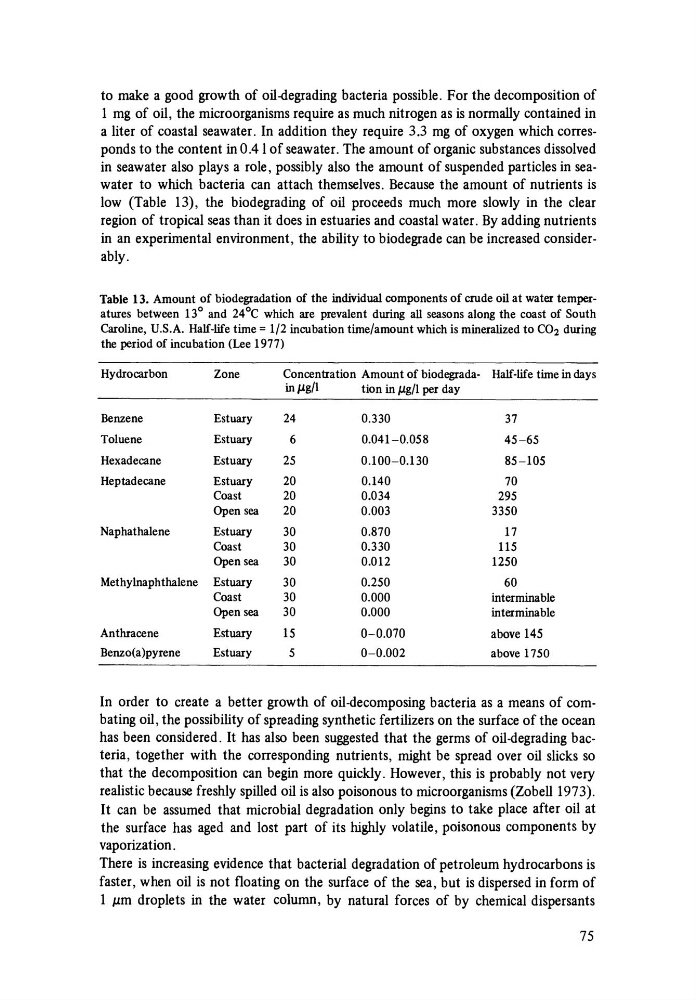
low (Table 13), the biodegrading of oil proceeds much more slowly in the clear
region of tropical seas than it does in estuaries and coastal water. By adding nutrients
in an experimental environment, the ability to biodegrade can be increased considerably.
Table 13. Amount of biodegradation of the individual components of crude oil at water temperatures between 13° and 24°C which are prevalent during all seasons along the coast of South
Caroline, U.S.A. Half-life time = 1/2 incubation time/amount which is mineralized to C02 during
the period of incubation (Lee 1977)
Hydrocarbon
Zone
Concentration Amount of biodegrada- Half-life time in days
in 1lg/1
tion in Ilg/1 per day
Benzene
Estuary
24
0.330
37
Toluene
Estuary
6
0.041-0.058
45-65
Hexadecane
Estuary
25
0.100-0.130
85-105
Heptadecane
Estuary
20
0.140
70
Coast
20
0.034
295
Open sea
20
0.003
3350
Naphathalene
Estuary
30
0.870
17
Coast
30
0.330
115
Open sea
30
0.012
1250
Methylnaphthalene Estuary
30
0.250
60
Coast
30
0.000
interminable
Open sea
30
0.000
interminable
Anthracene
Estuary
15
0-0.070
above 145
Benzo(a)pyrene
Estuary
5
0-0.002
above 1750
In order to create a better growth of oil-decomposing bacteria as a means of combating oil, the possibility of spreading synthetic fertilizers on the surface of the ocean
has been considered. It has also been suggested that the germs of oil~egrading bacteria, together with the corresponding nutrients, might be spread over oil slicks so
that the decomposition can begin more quickly. However, this is probably not very
realistic because freshly spilled oil is also poisonous to microorganisms (Zobell1973).
It can be assumed that microbial degradation only begins to take place after oil at
the surface has aged and lost part of its highly volatile, poisonous components by
vaporization.
There is increasing evidence that bacterial degradation of petroleum hydrocarbons is
faster, when oil is not floating on the surface of the sea, but is dispersed in form of
1 Ilm droplets in the water column, by natural forces of by chemical dispersants
75
1 mg of oil, the microorganisms require as much nitrogen as is normally contained in
a liter of coastal seawater. In addition they require 3.3 mg of oxygen which corresponds to the content in 0.41 of seawater. The amount of organic substances dissolved
in seawater also plays a role, possibly also the amount of suspended particles in seawater to which bacteria can attach themselves. Because the amount of nutrients is
low (Table 13), the biodegrading of oil proceeds much more slowly in the clear
region of tropical seas than it does in estuaries and coastal water. By adding nutrients
in an experimental environment, the ability to biodegrade can be increased considerably.
Table 13. Amount of biodegradation of the individual components of crude oil at water temperatures between 13° and 24°C which are prevalent during all seasons along the coast of South
Caroline, U.S.A. Half-life time = 1/2 incubation time/amount which is mineralized to C02 during
the period of incubation (Lee 1977)
Hydrocarbon
Zone
Concentration Amount of biodegrada- Half-life time in days
in 1lg/1
tion in Ilg/1 per day
Benzene
Estuary
24
0.330
37
Toluene
Estuary
6
0.041-0.058
45-65
Hexadecane
Estuary
25
0.100-0.130
85-105
Heptadecane
Estuary
20
0.140
70
Coast
20
0.034
295
Open sea
20
0.003
3350
Naphathalene
Estuary
30
0.870
17
Coast
30
0.330
115
Open sea
30
0.012
1250
Methylnaphthalene Estuary
30
0.250
60
Coast
30
0.000
interminable
Open sea
30
0.000
interminable
Anthracene
Estuary
15
0-0.070
above 145
Benzo(a)pyrene
Estuary
5
0-0.002
above 1750
In order to create a better growth of oil-decomposing bacteria as a means of combating oil, the possibility of spreading synthetic fertilizers on the surface of the ocean
has been considered. It has also been suggested that the germs of oil~egrading bacteria, together with the corresponding nutrients, might be spread over oil slicks so
that the decomposition can begin more quickly. However, this is probably not very
realistic because freshly spilled oil is also poisonous to microorganisms (Zobell1973).
It can be assumed that microbial degradation only begins to take place after oil at
the surface has aged and lost part of its highly volatile, poisonous components by
vaporization.
There is increasing evidence that bacterial degradation of petroleum hydrocarbons is
faster, when oil is not floating on the surface of the sea, but is dispersed in form of
1 Ilm droplets in the water column, by natural forces of by chemical dispersants
75