

54 °30'
53°30'
(Stout et al. 1972). Mullets (MugU) off the Pacific coast of Guatemala had amounts
of DDT up to 36 mg/kg. After shrimp had first died off, dead mullets were observed.
The cotton fields which were located directly on the coast had been intensively
treated with DDT (Keiser et al. 1974). DDT was used in large quantities as a pesticide
in the orchards all around the Sogne Fjord in Norway up until 1970. As a consequence, the liver of cod (Gadus morhua) from the Sogne Fjord contains DDT up to
10 mg/kg and may not be used for human consumption in the Federal Republic of
Germany (Stenersen and Kvalvag 1972). Fish caught at the mouth of the Viskan River
on the west coast of Sweden have such high amounts of dieldrin that they are not
allowed to be sold. Pesticides are also present in the waste water of wool factories
because in them textiles are treated against moths. PCB's can reach coastal waters
when factories in the vicinity of coastal areas have leakages in their cooling systems in
which PCB's are used as heat exchanger. One example is the Gulf of Mexico where
Penaeus shrimp had 17-132 mg/kg of PCB's in their intestine gland (Nimmo et al.
1971). Mangrove trees are very sensitive to herbicides. During the Vietnam War, approximately 1000 km 2 of mangrove fields were defoliated which consequently caused the
death of the plants (Odum and Johannes 1975). PCP, pentachlorophenol, seems to
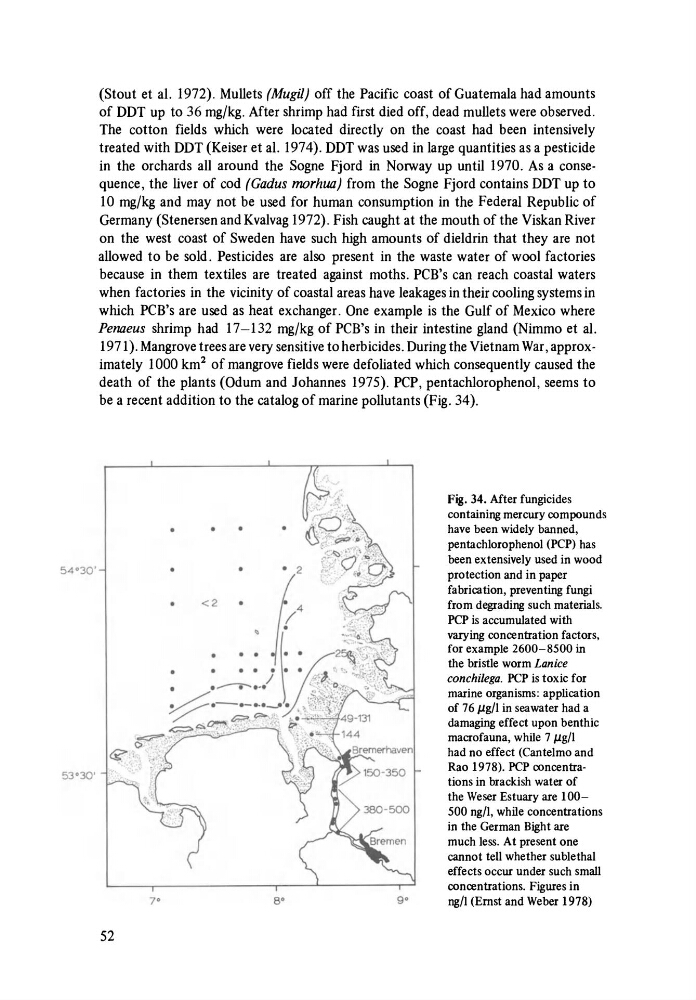
be a recent addition to the catalog of marine pollutants (Fig. 34).
go
52
Fig. 34. After fungicides
containing mercury compounds
have been widely banned,
pentachlorophenol (PCP) has
been extensively used in wood
protection and in paper
fabrication, preventing fungi
from degrading such materials.
PCP is accumulated with
varying concentration factors,
for example 2600-8500 in
the bristle worm Lanice
conchilega. PCP is toxic for
marine organisms: application
of 76 J.lg/l in seawater had a
damaging effect upon benthic
macrofauna, while 7 J.lg/l
had no effect (Cantelmo and
Rao 1978). PCP concentrations in brackish water of
the Weser Estuary are 100500 ng/l, while concentrations
in the German Bight are
much less. At present one
cannot tell whether sublethal
effects occur under such small
concentrations. Figures in
ng/l (Ernst and Weber 1978)
53°30'
(Stout et al. 1972). Mullets (MugU) off the Pacific coast of Guatemala had amounts
of DDT up to 36 mg/kg. After shrimp had first died off, dead mullets were observed.
The cotton fields which were located directly on the coast had been intensively
treated with DDT (Keiser et al. 1974). DDT was used in large quantities as a pesticide
in the orchards all around the Sogne Fjord in Norway up until 1970. As a consequence, the liver of cod (Gadus morhua) from the Sogne Fjord contains DDT up to
10 mg/kg and may not be used for human consumption in the Federal Republic of
Germany (Stenersen and Kvalvag 1972). Fish caught at the mouth of the Viskan River
on the west coast of Sweden have such high amounts of dieldrin that they are not
allowed to be sold. Pesticides are also present in the waste water of wool factories
because in them textiles are treated against moths. PCB's can reach coastal waters
when factories in the vicinity of coastal areas have leakages in their cooling systems in
which PCB's are used as heat exchanger. One example is the Gulf of Mexico where
Penaeus shrimp had 17-132 mg/kg of PCB's in their intestine gland (Nimmo et al.
1971). Mangrove trees are very sensitive to herbicides. During the Vietnam War, approximately 1000 km 2 of mangrove fields were defoliated which consequently caused the
death of the plants (Odum and Johannes 1975). PCP, pentachlorophenol, seems to
be a recent addition to the catalog of marine pollutants (Fig. 34).
go
52
Fig. 34. After fungicides
containing mercury compounds
have been widely banned,
pentachlorophenol (PCP) has
been extensively used in wood
protection and in paper
fabrication, preventing fungi
from degrading such materials.
PCP is accumulated with
varying concentration factors,
for example 2600-8500 in
the bristle worm Lanice
conchilega. PCP is toxic for
marine organisms: application
of 76 J.lg/l in seawater had a
damaging effect upon benthic
macrofauna, while 7 J.lg/l
had no effect (Cantelmo and
Rao 1978). PCP concentrations in brackish water of
the Weser Estuary are 100500 ng/l, while concentrations
in the German Bight are
much less. At present one
cannot tell whether sublethal
effects occur under such small
concentrations. Figures in
ng/l (Ernst and Weber 1978)