

In 1965, the number of Sterna sandvicensis terns on the island of Griend off the
coast of the Netherlands decreased dramatically. Only 650 out of 20,000 breeder
pairs survived; the dying birds showed definite signs of having been poisoned. The
fish that the terns ate were poisoned by the effluents of a chemical plant near Rotterdam that manufactures the chlorinated hydrocarbon pesticies telodrin, dieldrin, and
endrin. Between 1964 und 1967, the females of the Somateria mollissima eider duck
were also found to be dying in large numbers. Obviously the poisonous chlorinated
hydrocarbon substances were mobilized during breeding. In 1967, measures were taken
so that effluents of that type no longer leave the plant. By 1974, the number of terns
had risen back up to 5000 breeder pairs (Koeman et al. 1968; Koeman 1975).
Even in 1967, it was known that some organisms in the area around Los Angeles,
U.S.A., contained a high concentration of DDT. Then in 1970, a thorough investigation showed that the livers of fish from Baja California contained an average of less
than 1.2 mg/kg of DDT while 8 samples from the Santa Monica Bay were found to
contain 370 mg/kg 1 . Farther to the north the amounts were back to below I mg/kg.
In June, 1970, the canning of tuna fish had to be stopped because 13 mg/kg of DDT
were found to be present in the meat. The fish were taken from the area around Los
Angeles (Macgregor 1974).
In 1969, suspicions began to arise that something was the matter with the Pelecanus
occidentalis pelican which breeds on Anacapa Island, 35 nautical miles west of the
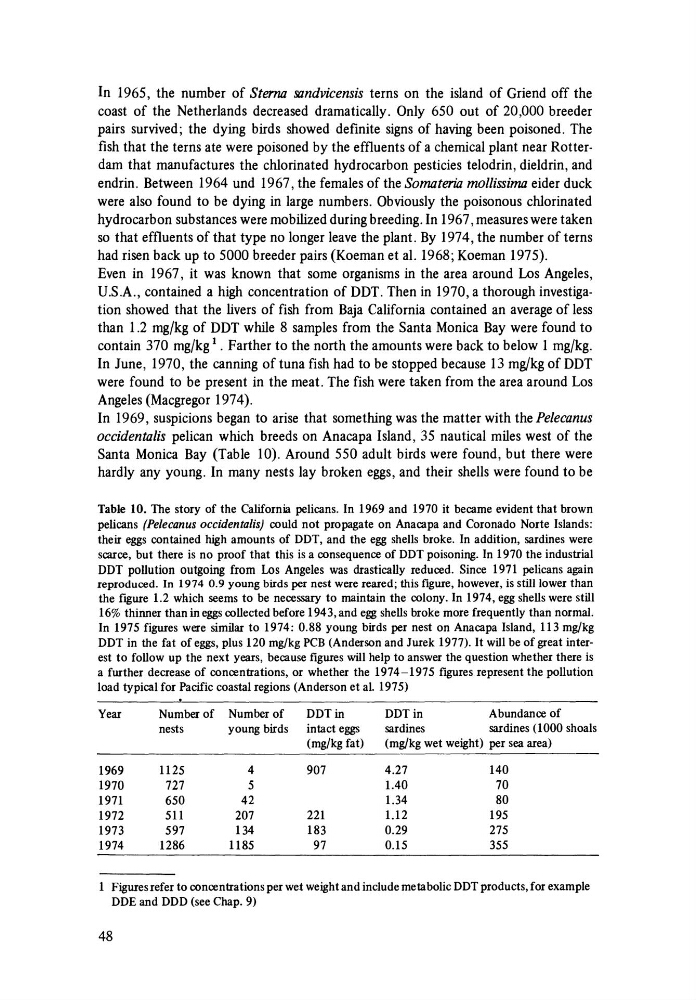
Santa Monica Bay (Table 1O). Around 550 adult birds were found, but there were
hardly any young. In many nests lay broken eggs, and their shells were found to be
Table 10. The story of the California pelicans. In 1969 and 1970 it became evident that brown
pelicans (Pelecanus occidentalis) could not propagate on Anacapa and Coronado Norte Islands:
their eggs contained high amounts of DDT, and the egg shells broke. In addition, sardines were
scarce, but there is no proof that this is a consequence of DDT poisoning. In 1970 the industrial
DDT pollution outgoing from Los Angeles was drastically reduced. Since 1971 pelicans again
reproduced. In 1974 0.9 young birds per nest were reared; this figure, however, is still lower than
the figure 1.2 which seems to be necessary to maintain the colony. In 1974, egg shells were still
16% thinner than in eggs collected before 1943, and egg shells broke more frequently than normal.
In 1975 figures were similar to 1974: 0.88 young birds per nest on Anacapa Island, 113 mg/kg
DDT in the fat of eggs, plus 120 mg/kg PCB (Anderson and Jurek 1977). It will be of great interest to follow up the next years, because figures will help to answer the question whether there is
a further decrease of concentrations, or whether the 1974-1975 figures represent the pollution
load typical for Pacific coastal regions (Anderson et a!. 1975)
Year
Number of Number of
DDT in
DDT in
Abundance of
nests
young birds
intact eggs
sardines
sardines (1000 shoals
(mg/kg fat)
(mg/kg wet weight) per sea area)
1969
1125
4
907
4.27
140
1970
727
5
1.40
70
1971
650
42
1.34
80
1972
511
207
221
1.12
195
1973
597
134
183
0.29
275
1974
1286
1185
97
0.15
355
Figures refer to concentrations per wet weight and include metabolic DDT products, for example
DDE and DDD (see Chap. 9)
48
coast of the Netherlands decreased dramatically. Only 650 out of 20,000 breeder
pairs survived; the dying birds showed definite signs of having been poisoned. The
fish that the terns ate were poisoned by the effluents of a chemical plant near Rotterdam that manufactures the chlorinated hydrocarbon pesticies telodrin, dieldrin, and
endrin. Between 1964 und 1967, the females of the Somateria mollissima eider duck
were also found to be dying in large numbers. Obviously the poisonous chlorinated
hydrocarbon substances were mobilized during breeding. In 1967, measures were taken
so that effluents of that type no longer leave the plant. By 1974, the number of terns
had risen back up to 5000 breeder pairs (Koeman et al. 1968; Koeman 1975).
Even in 1967, it was known that some organisms in the area around Los Angeles,
U.S.A., contained a high concentration of DDT. Then in 1970, a thorough investigation showed that the livers of fish from Baja California contained an average of less
than 1.2 mg/kg of DDT while 8 samples from the Santa Monica Bay were found to
contain 370 mg/kg 1 . Farther to the north the amounts were back to below I mg/kg.
In June, 1970, the canning of tuna fish had to be stopped because 13 mg/kg of DDT
were found to be present in the meat. The fish were taken from the area around Los
Angeles (Macgregor 1974).
In 1969, suspicions began to arise that something was the matter with the Pelecanus
occidentalis pelican which breeds on Anacapa Island, 35 nautical miles west of the
Santa Monica Bay (Table 1O). Around 550 adult birds were found, but there were
hardly any young. In many nests lay broken eggs, and their shells were found to be
Table 10. The story of the California pelicans. In 1969 and 1970 it became evident that brown
pelicans (Pelecanus occidentalis) could not propagate on Anacapa and Coronado Norte Islands:
their eggs contained high amounts of DDT, and the egg shells broke. In addition, sardines were
scarce, but there is no proof that this is a consequence of DDT poisoning. In 1970 the industrial
DDT pollution outgoing from Los Angeles was drastically reduced. Since 1971 pelicans again
reproduced. In 1974 0.9 young birds per nest were reared; this figure, however, is still lower than
the figure 1.2 which seems to be necessary to maintain the colony. In 1974, egg shells were still
16% thinner than in eggs collected before 1943, and egg shells broke more frequently than normal.
In 1975 figures were similar to 1974: 0.88 young birds per nest on Anacapa Island, 113 mg/kg
DDT in the fat of eggs, plus 120 mg/kg PCB (Anderson and Jurek 1977). It will be of great interest to follow up the next years, because figures will help to answer the question whether there is
a further decrease of concentrations, or whether the 1974-1975 figures represent the pollution
load typical for Pacific coastal regions (Anderson et a!. 1975)
Year
Number of Number of
DDT in
DDT in
Abundance of
nests
young birds
intact eggs
sardines
sardines (1000 shoals
(mg/kg fat)
(mg/kg wet weight) per sea area)
1969
1125
4
907
4.27
140
1970
727
5
1.40
70
1971
650
42
1.34
80
1972
511
207
221
1.12
195
1973
597
134
183
0.29
275
1974
1286
1185
97
0.15
355
Figures refer to concentrations per wet weight and include metabolic DDT products, for example
DDE and DDD (see Chap. 9)
48