

mg/kg
1000
100
10
Netherlands
Germany
East Anglia
West of Scotland
6
8
10 12
14 years
Table 9. Sandpipers hatch their eggs in the tundra
areas of the Arctic far away from the sea. Their
food there contains little mercury. For this reason,
the mercury content in the body tissue of sandpipers
is low when they migrate to the shallows of the
southern part of the North Sea in the fall. The longer
they feed there on Corophium crustaceans, Macoma
clams, Hydrobia snails, and Nereis bristle worms,
the higher the mercury concentration rises. Figures
are for the knot, Calidris canutus. from the Wash
area of southeast England. The range is given in
parentheses (Parslow 1973)
Date
August
October
January
February
March
Mercury concentration in liver
mg/kg dry weight
1.0 (0.4-1.5)
1.3 (0.8 -1.7)
7.3 (6.6-8.0)
9.8 (5.1-12.9)
14.4 (5.6-24.9)
3.3 Effluents from Pesticide Plants
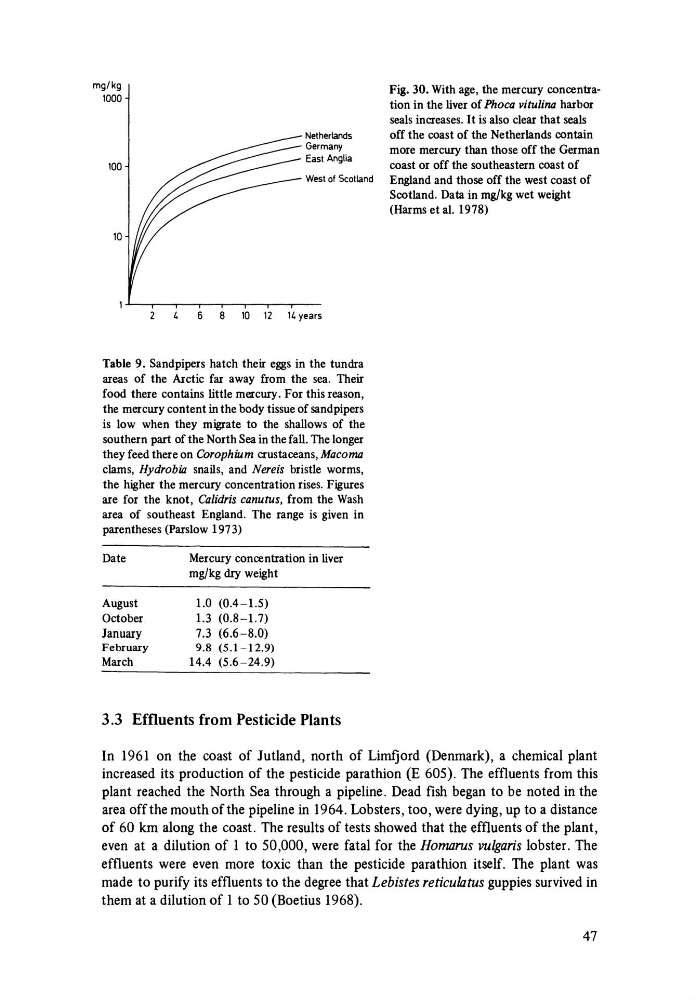
Fig. 30. With age, the mercury concentration in the liver of Phoca vitulina harbor
seals increases. It is also clear that seals
off the coast of the Netherlands contain
more mercury than those off the German
coast or off the southeastern coast of
England and those off the west coast of
Scotland. Data in mg/kg wet weight
(Harms et al. 1978)
In 1961 on the coast of Jutland, north of Limfjord (Denmark), a chemical plant
increased its production of the pesticide parathion (E 605). The effluents from this
plant reached the North Sea through a pipeline. Dead fish began to be noted in the
area off the mouth of the pipeline in 1964. Lobsters, too, were dying, up to a distance
of 60 km along the coast. The results of tests showed that the effluents of the plant,
even at a dilution of 1 to 50,000, were fatal for the Homarus vulgaris lobster. The
effluents were even more toxic than the pesticide parathion itself. The plant was
made to purify its effluents to the degree that Lebistes reticulatus guppies survived in
them at a dilution of 1 to 50 (Boetius 1968).
47
1000
100
10
Netherlands
Germany
East Anglia
West of Scotland
6
8
10 12
14 years
Table 9. Sandpipers hatch their eggs in the tundra
areas of the Arctic far away from the sea. Their
food there contains little mercury. For this reason,
the mercury content in the body tissue of sandpipers
is low when they migrate to the shallows of the
southern part of the North Sea in the fall. The longer
they feed there on Corophium crustaceans, Macoma
clams, Hydrobia snails, and Nereis bristle worms,
the higher the mercury concentration rises. Figures
are for the knot, Calidris canutus. from the Wash
area of southeast England. The range is given in
parentheses (Parslow 1973)
Date
August
October
January
February
March
Mercury concentration in liver
mg/kg dry weight
1.0 (0.4-1.5)
1.3 (0.8 -1.7)
7.3 (6.6-8.0)
9.8 (5.1-12.9)
14.4 (5.6-24.9)
3.3 Effluents from Pesticide Plants
Fig. 30. With age, the mercury concentration in the liver of Phoca vitulina harbor
seals increases. It is also clear that seals
off the coast of the Netherlands contain
more mercury than those off the German
coast or off the southeastern coast of
England and those off the west coast of
Scotland. Data in mg/kg wet weight
(Harms et al. 1978)
In 1961 on the coast of Jutland, north of Limfjord (Denmark), a chemical plant
increased its production of the pesticide parathion (E 605). The effluents from this
plant reached the North Sea through a pipeline. Dead fish began to be noted in the
area off the mouth of the pipeline in 1964. Lobsters, too, were dying, up to a distance
of 60 km along the coast. The results of tests showed that the effluents of the plant,
even at a dilution of 1 to 50,000, were fatal for the Homarus vulgaris lobster. The
effluents were even more toxic than the pesticide parathion itself. The plant was
made to purify its effluents to the degree that Lebistes reticulatus guppies survived in
them at a dilution of 1 to 50 (Boetius 1968).
47