

It is a goal for ecologists to establish temperature standards for different bodies of
water in order to be able to determine how water temperatures differ now from their
preindustrialized state and to determine into which areas additional warm water can
be introduced without reaching critical levels. In view of the high investment cost for
power plant construction and the additional high cost of cooling towers which disperse the heat into the atmosphere, calculations relevant to water temperatures are of
great economic importance. But only in recent years have the required funds been
designated and released for programs and measurement and the development of
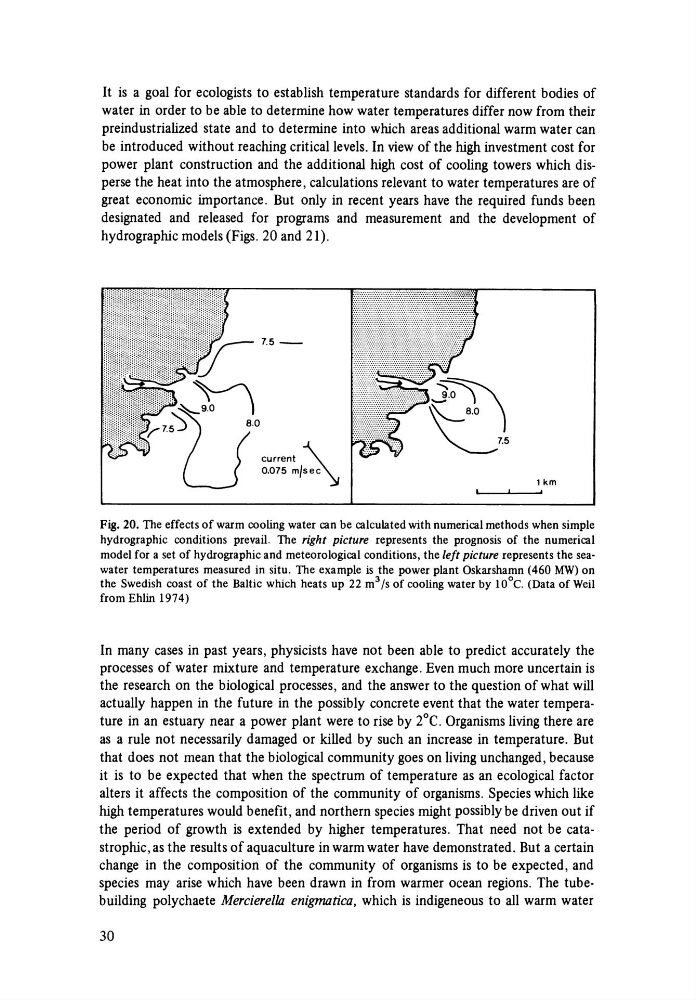
hydrographic models (Figs. 20 and 21).
7 . 5 -
(j );)
7.0
8.0
current
0.0" m/~
lkm
Fig. 20. The effects of warm cooling water can be calculated with numerical methods when simple
hydrographic conditions prevail. The right picture represents the prognosis of the numerical
model for a set of hydrographic and meteorological conditions, the left picture represents the seawater temperatures measured in situ. The example is the power plant Oskarshamn (460 MW) on
the Swedish coast of the Baltic which heats up 22 m 3 /s of cooling water by lOoC. (Data of Wei!
from Ehlin 1974)
In many cases in past years, phYSicists have not been able to predict accurately the
processes of water mixture and temperature exchange. Even much more uncertain is
the research on the biological processes, and the answer to the question of what will
actually happen in the future in the pOSSibly concrete event that the water temperature in an estuary near a power plant were to rise by 2°C. Organisms living there are
as a rule not necessarily damaged or killed by such an increase in temperature. But
that does not mean that the biological community goes on living unchanged, because
it is to be expected that when the spectrum of temperature as an ecological factor
alters it affects the composition of the community of organisms. Species which like
high temperatures would benefit, and northern species might possibly be driven out if
the period of growth is extended by higher temperatures. That need not be catastrophic, as the results of aquaculture in warm water have demonstrated. But a certain
change in the composition of the community of organisms is to be expected, and
species may arise which have been drawn in from warmer ocean regions. The tubebuilding polychaete Mercierella enigmatica, which is indigeneous to all warm water
30
water in order to be able to determine how water temperatures differ now from their
preindustrialized state and to determine into which areas additional warm water can
be introduced without reaching critical levels. In view of the high investment cost for
power plant construction and the additional high cost of cooling towers which disperse the heat into the atmosphere, calculations relevant to water temperatures are of
great economic importance. But only in recent years have the required funds been
designated and released for programs and measurement and the development of
hydrographic models (Figs. 20 and 21).
7 . 5 -
(j );)
7.0
8.0
current
0.0" m/~
lkm
Fig. 20. The effects of warm cooling water can be calculated with numerical methods when simple
hydrographic conditions prevail. The right picture represents the prognosis of the numerical
model for a set of hydrographic and meteorological conditions, the left picture represents the seawater temperatures measured in situ. The example is the power plant Oskarshamn (460 MW) on
the Swedish coast of the Baltic which heats up 22 m 3 /s of cooling water by lOoC. (Data of Wei!
from Ehlin 1974)
In many cases in past years, phYSicists have not been able to predict accurately the
processes of water mixture and temperature exchange. Even much more uncertain is
the research on the biological processes, and the answer to the question of what will
actually happen in the future in the pOSSibly concrete event that the water temperature in an estuary near a power plant were to rise by 2°C. Organisms living there are
as a rule not necessarily damaged or killed by such an increase in temperature. But
that does not mean that the biological community goes on living unchanged, because
it is to be expected that when the spectrum of temperature as an ecological factor
alters it affects the composition of the community of organisms. Species which like
high temperatures would benefit, and northern species might possibly be driven out if
the period of growth is extended by higher temperatures. That need not be catastrophic, as the results of aquaculture in warm water have demonstrated. But a certain
change in the composition of the community of organisms is to be expected, and
species may arise which have been drawn in from warmer ocean regions. The tubebuilding polychaete Mercierella enigmatica, which is indigeneous to all warm water
30