

If the effluents of cities contribute fairly large amounts of nutrients to the surface
water of the Baltic, an increase in the production of phytoplankton and intensification of the nutrient cycle result. More dead organic material sinks down from the
surface layer and reaches the deep water. There, the amount and activity of marine
bacteria increases. The oxygen is consumed by the bacteria until it is no longer available. Then, due to anaerobic activity, hydrogen sulfide results. The benthos, the
fauna on the ocean bottom, dies off.
One gram of phosphorus can result in a plant production equivalent to 50 g of organic
carbon. But dead organic substances with 50 g of carbon need 150 g of oxygen for
the process of bacterial decomposition.
Baltic marine scientists have no shadow of a doubt that eutrophication is occurring
in the surface waters of the Baltic. There is good evidence that blooms of bluegreen
algae that seem to appear more and more frequently in surface waters are the result
of this eutrophication. Recent hydrographic observations and more modern calculations indicate that the increasing quantities of dead organic substances introduced via
eutrophication or directly into the Baltic are the main reason for the trend to poorer
oxygen concentrations in the deep basins of the Baltic. It seems that hydrographic
trends are smaller than supposed a few years ago (Jansson 1980). Detailed research
programs that are devoted to explaining the processes of water exchanges in the Baltic
region and the oxygen and nutrient cycles will provide the answer to this question
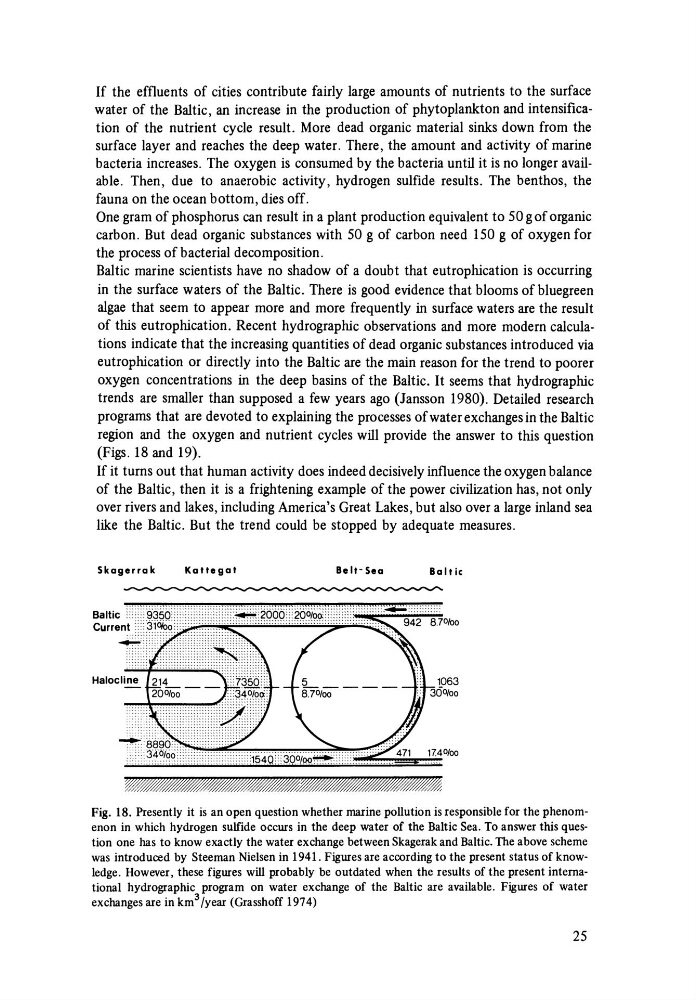
(Figs. 18 and 19).
If it turns out that human activity does indeed decisively influence the oxygen balance
of the Baltic, then it is a frightening example of the power civilization has, not only
over rivers and lakes, including America's Great Lakes, but also over a large inland sea
like the Baltic. But the trend could be stopped by adequate measures.
Skagerrak
Kallegal
Baltic:
Current
Halocline
Be It- Sea
Ball ic
8.7%0
1063
360100
1740/00
Fig. 18. Presently it is an open question whether marine pollution is responsible for the phenomenon in which hydrogen sulfide occurs in the deep water of the Baltic Sea. To answer this question one has to know exactly the water exchange between Skagerak and Baltic. The above scheme
was introduced by Steeman Nielsen in 1941. Figures are according to the present status of knowledge. However, these figures will probably be outdated when the results of the present international hydrographic program on water exchange of the Baltic are available. Figures of water
exchanges are in km 3 /year (Grasshoff 1974)
25
water of the Baltic, an increase in the production of phytoplankton and intensification of the nutrient cycle result. More dead organic material sinks down from the
surface layer and reaches the deep water. There, the amount and activity of marine
bacteria increases. The oxygen is consumed by the bacteria until it is no longer available. Then, due to anaerobic activity, hydrogen sulfide results. The benthos, the
fauna on the ocean bottom, dies off.
One gram of phosphorus can result in a plant production equivalent to 50 g of organic
carbon. But dead organic substances with 50 g of carbon need 150 g of oxygen for
the process of bacterial decomposition.
Baltic marine scientists have no shadow of a doubt that eutrophication is occurring
in the surface waters of the Baltic. There is good evidence that blooms of bluegreen
algae that seem to appear more and more frequently in surface waters are the result
of this eutrophication. Recent hydrographic observations and more modern calculations indicate that the increasing quantities of dead organic substances introduced via
eutrophication or directly into the Baltic are the main reason for the trend to poorer
oxygen concentrations in the deep basins of the Baltic. It seems that hydrographic
trends are smaller than supposed a few years ago (Jansson 1980). Detailed research
programs that are devoted to explaining the processes of water exchanges in the Baltic
region and the oxygen and nutrient cycles will provide the answer to this question
(Figs. 18 and 19).
If it turns out that human activity does indeed decisively influence the oxygen balance
of the Baltic, then it is a frightening example of the power civilization has, not only
over rivers and lakes, including America's Great Lakes, but also over a large inland sea
like the Baltic. But the trend could be stopped by adequate measures.
Skagerrak
Kallegal
Baltic:
Current
Halocline
Be It- Sea
Ball ic
8.7%0
1063
360100
1740/00
Fig. 18. Presently it is an open question whether marine pollution is responsible for the phenomenon in which hydrogen sulfide occurs in the deep water of the Baltic Sea. To answer this question one has to know exactly the water exchange between Skagerak and Baltic. The above scheme
was introduced by Steeman Nielsen in 1941. Figures are according to the present status of knowledge. However, these figures will probably be outdated when the results of the present international hydrographic program on water exchange of the Baltic are available. Figures of water
exchanges are in km 3 /year (Grasshoff 1974)
25