

2
1955
60
65
70
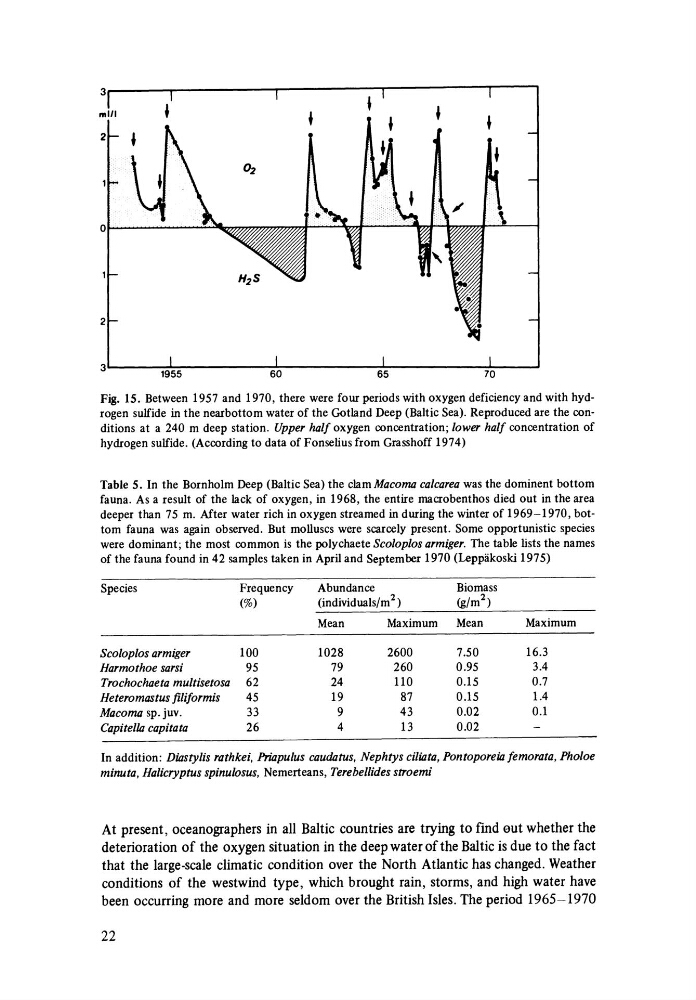
Fig. 15. Between 1957 and 1970, there were four periods with oxygen deficiency and with hydrogen sulfide in the nearbottom water of the Gotland Deep (Baltic Sea). Reproduced are the conditions at a 240 m deep station. Upper half oxygen concentration; lower half concentration of
hydrogen sulfide. (According to data of Fonselius from Grasshoff 1974)
Table 5. In the Bornholm Deep (Baltic Sea) the clam Macoma calcarea was the dominent bottom
fauna. As a result of the lack of oxygen, in 1968, the entire macrobenthos died out in the area
deeper than 75 m. After water rich in oxygen streamed in during the winter of 1969-1970, bottom fauna was again observed. But molluscs were scarcely present. Some opportunistic species
were dominant; the most common is the polychaete Scoloplos armiger. The table lists the names
of the fauna found in 42 samples taken in April and September 1970 (Leppakoski 1975)
Species
Frequency
Abundance
Biomass
(%)
(individuals/m 2 )
(g/m2)
Mean
Maximum
Mean
Maximum
Scoloplos armiger
100
1028
2600
7.50
16.3
Harmothoe sarsi
95
79
260
0.95
3.4
Trochochaeta multisetosa 62
24
110
0.15
0.7
Heteromastus fi/iformis
45
19
87
0.15
1.4
Macoma sp. juv.
33
9
43
0.02
0.1
Capitella capitata
26
4
13
0.02
In addition: Diastylis rathkei, Priapulus caudatus, Nephtys ciliata, Pontoporeia femorata, Pholoe
minuta, Halicryptus spinulosus, Nemerteans, Terebellides stroemi
At present, oceanographers in all Baltic countries are trying to find eut whether the
deterioration of the oxygen situation in the deep water of the Baltic is due to the fact
that the large-scale climatic condition over the North Atlantic has changed. Weather
conditions of the westwind type, which brought rain, storms, and high water have
been occurring more and more seldom over the British Isles. The period 1965-1970
22
1955
60
65
70
Fig. 15. Between 1957 and 1970, there were four periods with oxygen deficiency and with hydrogen sulfide in the nearbottom water of the Gotland Deep (Baltic Sea). Reproduced are the conditions at a 240 m deep station. Upper half oxygen concentration; lower half concentration of
hydrogen sulfide. (According to data of Fonselius from Grasshoff 1974)
Table 5. In the Bornholm Deep (Baltic Sea) the clam Macoma calcarea was the dominent bottom
fauna. As a result of the lack of oxygen, in 1968, the entire macrobenthos died out in the area
deeper than 75 m. After water rich in oxygen streamed in during the winter of 1969-1970, bottom fauna was again observed. But molluscs were scarcely present. Some opportunistic species
were dominant; the most common is the polychaete Scoloplos armiger. The table lists the names
of the fauna found in 42 samples taken in April and September 1970 (Leppakoski 1975)
Species
Frequency
Abundance
Biomass
(%)
(individuals/m 2 )
(g/m2)
Mean
Maximum
Mean
Maximum
Scoloplos armiger
100
1028
2600
7.50
16.3
Harmothoe sarsi
95
79
260
0.95
3.4
Trochochaeta multisetosa 62
24
110
0.15
0.7
Heteromastus fi/iformis
45
19
87
0.15
1.4
Macoma sp. juv.
33
9
43
0.02
0.1
Capitella capitata
26
4
13
0.02
In addition: Diastylis rathkei, Priapulus caudatus, Nephtys ciliata, Pontoporeia femorata, Pholoe
minuta, Halicryptus spinulosus, Nemerteans, Terebellides stroemi
At present, oceanographers in all Baltic countries are trying to find eut whether the
deterioration of the oxygen situation in the deep water of the Baltic is due to the fact
that the large-scale climatic condition over the North Atlantic has changed. Weather
conditions of the westwind type, which brought rain, storms, and high water have
been occurring more and more seldom over the British Isles. The period 1965-1970
22