

o
m
100
200
Skagerak Belt-Sea Bornholm Deep Gotland Deep
Gulfof Finland
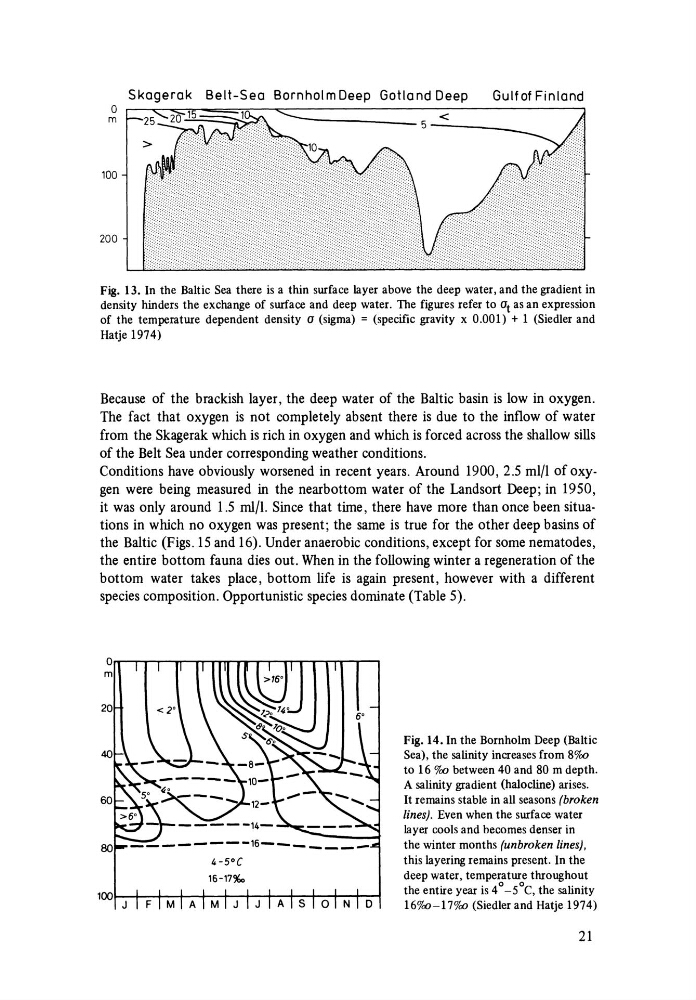
Fig. 13. In the Baltic Sea there is a thin surface layer above the deep water, and the gradient in
density hinders the exchange of surface and deep water. The figures refer to at as an expression
of the temperature dependent density a (sigma) = (specific gravity x 0.001) + 1 (Siedler and
Hatje 1974)
Because of the brackish layer, the deep water of the Baltic basin is low in oxygen.
The fact that oxygen is not completely absent there is due to the inflow of water
from the Skagerak which is rich in oxygen and which is forced across the shallow sills
of the Belt Sea under corresponding weather conditions.
Conditions have obviously worsened in recent years. Around 1900, 2.5 ml/l of oxygen were being measured in the nearbottom water of the Landsort Deep; in 1950,
it was only around 1.5 rolll. Since that time, there have more than once been situations in which no oxygen was present; the same is true for the other deep basins of
the Baltic (Figs. 15 and 16). Under anaerobic conditions, except for some nematodes,
the entire bottom fauna dies out. When in the following winter a regeneration of the
bottom water takes place, bottom life is again present, however with a different
species composition. Opportunistic species dominate (Table 5).
4-S0C
16-17%0
Fig. 14. In the Bornholm Deep (Baltic
Sea), the salinity increases from 80/00
to 16 0/00 between 40 and 80 m depth.
A salinity gradient (halocIine) arises.
It remains stable in all seasons (broken
lines). Even when the surface water
layer cools and becomes denser in
the winter months (unbroken lines),
this layering remains present. In the
deep water, temperature throughout
the entire year is 4 ° -SoC, the salinity
160/00-170/00 (Siedlerand Hatje 1974)
21
m
100
200
Skagerak Belt-Sea Bornholm Deep Gotland Deep
Gulfof Finland
Fig. 13. In the Baltic Sea there is a thin surface layer above the deep water, and the gradient in
density hinders the exchange of surface and deep water. The figures refer to at as an expression
of the temperature dependent density a (sigma) = (specific gravity x 0.001) + 1 (Siedler and
Hatje 1974)
Because of the brackish layer, the deep water of the Baltic basin is low in oxygen.
The fact that oxygen is not completely absent there is due to the inflow of water
from the Skagerak which is rich in oxygen and which is forced across the shallow sills
of the Belt Sea under corresponding weather conditions.
Conditions have obviously worsened in recent years. Around 1900, 2.5 ml/l of oxygen were being measured in the nearbottom water of the Landsort Deep; in 1950,
it was only around 1.5 rolll. Since that time, there have more than once been situations in which no oxygen was present; the same is true for the other deep basins of
the Baltic (Figs. 15 and 16). Under anaerobic conditions, except for some nematodes,
the entire bottom fauna dies out. When in the following winter a regeneration of the
bottom water takes place, bottom life is again present, however with a different
species composition. Opportunistic species dominate (Table 5).
4-S0C
16-17%0
Fig. 14. In the Bornholm Deep (Baltic
Sea), the salinity increases from 80/00
to 16 0/00 between 40 and 80 m depth.
A salinity gradient (halocIine) arises.
It remains stable in all seasons (broken
lines). Even when the surface water
layer cools and becomes denser in
the winter months (unbroken lines),
this layering remains present. In the
deep water, temperature throughout
the entire year is 4 ° -SoC, the salinity
160/00-170/00 (Siedlerand Hatje 1974)
21