

contaminated (Table 43). The concentration of DDT in the muscle tissue of cod
(Gadus morhua) from various regions of the Baltic Sea is 2-10 times higher than that
in those from the Kattegat-Skagerak area, which is less influenced by pesticides used
in forestry. The figures of PCB concentration are 20-30 times higher in cod from the
Baltic Sea than those from the Kattegat-Skagerak area, where 8-21 Jlg/kg are found
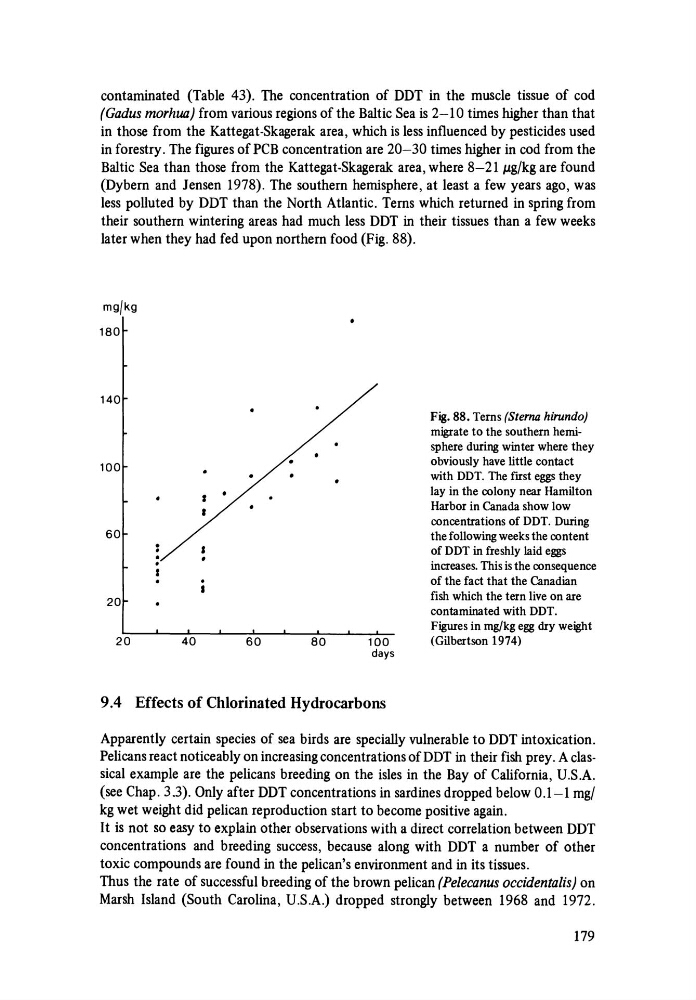
(Dybern and Jensen 1978). The southern hemisphere, at least a few years ago, was
less polluted by DDT than the North Atlantic. Terns which returned in spring from
their southern wintering areas had much less DDT in their tissues than a few weeks
later when they had fed upon northern food (Fig. 88).
mg/kg
180
140
80
100
days
9.4 Effects of Chlorinated Hydrocarbons
Fig. 88. Terns (Sterna hirundo)
migrate to the southern hemisphere during winter where they
obviously have little contact
with DDT. The first eggs they
lay in the colony near Hamilton
Harbor in Canada show low
concentrations of DDT. During
the following weeks the content
of DDT in freshly laid eggs
increases. This is the consequence
of the fact that the Canadian
fish which the tern live on are
contaminated with DDT.
Figures in mg/kg egg dry weight
(Gilbertson 1974)
Apparently certain species of sea birds are specially vulnerable to DDT intoxication.
Pelicans react noticeably on increasing concentrations of DDT in their fish prey. A classical example are the pelicans breeding on the isles in the Bay of California, U.S.A.
(see Chap. 3.3). Only after DDT concentrations in sardines dropped below 0.1-1 mg/
kg wet weight did pelican reproduction start to become positive again.
It is not so easy to explain other observations with a direct correlation between DDT
concentrations and breeding success, because along with DDT a number of other
toxic compounds are found in the pelican's environment and in its tissues.
Thus the rate of successful breeding of the brown pelican (Pelecanus occidentalis) on
Marsh Island (South Carolina, U.S.A.) dropped strongly between 1968 and 1972.
179
(Gadus morhua) from various regions of the Baltic Sea is 2-10 times higher than that
in those from the Kattegat-Skagerak area, which is less influenced by pesticides used
in forestry. The figures of PCB concentration are 20-30 times higher in cod from the
Baltic Sea than those from the Kattegat-Skagerak area, where 8-21 Jlg/kg are found
(Dybern and Jensen 1978). The southern hemisphere, at least a few years ago, was
less polluted by DDT than the North Atlantic. Terns which returned in spring from
their southern wintering areas had much less DDT in their tissues than a few weeks
later when they had fed upon northern food (Fig. 88).
mg/kg
180
140
80
100
days
9.4 Effects of Chlorinated Hydrocarbons
Fig. 88. Terns (Sterna hirundo)
migrate to the southern hemisphere during winter where they
obviously have little contact
with DDT. The first eggs they
lay in the colony near Hamilton
Harbor in Canada show low
concentrations of DDT. During
the following weeks the content
of DDT in freshly laid eggs
increases. This is the consequence
of the fact that the Canadian
fish which the tern live on are
contaminated with DDT.
Figures in mg/kg egg dry weight
(Gilbertson 1974)
Apparently certain species of sea birds are specially vulnerable to DDT intoxication.
Pelicans react noticeably on increasing concentrations of DDT in their fish prey. A classical example are the pelicans breeding on the isles in the Bay of California, U.S.A.
(see Chap. 3.3). Only after DDT concentrations in sardines dropped below 0.1-1 mg/
kg wet weight did pelican reproduction start to become positive again.
It is not so easy to explain other observations with a direct correlation between DDT
concentrations and breeding success, because along with DDT a number of other
toxic compounds are found in the pelican's environment and in its tissues.
Thus the rate of successful breeding of the brown pelican (Pelecanus occidentalis) on
Marsh Island (South Carolina, U.S.A.) dropped strongly between 1968 and 1972.
179