

___ ORen sea
DBP _ _ _
DEHP
I
Trichlorethylene - __ _
0< and 1- HCH
_
PCP_PCB
-
Trichlorofluoromethane
_
Perchlorethylene
-
Dieldrin
:
DDT---_
Carbontetrachloride :::==_
Tetrachlorophenol
Trichlorophenol---ngll
1000
100
10
0.1
0.Q1
estuaries, coastal sea
DBP
~DEHP
I~ Trichlorethylene
I
Carbontetrachloride and
I
~ 1,1,1- Trichlorethane
~ Perchlorethylene
~PCP
Tetrachlorophenol
- - I - HCH
-
0( -HCH and
Trichlorophenol
: -Hexachlorobutadiene
_____ --PCB
DDT
-
Dieldrin
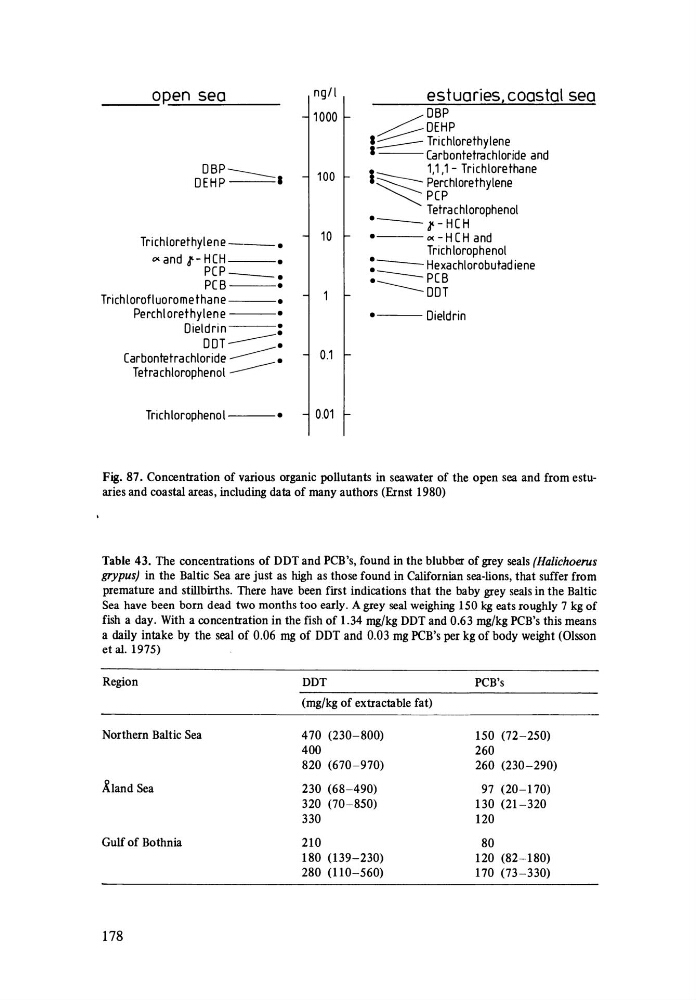
Fig. 87. Concentration of various organic pollutants in seawater of the open sea and from estuaries and coastal areas, including data of many authors (Ernst 1980)
Table 43. The concentrations of DDT and PCB's, found in the blubber of grey seals (Halichoerus
grypus) in the Baltic Sea are just as high as those found in Californian sea-lions, that suffer from
premature and stillbirths. There have been first indications that the baby grey seals in the Baltic
Sea have been born dead two months too early. A grey seal weighing 150 kg eats roughly 7 kg of
fish a day. With a concentration in the fish of 1.34 mg/kg DDT and 0.63 mg/kg PCB's this means
a daily intake by the seal of 0.06 mg of DDT and 0.03 mg PCB's per kg of body weight (Olsson
et al. 1975)
Region
Northern Baltic Sea
Kland Sea
Gulf of Bothnia
178
DDT
(mg/kg of extractable fat)
470 (230-800)
400
820 (670-970)
230 (68-490)
320 (70-850)
330
210
180 (139-230)
280 (110-560)
PCB's
150 (72-250)
260
260 (230-290)
97 (20-170)
130 (21-320
120
80
120 (82-180)
170 (73-330)
DBP _ _ _
DEHP
I
Trichlorethylene - __ _
0< and 1- HCH
_
PCP_PCB
-
Trichlorofluoromethane
_
Perchlorethylene
-
Dieldrin
:
DDT---_
Carbontetrachloride :::==_
Tetrachlorophenol
Trichlorophenol---ngll
1000
100
10
0.1
0.Q1
estuaries, coastal sea
DBP
~DEHP
I~ Trichlorethylene
I
Carbontetrachloride and
I
~ 1,1,1- Trichlorethane
~ Perchlorethylene
~PCP
Tetrachlorophenol
- - I - HCH
-
0( -HCH and
Trichlorophenol
: -Hexachlorobutadiene
_____ --PCB
DDT
-
Dieldrin
Fig. 87. Concentration of various organic pollutants in seawater of the open sea and from estuaries and coastal areas, including data of many authors (Ernst 1980)
Table 43. The concentrations of DDT and PCB's, found in the blubber of grey seals (Halichoerus
grypus) in the Baltic Sea are just as high as those found in Californian sea-lions, that suffer from
premature and stillbirths. There have been first indications that the baby grey seals in the Baltic
Sea have been born dead two months too early. A grey seal weighing 150 kg eats roughly 7 kg of
fish a day. With a concentration in the fish of 1.34 mg/kg DDT and 0.63 mg/kg PCB's this means
a daily intake by the seal of 0.06 mg of DDT and 0.03 mg PCB's per kg of body weight (Olsson
et al. 1975)
Region
Northern Baltic Sea
Kland Sea
Gulf of Bothnia
178
DDT
(mg/kg of extractable fat)
470 (230-800)
400
820 (670-970)
230 (68-490)
320 (70-850)
330
210
180 (139-230)
280 (110-560)
PCB's
150 (72-250)
260
260 (230-290)
97 (20-170)
130 (21-320
120
80
120 (82-180)
170 (73-330)