

herring 0.06 mg/kg (variation 0.02-0.26). It is good to know that apparently the
North Sea is not polluted by mercury, apart from regional pollution in coastal areas
(Fig. 76; Ices 1974; see Chap. 3.2 and 4.2).
8.2 Mercury in Large Fish, Seal, and Open Sea Marine Birds
Tuna fish (Thunnus thynnus) live mainly in the open seas and avoid the areas where
rivers flow into an ocean. Therefore, they do not come into contact with ocean areas
that are contaminated by effluents. Some quantities of canned tuna fish are seized in
various countries, however, because they contain more than 0.5 mg/kg of mercury.
This question is under public discussion. To be sure, of 56 brands of canned tuna fish
tested by the Bundesforschungsanstalt fiir Fischerei in Hamburg, Federal Republic of
Germany, half contained less than 0.2 mg/kg of mercury (28 samples), an additional
20 were between 0.2 and 0.4 mg/kg, 7 between 0.4 and 0.5 mg/kg, and only one contained 0.9 mg/kg (Mundt and Feldt 1971). But other tests again and again show
amounts around 1 mg/kg in tuna fish from various sources, primarily in older fish
that are over 2 m long (Peterson et al. 1973). The concentration is even higher in
swordfish (Xiphias glodius). Five fish cought in the Straits of Gibraltar contained
between 1 and 2 mg/kg (Establier 1972). Indeed, a case of mercury poisoning did
occur in the U.S.A., following the eating of swordfish meat (Kahn 1971), but the
affected person had eaten a lot of swordfish meat over a fairly long period of time as
part of a diet to lose weight.
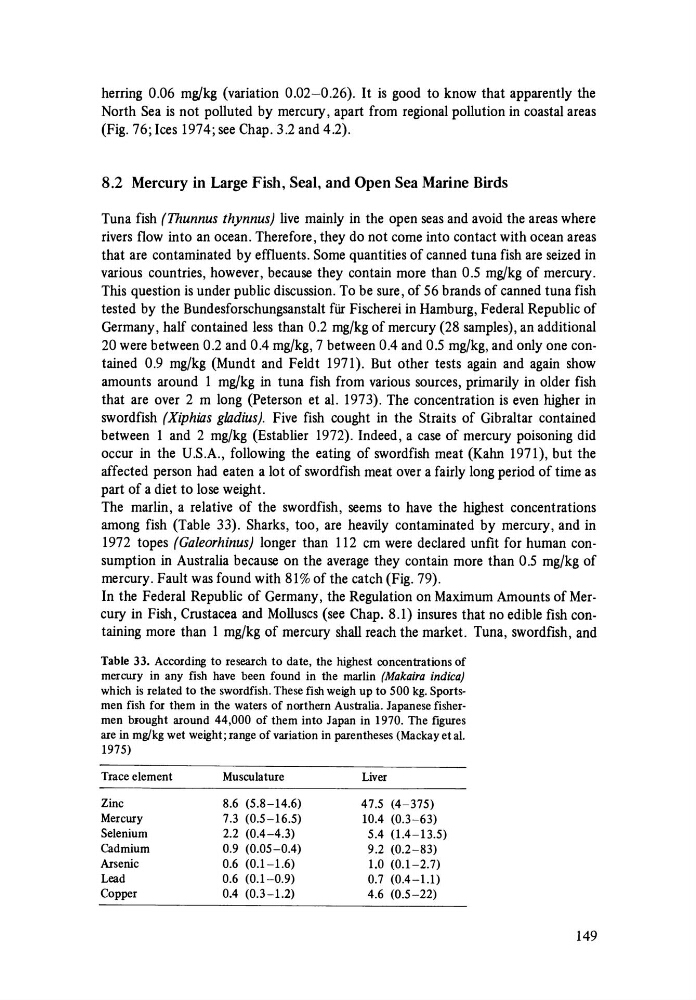
The marlin, a relative of the swordfish, seems to have the highest concentrations
among fish (Table 33). Sharks, too, are heavily contaminated by mercury, and in
1972 topes (Ga/eorhinus) longer than 112 cm were declared unfit for human consumption in Australia because on the average they contain more than 0.5 mg/kg of
mercury. Fault was found with 81 % of the catch (Fig. 79).
In the Federal Republic of Germany, the Regulation on Maximum Amounts of Mercury in Fish, Crustacea and Molluscs (see Chap. 8.1) insures that no edible fish containing more than 1 mg/kg of mercury shall reach the market. Tuna, swordfish, and
Table 33. According to research to date, the highest concentrations of
mercury in any fish have been found in the marlin (Makaira indica)
which is related to the swordfish. These fish weigh up to 500 kg. Sportsmen fish for them in the waters of northern Australia. Japanese fishermen bJought around 44,000 of them into Japan in 1970. The figures
are in mg/kg wet weight; range of variation in parentheses (Mackay et aI.
1975)
Trace element
Zinc
Mercury
Selenium
Cadmium
Arsenic
Lead
Copper
Musculature
8.6 (5.8-14.6)
7.3 (0.5-16.5)
2.2 (0.4-4.3)
0.9 (0.05-0.4)
0.6 (0.1-1.6)
0.6 (0.1-0.9)
0.4 (0.3-1.2)
Liver
47.5 (4-375)
10.4 (0.3-63)
5.4 (1.4-13.5)
9.2 (0.2-83)
1.0 (0.1-2.7)
0.7 (0.4-1.1)
4.6 (0.5-22)
149
North Sea is not polluted by mercury, apart from regional pollution in coastal areas
(Fig. 76; Ices 1974; see Chap. 3.2 and 4.2).
8.2 Mercury in Large Fish, Seal, and Open Sea Marine Birds
Tuna fish (Thunnus thynnus) live mainly in the open seas and avoid the areas where
rivers flow into an ocean. Therefore, they do not come into contact with ocean areas
that are contaminated by effluents. Some quantities of canned tuna fish are seized in
various countries, however, because they contain more than 0.5 mg/kg of mercury.
This question is under public discussion. To be sure, of 56 brands of canned tuna fish
tested by the Bundesforschungsanstalt fiir Fischerei in Hamburg, Federal Republic of
Germany, half contained less than 0.2 mg/kg of mercury (28 samples), an additional
20 were between 0.2 and 0.4 mg/kg, 7 between 0.4 and 0.5 mg/kg, and only one contained 0.9 mg/kg (Mundt and Feldt 1971). But other tests again and again show
amounts around 1 mg/kg in tuna fish from various sources, primarily in older fish
that are over 2 m long (Peterson et al. 1973). The concentration is even higher in
swordfish (Xiphias glodius). Five fish cought in the Straits of Gibraltar contained
between 1 and 2 mg/kg (Establier 1972). Indeed, a case of mercury poisoning did
occur in the U.S.A., following the eating of swordfish meat (Kahn 1971), but the
affected person had eaten a lot of swordfish meat over a fairly long period of time as
part of a diet to lose weight.
The marlin, a relative of the swordfish, seems to have the highest concentrations
among fish (Table 33). Sharks, too, are heavily contaminated by mercury, and in
1972 topes (Ga/eorhinus) longer than 112 cm were declared unfit for human consumption in Australia because on the average they contain more than 0.5 mg/kg of
mercury. Fault was found with 81 % of the catch (Fig. 79).
In the Federal Republic of Germany, the Regulation on Maximum Amounts of Mercury in Fish, Crustacea and Molluscs (see Chap. 8.1) insures that no edible fish containing more than 1 mg/kg of mercury shall reach the market. Tuna, swordfish, and
Table 33. According to research to date, the highest concentrations of
mercury in any fish have been found in the marlin (Makaira indica)
which is related to the swordfish. These fish weigh up to 500 kg. Sportsmen fish for them in the waters of northern Australia. Japanese fishermen bJought around 44,000 of them into Japan in 1970. The figures
are in mg/kg wet weight; range of variation in parentheses (Mackay et aI.
1975)
Trace element
Zinc
Mercury
Selenium
Cadmium
Arsenic
Lead
Copper
Musculature
8.6 (5.8-14.6)
7.3 (0.5-16.5)
2.2 (0.4-4.3)
0.9 (0.05-0.4)
0.6 (0.1-1.6)
0.6 (0.1-0.9)
0.4 (0.3-1.2)
Liver
47.5 (4-375)
10.4 (0.3-63)
5.4 (1.4-13.5)
9.2 (0.2-83)
1.0 (0.1-2.7)
0.7 (0.4-1.1)
4.6 (0.5-22)
149