

Cl
r
Cl
~
Cl
E
. /,
100
./0
8'
o·
10
. •
• .
1.0
0.1 OL.I~~~~I~.O-~~~I~O ~~~~IOO~~~~I 000
mg/kg Se
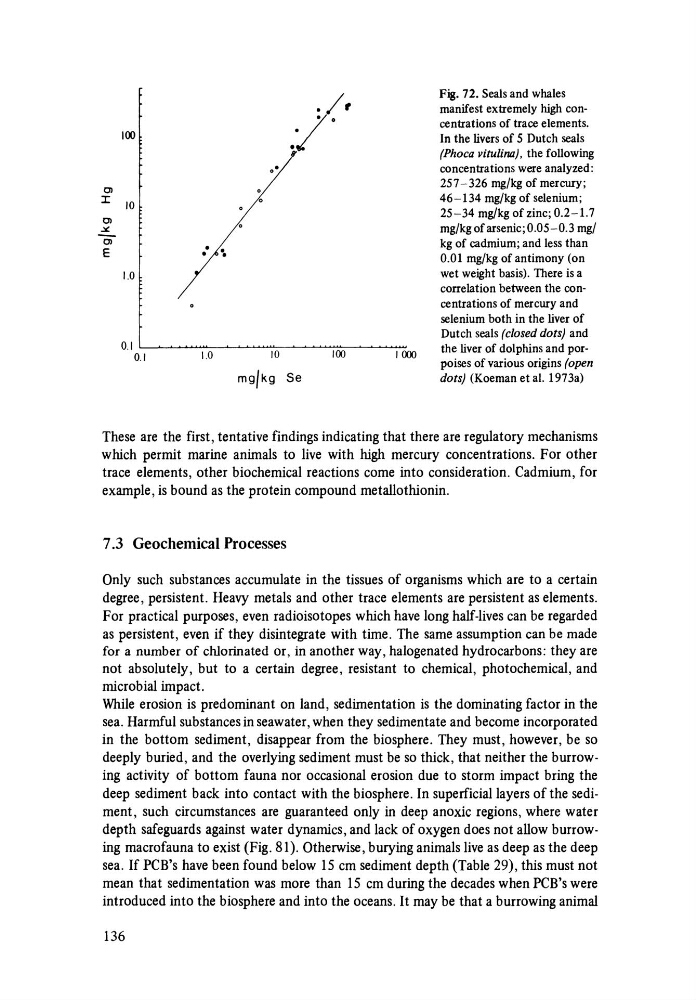
Fig. 72. Seals and whales
manifest extremely high concentrations of trace elements.
In the livers of 5 Dutch seals
(Phoca vitulina). the following
concentrations were analyzed:
257-326 mg/kg of mercury;
46-134 mg/kg of selenium;
25-34 mg/kg of zinc; 0.2-1.7
mg/kg of arsenic; 0.05 -0.3 mg/
kg of cadmium; and less than
0.01 mg/kg of antimony (on
wet weight basis). There is a
correlation between the concentrations of mercury and
selenium both in the liver of
Dutch seals (closed dots) and
the liver of dolphins and porpoises of various origins (open
dots) (Koeman et al. 197 3a)
These are the first, tentative findings indicating that there are regulatory mechanisms
which permit marine animals to live with high mercury concentrations. For other
trace elements, other biochemical reactions come into consideration. Cadmium, for
example, is bound as the protein compound metallothionin.
7.3 Geochemical Processes
Only such substances accumulate in the tissues of organisms which are to a certain
degree, persistent. Heavy metals and other trace elements are persistent as elements.
For practical purposes, even radiOisotopes which have long half-lives can be regarded
as persistent, even if they disintegrate with time. The same assumption can be made
for a number of chlorinated or, in another way, halogenated hydrocarbons: they are
not absolutely, but to a certain degree, resistant to chemical, photochemical, and
microbial impact.
While erosion is predominant on land, sedimentation is the dominating factor in the
sea. Harmful substances in seawater, when they sedimentate and become incorporated
in the bottom sediment, disappear from the biosphere. They must, however, be so
deeply buried, and the overlying sediment must be so thick, that neither the burrowing activity of bottom fauna nor occasional erosion due to storm impact bring the
deep sediment back into contact with the biosphere. In superficial layers of the sediment, such circumstances are guaranteed only in deep anoxic regions, where water
depth safeguards against water dynamics, and lack of oxygen does not allow burrowing macrofauna to exist (Fig. 81). Otherwise, burying animals live as deep as the deep
sea. If PCB's have been found below 15 cm sediment depth (Table 29), this must not
mean that sedimentation was more than 15 cm during the decades when PCB's were
introduced into the biosphere and into the oceans. It may be that a burrowing animal
136
r
Cl
~
Cl
E
. /,
100
./0
8'
o·
10
. •
• .
1.0
0.1 OL.I~~~~I~.O-~~~I~O ~~~~IOO~~~~I 000
mg/kg Se
Fig. 72. Seals and whales
manifest extremely high concentrations of trace elements.
In the livers of 5 Dutch seals
(Phoca vitulina). the following
concentrations were analyzed:
257-326 mg/kg of mercury;
46-134 mg/kg of selenium;
25-34 mg/kg of zinc; 0.2-1.7
mg/kg of arsenic; 0.05 -0.3 mg/
kg of cadmium; and less than
0.01 mg/kg of antimony (on
wet weight basis). There is a
correlation between the concentrations of mercury and
selenium both in the liver of
Dutch seals (closed dots) and
the liver of dolphins and porpoises of various origins (open
dots) (Koeman et al. 197 3a)
These are the first, tentative findings indicating that there are regulatory mechanisms
which permit marine animals to live with high mercury concentrations. For other
trace elements, other biochemical reactions come into consideration. Cadmium, for
example, is bound as the protein compound metallothionin.
7.3 Geochemical Processes
Only such substances accumulate in the tissues of organisms which are to a certain
degree, persistent. Heavy metals and other trace elements are persistent as elements.
For practical purposes, even radiOisotopes which have long half-lives can be regarded
as persistent, even if they disintegrate with time. The same assumption can be made
for a number of chlorinated or, in another way, halogenated hydrocarbons: they are
not absolutely, but to a certain degree, resistant to chemical, photochemical, and
microbial impact.
While erosion is predominant on land, sedimentation is the dominating factor in the
sea. Harmful substances in seawater, when they sedimentate and become incorporated
in the bottom sediment, disappear from the biosphere. They must, however, be so
deeply buried, and the overlying sediment must be so thick, that neither the burrowing activity of bottom fauna nor occasional erosion due to storm impact bring the
deep sediment back into contact with the biosphere. In superficial layers of the sediment, such circumstances are guaranteed only in deep anoxic regions, where water
depth safeguards against water dynamics, and lack of oxygen does not allow burrowing macrofauna to exist (Fig. 81). Otherwise, burying animals live as deep as the deep
sea. If PCB's have been found below 15 cm sediment depth (Table 29), this must not
mean that sedimentation was more than 15 cm during the decades when PCB's were
introduced into the biosphere and into the oceans. It may be that a burrowing animal
136