

6.4 Effects of Radioactivity
The distribution of natural radioactivity in the ocean varies: the ocean water has a radioactivity level of approximately 320 pCi/l, the sand has a level of 5000-10,000 pCi/
kg and the mud between 20,000-30,000 pCi/kg. Algae in coastal areas, like Fucus
and Porphyra, have a radioactivity of 5000-15,000 pCi/kg, mollusc and fish of
1000-3000 pCi/kg, both referring to wet weight. When the level of radioactivity is
raised artificially, either by fall-out or due to wastes from recycling plants, the levels
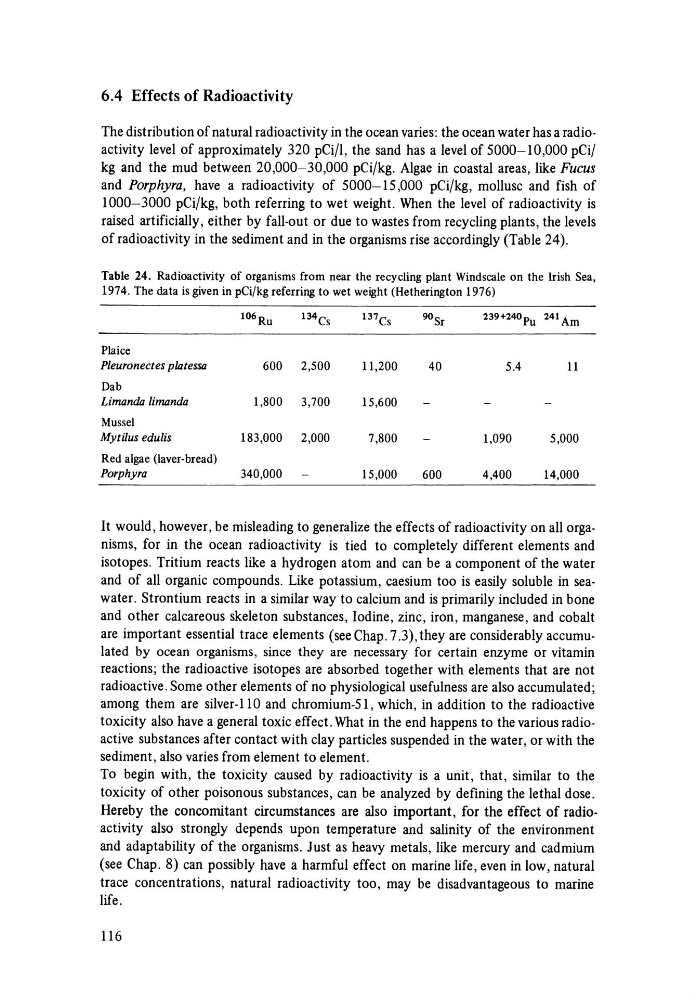
of radioactivity in the sediment and in the organisms rise accordingly (Table 24).
Table 24. Radioactivity of organisms from near the recycling plant Windscale on the Irish Sea,
1974. The data is given in pCi/kg referring to wet weight (Hetherington 1976)
106 Ru
134 Cs
137 Cs
90 Sr
239+240 pu 241 Am
Plaice
Pleuronectes platessa
600
2,500
11,200
40
5.4
11
Dab
Limanda limanda
1,800
3,700
15,600
Mussel
Mytilus edulis
183,000
2,000
7,800
1,090
5,000
Red algae (laver-bread)
Porphyra
340,000
15,000
600
4,400
14,000
It would, however, be misleading to generalize the effects of radioactivity on all organisms, for in the ocean radioactivity is tied to completely different elements and
isotopes. Tritium reacts like a hydrogen atom and can be a component of the water
and of all organic compounds. Like potassium, caesium too is easily soluble in seawater. Strontium reacts in a similar way to calcium and is primarily included in bone
and other calcareous skeleton substances, Iodine, zinc, iron, manganese, and cobalt
are important essential trace elements (see Chap. 7.3), they are considerably accumulated by ocean organisms, since they are necessary for certain enzyme or vitamin
reactions; the radioactive isotopes are absorbed together with elements that are not
radioactive. Some other elements of no physiological usefulness are also accumulated;
among them are silver-110 and chromium-51, which, in addition to the radioactive
toxicity also have a general toxic effect. What in the end happens to the various radioactive substances after contact with clay particles suspended in the water, or with the
sediment, also varies from element to element.
To begin with, the toxicity caused by radioactivity is a unit, that, similar to the
toxicity of other poisonous substances, can be analyzed by defining the lethal dose.
Hereby the concomitant circumstances are also important, for the effect of radioactivity also strongly depends upon temperature and salinity of the environment
and adaptability of the organisms. Just as heavy metals, like mercury and cadmium
(see Chap. 8) can possibly have a harmful effect on marine life, even in low, natural
trace concentrations, natural radioactivity too, may be disadvantageous to marine
life.
116
The distribution of natural radioactivity in the ocean varies: the ocean water has a radioactivity level of approximately 320 pCi/l, the sand has a level of 5000-10,000 pCi/
kg and the mud between 20,000-30,000 pCi/kg. Algae in coastal areas, like Fucus
and Porphyra, have a radioactivity of 5000-15,000 pCi/kg, mollusc and fish of
1000-3000 pCi/kg, both referring to wet weight. When the level of radioactivity is
raised artificially, either by fall-out or due to wastes from recycling plants, the levels
of radioactivity in the sediment and in the organisms rise accordingly (Table 24).
Table 24. Radioactivity of organisms from near the recycling plant Windscale on the Irish Sea,
1974. The data is given in pCi/kg referring to wet weight (Hetherington 1976)
106 Ru
134 Cs
137 Cs
90 Sr
239+240 pu 241 Am
Plaice
Pleuronectes platessa
600
2,500
11,200
40
5.4
11
Dab
Limanda limanda
1,800
3,700
15,600
Mussel
Mytilus edulis
183,000
2,000
7,800
1,090
5,000
Red algae (laver-bread)
Porphyra
340,000
15,000
600
4,400
14,000
It would, however, be misleading to generalize the effects of radioactivity on all organisms, for in the ocean radioactivity is tied to completely different elements and
isotopes. Tritium reacts like a hydrogen atom and can be a component of the water
and of all organic compounds. Like potassium, caesium too is easily soluble in seawater. Strontium reacts in a similar way to calcium and is primarily included in bone
and other calcareous skeleton substances, Iodine, zinc, iron, manganese, and cobalt
are important essential trace elements (see Chap. 7.3), they are considerably accumulated by ocean organisms, since they are necessary for certain enzyme or vitamin
reactions; the radioactive isotopes are absorbed together with elements that are not
radioactive. Some other elements of no physiological usefulness are also accumulated;
among them are silver-110 and chromium-51, which, in addition to the radioactive
toxicity also have a general toxic effect. What in the end happens to the various radioactive substances after contact with clay particles suspended in the water, or with the
sediment, also varies from element to element.
To begin with, the toxicity caused by radioactivity is a unit, that, similar to the
toxicity of other poisonous substances, can be analyzed by defining the lethal dose.
Hereby the concomitant circumstances are also important, for the effect of radioactivity also strongly depends upon temperature and salinity of the environment
and adaptability of the organisms. Just as heavy metals, like mercury and cadmium
(see Chap. 8) can possibly have a harmful effect on marine life, even in low, natural
trace concentrations, natural radioactivity too, may be disadvantageous to marine
life.
116