

however, one has become more sceptic and in early 1978 the standards were lowered
considerably, for example down to 1011 Ci for beta-, and gamma-emitters (Olivier
1978).
Plans to deposit high-level radioactive wastes in the ocean, too, have always existed.
The idea of taking advantage of zones, where geophysical processes cause the seabed
to be gradually transported further down, seemed tempting. Unfortunately the speed
of transportation is low and the zones that come into question are geologically
unstable. One has to think 1 million years ahead if one wants to create secure final
deposits for radioactive substances with long half-lives. Strontium-90 and caesium137 which are mainly contained in radioactive waste, have half-lives of only roughly
30 years, but the half-life of plutonium-239 is 24,000 years, that of techneticum-99
is over 200,000 years and the half-life of neptunium-237 is over 2 million years.
Simple dumping into the ocean is out of the question, for the deep sea too, is linked
to the productive surface waters of the ocean by organism-migration and ocean currents; when a deep-sea fish enters the intermediate water layers it can very quickly
transfer radioactivity into the higher water layers, too. The latest concepts therefore
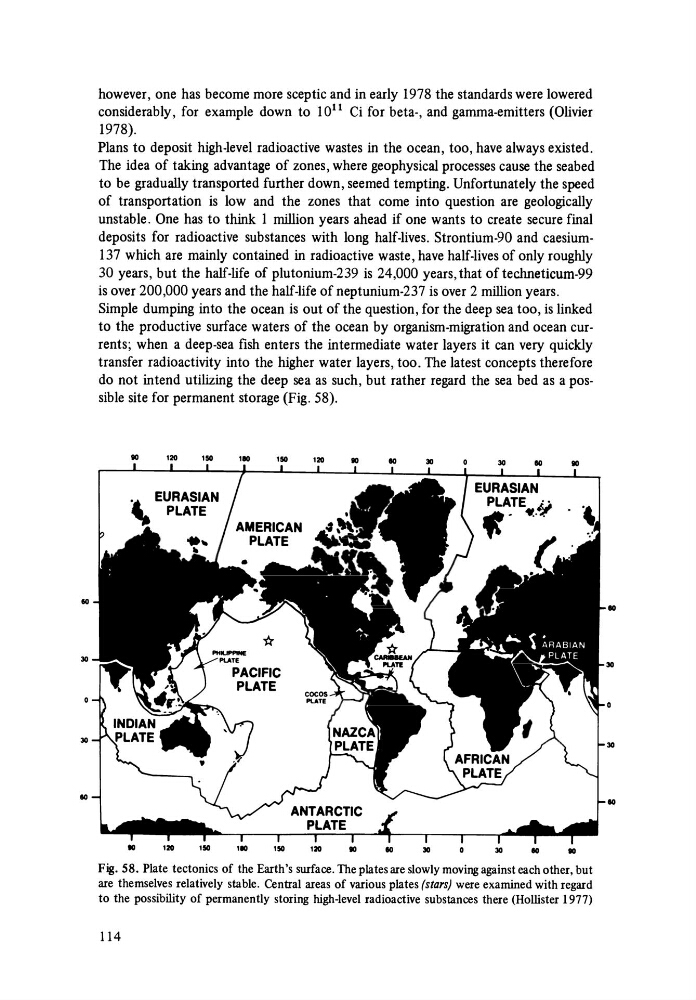
do not intend utilizing the deep sea as such, but rather regard the sea bed as a possible site for permanent storage (Fig. 58).
Fig. 58. Plate tectonics of the Earth's surface. The plates are slowly moving against each other, but
are themselves relatively stable. Central areas of various plates (stars) were examined with regard
to the possibility of permanently storing high-level radioactive substances there (Hollister 1977)
114
considerably, for example down to 1011 Ci for beta-, and gamma-emitters (Olivier
1978).
Plans to deposit high-level radioactive wastes in the ocean, too, have always existed.
The idea of taking advantage of zones, where geophysical processes cause the seabed
to be gradually transported further down, seemed tempting. Unfortunately the speed
of transportation is low and the zones that come into question are geologically
unstable. One has to think 1 million years ahead if one wants to create secure final
deposits for radioactive substances with long half-lives. Strontium-90 and caesium137 which are mainly contained in radioactive waste, have half-lives of only roughly
30 years, but the half-life of plutonium-239 is 24,000 years, that of techneticum-99
is over 200,000 years and the half-life of neptunium-237 is over 2 million years.
Simple dumping into the ocean is out of the question, for the deep sea too, is linked
to the productive surface waters of the ocean by organism-migration and ocean currents; when a deep-sea fish enters the intermediate water layers it can very quickly
transfer radioactivity into the higher water layers, too. The latest concepts therefore
do not intend utilizing the deep sea as such, but rather regard the sea bed as a possible site for permanent storage (Fig. 58).
Fig. 58. Plate tectonics of the Earth's surface. The plates are slowly moving against each other, but
are themselves relatively stable. Central areas of various plates (stars) were examined with regard
to the possibility of permanently storing high-level radioactive substances there (Hollister 1977)
114