

55·
50·
s·
o·
......................... ...............
.................... ......................
................................... ..............
5·
10·
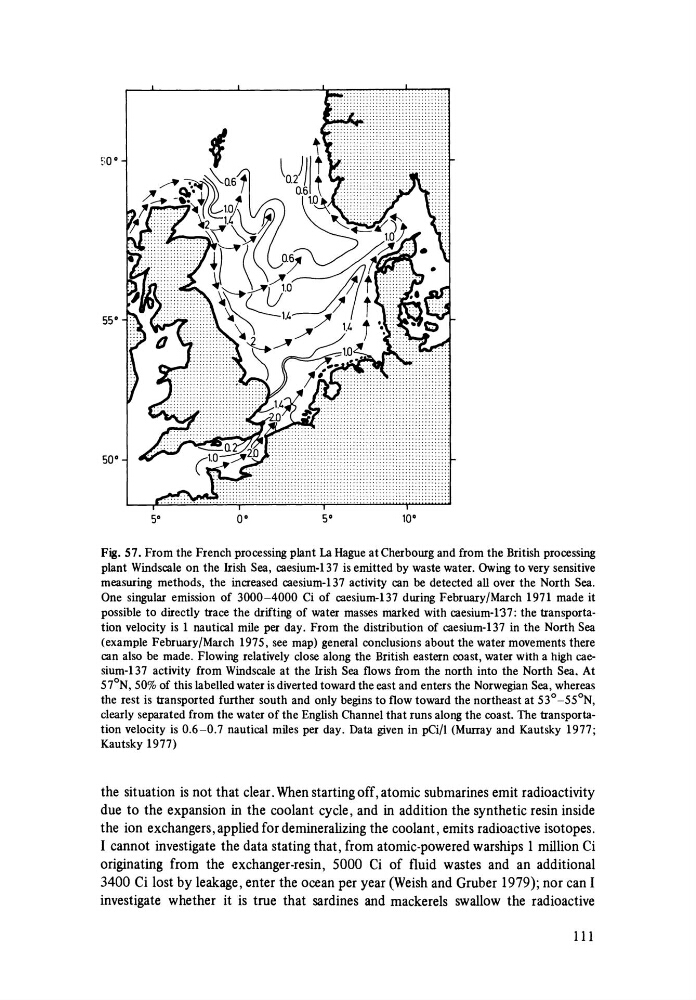
Fig. 57. From the French processing plant La Hague at Cherbourg and from the British processing
plant Windscale on the Irish Sea, caesium-137 is emitted by waste water. Owing to very sensitive
measuring methods, the increased caesium-137 activity can be detected all over the North Sea.
One singular emission of 3000-4000 Ci of caesium-137 during February/March 1971 made it
possible to directly trace the drifting of water masses marked with caesium-137: the transportation velocity is 1 nautical mile per day. From the distribution of caesium-13 7 in the North Sea
(example February/March 1975, see map) general conclusions about the water movements there
can also be made. Flowing relatively close along the British eastern coast, water with a high caesium-137 activity from Wind scale at the Irish Sea flows from the north into the North Sea. At
57°N, 50% of this labelled water is diverted toward the east and enters the Norwegian Sea, whereas
the rest is transported further south and only begins to flow toward the northeast at 53° -55°N,
clearly separated from the water of the English Channel that runs along the coast. The transportation velocity is 0.6-0.7 nautical miles per day. Data given in pCi/1 (Murray and Kautsky 1977;
Kautsky 1977)
the situation is not that clear. When starting off, atomic submarines emit radioactivity
due to the expansion in the coolant cycle, and in addition the synthetic resin inside
the ion exchangers, applied for demineralizing the coolant, emits radioactive isotopes.
I cannot investigate the data stating that, from atomic-powered warships 1 million Ci
originating from the exchanger-resin, 5000 Ci of fluid wastes and an additional
3400 Ci lost by leakage, enter the ocean per year (Weish and Gruber 1979); nor can I
investigate whether it is true that sardines and mackerels swallow the radioactive
111
50·
s·
o·
......................... ...............
.................... ......................
................................... ..............
5·
10·
Fig. 57. From the French processing plant La Hague at Cherbourg and from the British processing
plant Windscale on the Irish Sea, caesium-137 is emitted by waste water. Owing to very sensitive
measuring methods, the increased caesium-137 activity can be detected all over the North Sea.
One singular emission of 3000-4000 Ci of caesium-137 during February/March 1971 made it
possible to directly trace the drifting of water masses marked with caesium-137: the transportation velocity is 1 nautical mile per day. From the distribution of caesium-13 7 in the North Sea
(example February/March 1975, see map) general conclusions about the water movements there
can also be made. Flowing relatively close along the British eastern coast, water with a high caesium-137 activity from Wind scale at the Irish Sea flows from the north into the North Sea. At
57°N, 50% of this labelled water is diverted toward the east and enters the Norwegian Sea, whereas
the rest is transported further south and only begins to flow toward the northeast at 53° -55°N,
clearly separated from the water of the English Channel that runs along the coast. The transportation velocity is 0.6-0.7 nautical miles per day. Data given in pCi/1 (Murray and Kautsky 1977;
Kautsky 1977)
the situation is not that clear. When starting off, atomic submarines emit radioactivity
due to the expansion in the coolant cycle, and in addition the synthetic resin inside
the ion exchangers, applied for demineralizing the coolant, emits radioactive isotopes.
I cannot investigate the data stating that, from atomic-powered warships 1 million Ci
originating from the exchanger-resin, 5000 Ci of fluid wastes and an additional
3400 Ci lost by leakage, enter the ocean per year (Weish and Gruber 1979); nor can I
investigate whether it is true that sardines and mackerels swallow the radioactive
111